

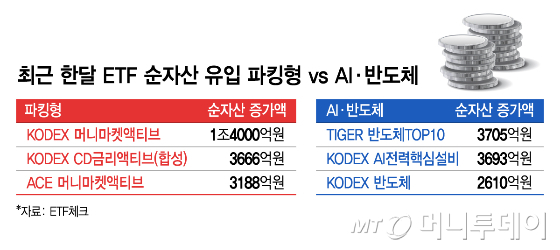
ETF (exchange-traded fund) investors are playing it safe on one side while betting aggressively on the other. Over the past month, trillions of won have poured into parking-type ETFs designed to hold idle funds, while net assets in AI and semiconductor ETFs have grown by hundreds of billions of won each. This marks a simultaneous appearance of 'risk-off' (avoidance of risky assets) and 'risk-on' (preference for risky assets) within the same market.
According to an ETF check on the 23rd, the ETF with the largest increase in net assets over the past month was KODEX Money Market Active, which grew by 1.3985 trillion won. Money Market Active products are representative parking-type ETFs.
Parking-type ETFs are products designed to manage short-term funds like bank deposits. They are primarily sought by investors looking to temporarily park money they have not yet decided where to invest. These products typically invest in bonds or short-term financial instruments, aiming for relatively stable returns. A key feature is that interest accrues even if the funds are deposited for just one day.
In addition to Money Market Active, short-term bond ETFs, CD Rate Active ETFs (negotiable certificates of deposit), and KOFR Rate Active ETFs are also classified as parking-type products.
Beyond KODEX Money Market Active, 366.6 billion won flowed into KODEX CD Rate Active (Synthetic), 318.8 billion won into ACE Money Market Active, and 231.2 billion won into TIGER 1-Year Rate Active (Synthetic) during the same period. Furthermore, net assets exceeding 200 billion won each flowed into bond-comprehensive ETFs such as RISE Comprehensive Bond (A or higher) Active and KODEX Comprehensive Bond (AA- or higher) Active.
This ETF investment trend appears to have emerged amid lingering aftershocks of increased volatility following the launch of single-stock leverage ETFs, alongside surging U.S. Treasury yields, the Federal Open Market Committee's (FOMC) base rate hike, and an ongoing war between the United States and Iran, all contributing to growing stock market uncertainty.
At the same time, it is notable that net assets in active-type ETFs increased significantly during the same period, including 370.5 billion won in TIGER Semiconductor TOP10, 369.3 billion won in KODEX AI Power Core Facilities, and 261 billion won in KODEX Semiconductor. Among ETF products that saw substantial investor inflows, active-type products focusing on AI and semiconductors as core themes are nearly the only ones.
Analysts suggest this reflects an investment sentiment where, while it is difficult to be certain when the overall stock market will rise or when volatility will subside, investors are willing to bet on the medium- to long-term growth potential of AI and semiconductor stocks.
Indeed, over the past month, Samsung Electronics was the spot stock most frequently net-purchased by domestic retail investors, with net purchases totaling approximately 1.4 trillion won. Second place went to SK Hynix with about 500 billion won in net purchases, followed by Samsung Electro-Mechanics, a related stock of Samsung Electronics, with net purchases of around 190 billion won. In the financial investment sector's net purchase data reflecting retail ETF buying trends, Samsung Electronics also ranked first with approximately 4 trillion won in net purchases during the same period.
The securities industry analyzes that this trend differs somewhat from past ETF investment patterns. Previously, when expectations for stock market gains grew, funds moved broadly into index-tracking products, and when anxiety increased, they shifted to safe assets like cash.
Recently, however, funds seeking to avoid volatility are flowing into a variety of newly launched parking-type products, while capital willing to take risks is rapidly narrowing its focus from the entire market to leading sectors such as AI and semiconductors.
An official in the financial investment industry stated, "It appears that recent ETF market fund flows are gradually moving away from the traditional distinction between risky assets and safe assets," adding, "The simultaneous movement of funds into parking-type products and AI/semiconductor ETFs signifies that investors' defensive and aggressive sentiments currently coexist."

 in STOCK
