

With the government releasing an unprecedented 1.18 gigawatts (GW) of energy storage system (ESS) capacity to the market, competition among the three major domestic battery companies has resumed again. While the volume released is more than double that of the previous round—creating greater opportunities for expanding orders—the burden on profitability due to price competition remains unchanged. The three battery firms are carefully deliberating their bidding strategies while considering both order volumes and profitability.
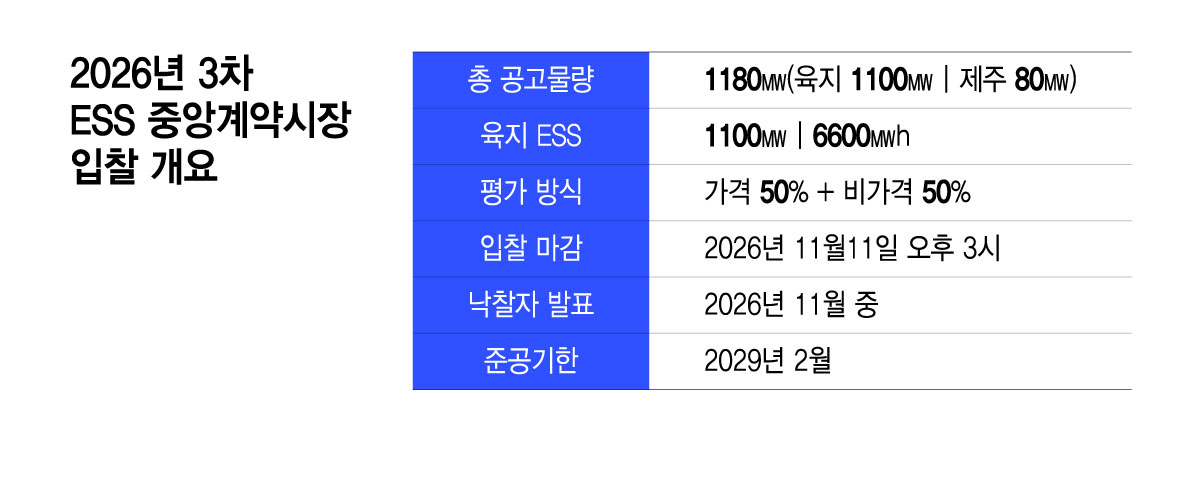
According to the battery industry on the 23rd, the Ministry of Climate, Energy and Environment announced yesterday that it would open the 2026 central contract market for ESS and select a total of 1,180 megawatts (MW) of ESS power plant operators. The capacity is divided into 1,100 MW on land and 80 MW in Jeju. Selected operators must complete ESS construction by February 2029. Bidding will proceed until November 11, with the successful bidder to be determined later that same month.
The volume announced this time exceeds the cumulative awarded amounts from the previous two rounds. In last year's first-round central contract market for ESS, a total of 563 MW was awarded, and in this year's second round, 565 MW was selected. This time's 1,180 MW is approximately 4.6% larger than the combined 1,128 MW from the two prior rounds. As the government accelerates ESS deployment, the market size is rapidly expanding.
The expansion in volume also aligns with what the domestic battery industry has been advocating. The industry conveyed to the government its view that there is a need to expand the order volume for the ESS market in the first half of this year. With slowing demand for electric vehicles leading to increased surplus production capacity for batteries, competing over limited volumes could lead to a race to the bottom on pricing. The industry's stance was that sufficient volume must be supplied to the initial market to secure economies of scale. Overall, it is assessed that since the market itself has more than doubled compared to previous bidding rounds, the absolute order volume that the three battery firms can secure has increased.
However, concerns over price competition remain. This bidding round also maintains a 50-50 weighting between price and non-price evaluation criteria, identical to the second-round market. Following concerns about excessive price competition after the first-round market (where price accounted for 60% and non-price for 40%), the evaluation criteria were adjusted from the second round onward to reduce the weight of price, and the same standard applies this time. Ultimately, battery firms find themselves weighing between expanding order volumes and securing adequate profitability amid the largest-ever volume on offer.
Additionally, the industry expresses dissatisfaction with the technical criteria. The battery sector has consistently urged that the residual capacity criterion for ESS be relaxed from the current 90% to a range of 80–85%, but this time the 90th% standard remains unchanged. Meeting the 90th% residual capacity requirement necessitates not only higher initial installation capacity but also enhanced specifications for cooling systems and battery management systems (BMS). Industry voices argue that since these requirements amount to practically excessive specifications, there is a need to make future technical criteria more realistic.
This bidding round is expected to offer opportunities for order expansion to LG Energy Solution, Samsung SDI, and SK On alike. In the first-round market, Samsung SDI secured over 75% of the total volume, but in the second round, SK On captured half, shifting the landscape. Given that the largest-ever volume is being released all at once, how much volume each of the three firms secures through what pricing strategy will likely determine future domestic ESS market share and profitability.
A representative from the domestic battery industry stated, "The expansion in order volume for this central contract market is positive from the industry's perspective," adding, "While concerns over price competition remain, the weighting between price and non-price evaluation criteria has already been adjusted once in previous markets." The representative further noted, "What is regrettable is that technical standards such as residual capacity, which the industry has consistently advocated for, remain unchanged this time as well."

 in INDUSTRY
