

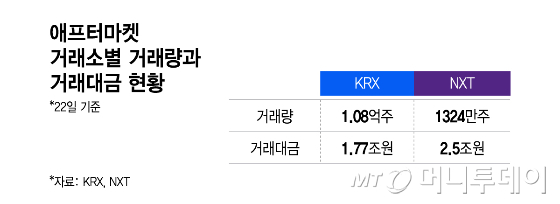
With the launch of the Korea Exchange (KRX: hereinafter "Exchange") Aftermarket on the 14th, competition between the Exchange and NextTrade (NXT) for the aftermarket has intensified. The Exchange handles more trading volume as it allows trading in all listed companies, while NXT records higher trading value since it focuses on major listed stocks. Some analysts suggest that the competitive environment, which was centered on the regular market since NXT’s launch last year, has now shifted to the aftermarket.
As of the 22nd, NXT’s Aftermarket trading value stood at 2.4597 trillion won, approximately 30% higher than the Exchange’s Aftermarket trading value of 1.7697 trillion won.
NXT’s Aftermarket trading value reached its peak earlier this year, hitting as high as 13.4921 trillion won on June 23, driven by the semiconductor supercycle (boom period) and the surge in single-stock leveraged ETFs (exchange-traded funds).
Through August this year, NXT’s Aftermarket trading value mostly fluctuated between 3 trillion and 5 trillion won. Although it exceeded 11 trillion won on August 19, it dropped to the 2nd–3 trillion won range in September. Since the Exchange launched its Aftermarket on the 14th, trading values have hovered around 1 trillion won. The achievement of 2 trillion won on the 22nd marks the first time since the Exchange’s Aftermarket launch.
Compared to before the Exchange’s Aftermarket opened, a significant portion of post-market trading demand that was virtually monopolized by NextTrade has now been distributed across both markets.
While NXT’s Aftermarket handles only about 600 listed stocks, the Exchange’s Aftermarket enables trading in all 2,800+ listed stocks from KOSPI and KOSDAQ. This difference appears to have encouraged investors seeking diverse stock options to shift toward the Exchange’s platform.
The market had anticipated that NextTrade’s Aftermarket, which opens 20 minutes earlier at 3:40 p.m., would retain a large number of investors. However, evaluations also suggest that the advantages offered by the Exchange’s Aftermarket have begun to demonstrate competitiveness among investors. In fact, from the 14th to the 22nd, the average daily trading volume of the Exchange’s Aftermarket reached 107.79 million shares, vastly surpassing NextTrade’s volume of around 10 million shares.
This situation overlaps with an event earlier last year when NextTrade opened as Korea’s first alternative trading system (ATS), shaking the Exchange’s monopoly over the trading market.
At that time, NextTrade established itself in the market by offering lower transaction fees than the Exchange and providing 12-hour trading from 8 a.m. to 8 p.m. In particular, the implementation of the Smart Order Routing (SOR) system, which automatically directs orders to the most favorable market based on price, cost, and execution probability when investors do not directly choose an exchange, triggered direct competition for order attraction and even caught the Exchange off guard.
The market views that with the launch of the Exchange’s Aftermarket, the competition for dominance in the stock market between the Exchange and NextTrade has entered its second round. Last year, NextTrade quickly solidified its position in the competitive landscape thanks to SOR. This year, however, attention is focused on how the Exchange, which holds a wide range of tradable stocks, will shape the competitive environment in the aftermarket race.
A securities industry official stated, "While development through competition between both exchanges is important, the goal of extending trading hours is to attract new investor demand, such as from foreign investors, into the domestic market. Rather than competing for immediate trading volume share, it is crucial to build a competitive framework where both markets grow liquidity together and expand their investor base."

 in STOCK
