

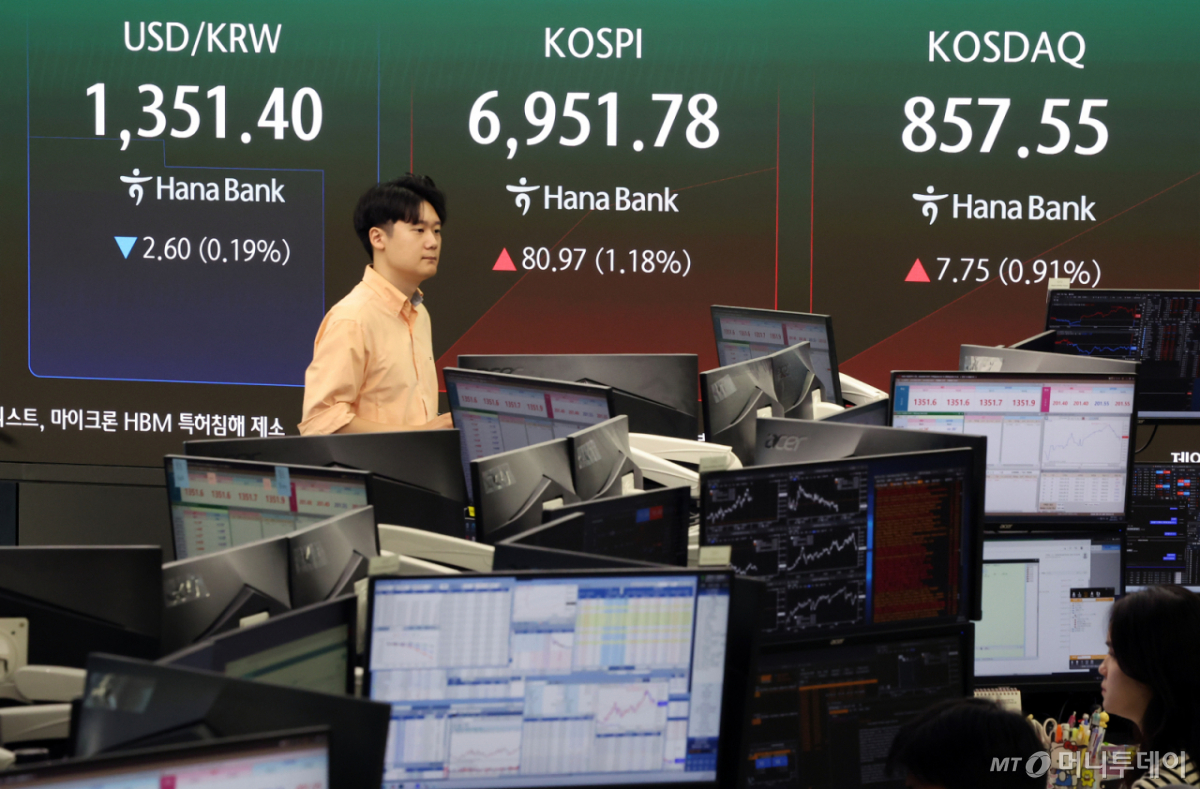
The KOSPI showed strength despite rising interest rates and oil prices. Foreign net buying appeared to drive the index higher. The securities industry analyzed that investor sentiment toward semiconductors had been stimulated.
As of 10:50 a.m. on the 30th, the KOSPI stood at 6,909.01, up 39.09 points (0.57%) from the previous day. The index opened higher by 72.66 points (1.06%) at 6,943.47 and has continued to maintain its upward momentum. This marked a rebound for the KOSPI after three days.
The KOSPI was not affected by the New York stock market. On the 29th (local time), the Dow Jones Industrial Average on the New York Stock Exchange closed at 51,349.92, down 131.59 points (0.26%) from the previous session. The S&P 500 index fell by 12.85 points (0.17%) to 7,670.84, and the NASDAQ Composite Index dropped by 22.84 points (0.09%) to 26,797.54.
Analysts suggest that the New York stock market was hit by rising interest rates and oil prices. On the 29th (local time), the yield on U.S. 30-year Treasury bonds rose to 5.621% intraday, marking the highest level in 24 years since 2002. The yield on U.S. 10-year Treasuries, a global benchmark, reached 5.293% during trading. U.S. West Texas Intermediate (WTI) crude oil futures for November delivery closed at $89.38 per barrel. Although this is the lowest level in the past month, anxiety remains high as negotiations between the United States and Iran have not made progress.
The securities industry expects the KOSPI to continue its bull market despite negative macroeconomic conditions. It is predicted that an upward trend will unfold, centered on the semiconductor sector, which holds a large weight in the KOSPI.
SK Hynix, one of the top two semiconductor stocks, was trading at 1,792,000 won as of this time, up 25,000 won (1.42%) from the previous day. Future Industry (8.21%), Shinseong Engineering (2.74%), and SK Square (0.81%) were also strong. Including these stocks, a total of 104 stocks in the semiconductor and semiconductor equipment sectors showed gains.
The rise in semiconductor stocks is being boosted by news regarding investments in AI infrastructure. Recently, the investment prospectus for Anthropic's upcoming initial public offering (IPO) included a long-term spending plan for AI computing and infrastructure worth at least $518 billion (approximately 700 trillion won) over the next 10 years. Consequently, semiconductor stocks rose even on the New York stock market, which had seen weakness overnight. Micron closed up $17.31 (1.64%) at $1,071.29, SanDisk rose by $16.87 (0.98%) to $1,729.76, and SK Hynix's American Depositary Receipts (ADRs) jumped by $4.76 (2.62%) to close at $186.68.
Jung Hong-sik, a researcher at LS Securities, stated, "We believe that the continuous development of AI will lead to demand for HBM and DRAM with higher capacity and bandwidth, alongside the advancement of computing processors such as GPUs, ASICs, and CPUs." He added, "The warmth in earnings is expected to spread across memory fab expansion, the infrastructure value chain, and the testing value chain."
Han Ji-young, a researcher at Kiwoom Securities, said, "The domestic stock market will be boosted by factors such as the decline in 10-year Treasury yields in the latter half of U.S. trading hours, and news of successful rebounds in AI and semiconductor stocks like Micron and Meta."

 in STOCK
