

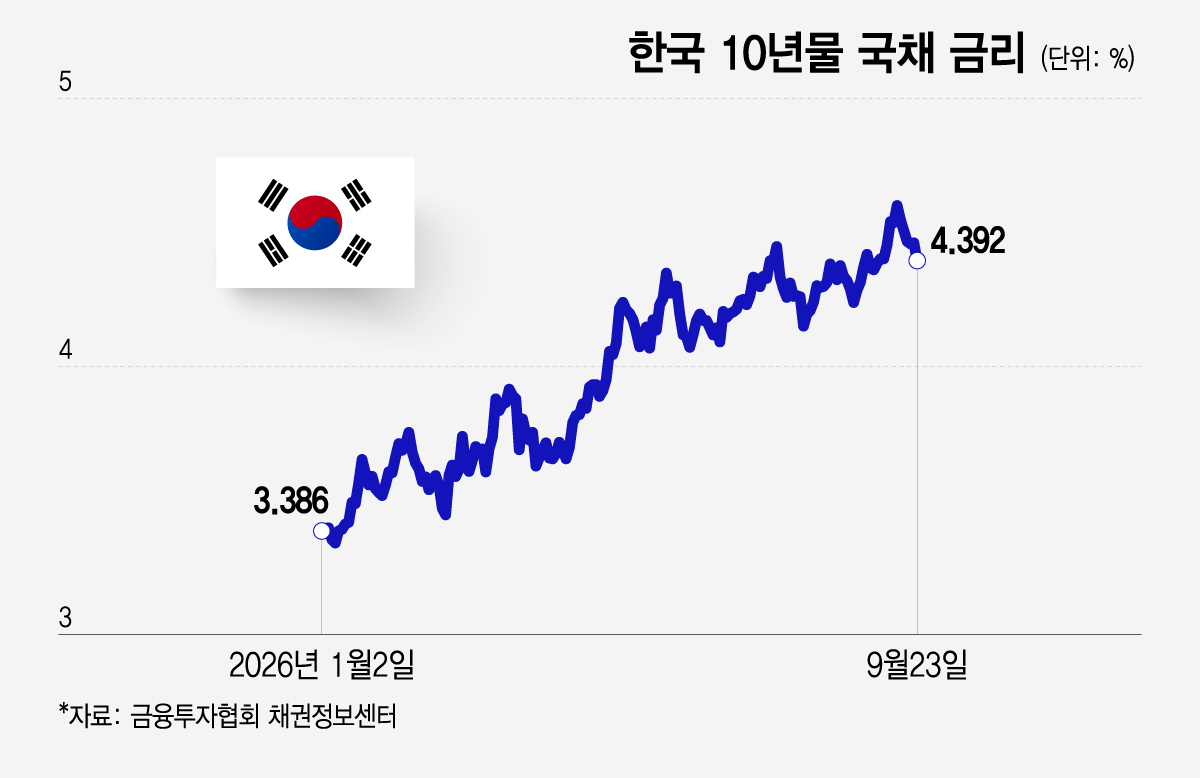
While the U.S. 10-year government bond yield has surpassed 5.2%, South Korea's 10-year government bond yield has recently risen at a rate 2.3 times faster than that of the United States over the past year (based on percentage increase). This is interpreted as a result of rising domestic inflation, consecutive base rate hikes by the Bank of Korea, and foreign sales of domestic bonds amid higher U.S. interest rates.
According to Investing.com on the 28th, the U.S. 10-year government bond yield stood at an annualized 5.211% as of 1:55 p.m., up 2.4 basis points (1bp=0.01 percentage point) from the previous trading session. Domestically, based on data compiled by the Korea Financial Investment Association, South Korea's 10-year government bond yield reached 4.542% that morning, rising 15.0 basis points compared to the last trading day before the holiday period on the 23rd. Compared to September 26 of last year (one year prior), it has risen by 159.9 basis points (54.3%), and is 115.7 basis points higher than at the end of last year. South Korea's 10-year government bond yield fell to as low as 3.341% on January 8 this year before surging to 4.600% on the 15th. According to the U.S. Department of the Treasury, the U.S. 10-year government bond yield was 4.20% on September 26 (local time) last year; the afternoon rate today is 101.1 basis points (24.1%) higher than that level. In terms of percentage increase, South Korea's 10-year government bond yield rise (54.3%) reached 2.3 times that of the United States.
Rising U.S. Treasury yields are analyzed to have pulled up domestic bond yields regardless of issuer or maturity. South Korea's 3-year government bond yield stood at 4.112%, up 155.0 basis points from a year ago, marking its highest level since November 8, 2022. The 30-year bond rose by 186.7 basis points to 4.679%.
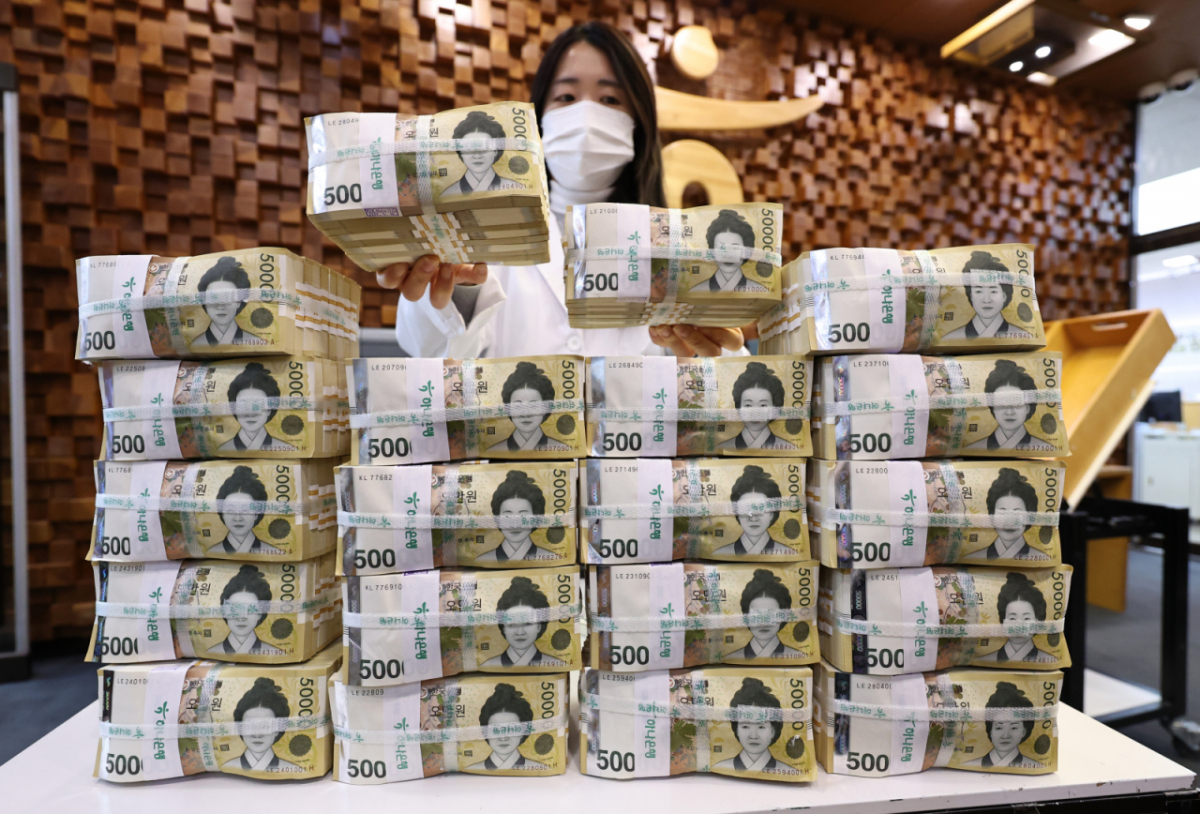
Yield on unsecured 3-year corporate bonds rose to 4.787% for AA- rated bonds (up 178.6 basis points) and to 10.584% for BBB- rated bonds (up 173.8 basis points). The AA- level marks the highest since November 3, 2023. Rising yields are increasing refinancing burdens for lower-rated companies. According to the Bank of Korea's "Q1 2026 Corporate Management Analysis," operating profit margins for large corporations in Q1 this year increased more than twofold from 6.4% to 14.8%, while SMEs (small and medium-sized enterprises) improved only slightly from 4.1% to 4.7%, a gain of just 0.6 percentage points. This means lower-rated companies with profit margins barely reaching the 4th% range must refinance corporate bonds at interest rates exceeding 10%.
Previously, the Bank of Korea raised its base rate from an annualized 2.50% to 2.75% on July 16, followed by another increase to 3.00% on August 27. The Bank of Korea cited strengthening growth momentum centered on exports and investment, inflation exceeding target levels, and financial stability risks as reasons for the rate hikes.
According to the investment banking (IB) industry, foreigners are estimated to have sold domestic bonds worth 839.7 billion won in net terms last month. This marks the first monthly net sale since January 2023, a span of three years and seven months.
Yoon Yeosam, a researcher at Meritz Securities, stated, "Exports remained healthy through September and exchange rates stabilized, but with oil prices rebounding, inflation driven by import costs in September and October may resurface, suggesting the domestic bond market will continue to face uncertain trends." He added, "As we did not experience the sharp rise and slight decline in U.S. yields over the two-day Chuseok holiday period, it is necessary to review appropriate yield levels immediately after the holiday."

 in STOCK

