

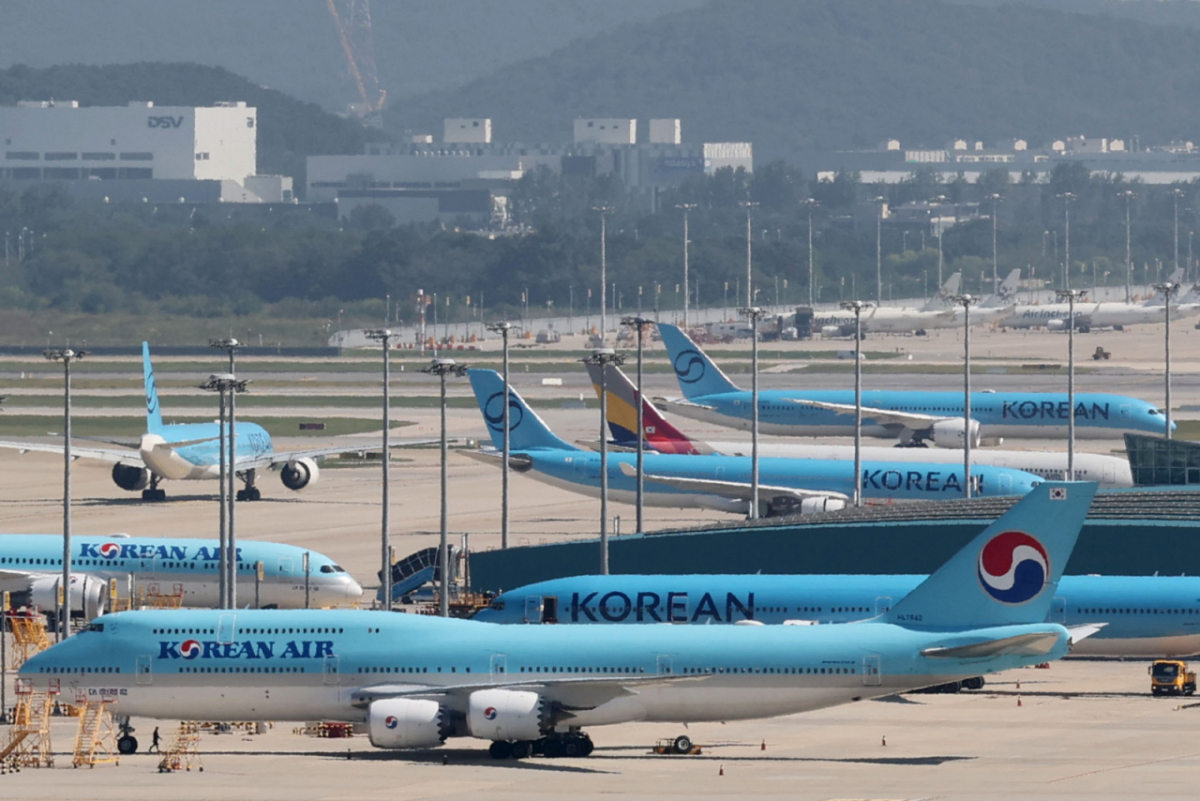
The Fair Trade Commission has effectively decided not to accept Korean Air's request to relax the obligation to maintain supply seats on the Guam route, where demand has decreased due to changes in travel trends and other factors. The reason is that the circumstances did not arise after the corrective measures imposing the seat maintenance obligation were issued by the Korea Fair Trade Commission.
The Korea Fair Trade Commission also warned of imposing penalty payments for non-compliance and filing a corporate prosecution against Korean Air, Asiana Airlines, and others for failing to fulfill the supply seat maintenance obligation on the 'Cheongju-Jeju' route.
On the 30th, the Korea Fair Trade Commission announced that it had submitted an examination report (equivalent to an indictment from the Prosecution Service) regarding non-compliance with corrective measures and applications for modification of corrective measures related to the Korean Air-Asiana Airlines business combination.
The examination report is a document recording the illegality identified during the investigation process by Korea Fair Trade Commission examiners and opinions on related measures. However, it does not bind the committee's final judgment. A final judgment on the case will be made after future independent committee deliberations.
Previously, when approving the business combination between Korean Air and Asiana Airlines, the Korea Fair Trade Commission prohibited reducing the number of supply seats on 40 routes with concerns about competition restriction to less than 90% compared to 2019.
Problems arose on the Guam route. This is because passenger demand for Guam decreased due to infrastructure deterioration and changes in travel trends.
According to aviation statistics from the Ministry of Land, Infrastructure and Transport, only three passengers boarded Korean Air flight KE2260, which departed from Guam and arrived in Busan on November 7 last year. Considering that a typical aircraft with 180 seats carries a total of six staff members, including the captain, first officer, and four cabin crew, there were more crew members than passengers.
In response, Korean Air requested that voluntary slot surrender be recognized as completing structural measures, and asked to lower the supply seat maintenance obligation standard from 90% compared to 2019 to 70%.
However, the Korea Fair Trade Commission did not accept this. The reason is that circumstances constituting grounds for changing corrective measures must have occurred after December 24, 2024, when the committee finalized the corrective measures, whereas the decline in popularity of the Guam route had been evident prior to that.
Jeon Seong-bok, Director of the Corporate Transaction and Combination Review Division at the Korea Fair Trade Commission, said, "The absence of a significant change in circumstances after (the finalization of the corrective measures) is the biggest argument for (the opinion to reject)."
Furthermore, based on data analysis, the Korea Fair Trade Commission believes that Korean Air only began managing supply seat ratios toward the end of the year, resulting in some flights with extremely low load factors. It was explained that when viewed over the entire year, there are other routes with average load factors lower than those on the Guam route.
Meanwhile, regarding the fact that Korean Air, Asiana Airlines, and others supplied fewer than 90% of the supply seats on the 'Cheongju-Jeju' route compared to 2019 from December 2024 to the end of last year, the examination report included an opinion that imposing penalty payments for non-compliance and filing a corporate prosecution are necessary.
Director Jeon stated, "We hope Korean Air will comply with the corrective measures more responsibly," adding, "We wish that there will be no further non-compliance with corrective measures and that they are well observed during the compliance period."

 in INDUSTRY
