

With backlash extending from social groups to the industry over the mandatory tender offer system, the National Assembly's processing of the bill has been temporarily suspended. Given that there are strong arguments that the currently discussed plan is insufficient to protect minority shareholders, attention is turning to whether the content will be revised through re-deliberation.
According to political circles and others on the 30th, an amendment to the Capital Markets Act, centered on the introduction of a mandatory tender offer system, was scheduled to be listed at the National Assembly plenary session on the 1st of next month but has been postponed. The amendment bill, which had gone through bipartisan agreement, was originally planned to be submitted to the National Assembly plenary session for a vote.
It appears that, with backlash intensifying from social groups to the asset management industry, it was decided not to list the bill at the plenary session immediately and instead to re-deliberate internally. The purpose of introducing the mandatory tender offer system is to protect minority shareholders, but as criticism continued that the current plan is inadequate, this is interpreted as a result of being mindful of public opinion.
A mandatory tender offer is a system that requires the mandatory public purchase of shares above a certain percentage when acquiring enough shares to secure control of a listed company. The core is that general shareholders also have the right to sell their held shares at the same price as the controlling shareholder. As cases repeatedly occurred where major shareholders sold their stakes at high prices with a control premium during corporate M&A (mergers and acquisitions) processes while general shareholders did not receive fair value, it emerged as a measure to protect minority shareholders.
The ratio subject to mandatory tender offer, which was the key issue, was decided as "50% + 1 share or more" by bipartisan agreement. "50% + 1 share or more" means that if one secures a 25% stake to become the largest shareholder, they must mandatorily make a public tender offer for the remaining 25% + 1 share or more.
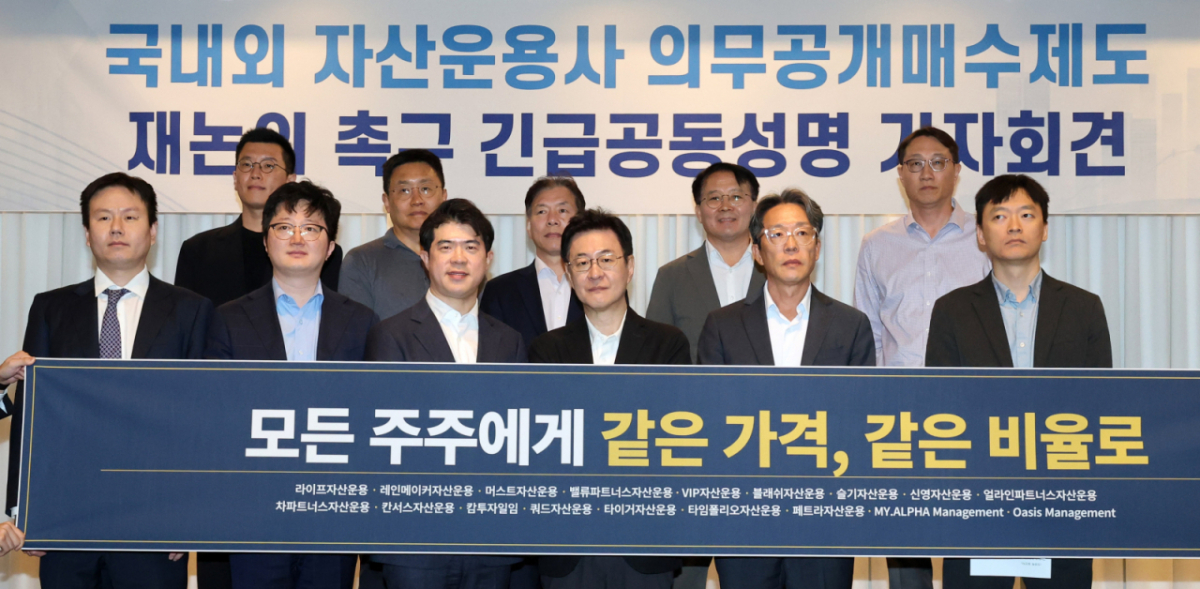
However, the financial investment industry objected, arguing that it is difficult to achieve the purpose of protecting minority shareholders with the current amendment bill. Eighteen domestic and international asset management companies, including Life Asset Management and VIP Asset Management, held an emergency press conference on this day to urge the National Assembly to postpone the processing of the mandatory tender offer introduction bill. It was evaluated as unusual for asset management companies to gather to issue a joint statement and hold an emergency press conference.
The industry pointed out as a problem that controlling shareholders are allowed to sell their entire stake to the acquirer before general shareholders. If a controlling shareholder holds a 40% stake, the acquirer would first purchase the 40th% off-market and then only make a public tender offer to general shareholders for the remaining 10% + 1 share. From the perspective of general shareholders, the number of shares they can sell is limited. If the controlling shareholder's stake already exceeds half, general shareholders may not even get the opportunity to sell their shares.
The argument is that while rights are equal between controlling and general shareholders, the current amendment bill creates a disparity by allowing the acquirer to make a prior purchase of the controlling shareholder's stake. Lee Chae-won, Lee Sa-hoe (Chairman) of Life Asset Management, argued, "Even though they hold shares of the same class, the fact that someone (the major shareholder) can dispose of their held shares while someone else (a general shareholder) can only sell a portion undermines the returns for general shareholders."
It was also argued that if the current amendment bill passes as is, the "Korea Discount" (the undervaluation phenomenon in the Korean stock market) could deepen. One of the main causes of the Korea Discount is insufficient protection of general shareholders, and if the amendment bill is implemented as is, it could entrench the wrong practice where controlling shareholders benefit more than general shareholders. Chairman Lee said, "Social consensus is needed through sufficient public deliberation."

 in STOCK
