

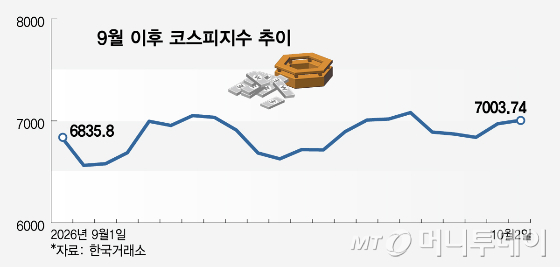
Last week, the KOSPI closed the week by recovering the 7,000 mark, driven by U.S. semiconductor company Micron's surprise earnings and South Korea's record-high September semiconductor exports, despite pressure from high interest rates.
The share buybacks that have propped up Samsung Electronics' stock price are expected to end in mid-October, removing the "prop" that has absorbed selling pressure from retail and foreign investors. Amid growing concerns over supply and demand dynamics, Samsung Electronics is scheduled to release its preliminary Q3 earnings this week. The securities industry's expectations are set around the company surpassing 100 trillion won in quarterly operating profit for the first time. Attention is turning to whether retail and foreign investors, who have consistently made net sales of Samsung Electronics shares, will switch to net buying after confirming the growth potential of its earnings.
According to the Korea Exchange on the 5th, the KOSPI closed at 7,003.74 last week (September 28 – October 2), down 77.18 points (1.09%) from the previous Friday's close of 7,080.92. It closed below the 6,000 mark on four of the five trading days but recovered the 7,000 level on the final trading day.
During this period, foreign and institutional investors made net sales of 832.34 billion won and 971.161 billion won, respectively, in the KOSPI market. Retail investors alone made net purchases of 190.23 billion won. Other corporations, presumed to be engaged in share buybacks by Samsung Electronics and SK Hynix, purchased shares worth 738.45 billion won, absorbing foreign selling pressure.
Last week's domestic stock market showed a pattern where high interest rates capped the upside, while Micron's strong results and South Korea's robust September exports supported the downside. The U.S. 10-year Treasury yield broke through 5.3% intraday, hitting its highest level in 24 years. The 30-year yield also rose to 5.64%, recording its highest level since 2002. The possibility that the Federal Reserve System (Fed) will raise the base rate at its October Federal Open Market Committee (FOMC) meeting remains.
Micron announced that both its revenue for the fourth quarter of fiscal year 2026 (June–August) and its revenue guidance for the next quarter exceeded market expectations. It also emphasized that the current industry environment is a structural cycle where supply shortages will continue through 2027–2028. Additionally, September export statistics showed semiconductor exports increased by 262.8% year-on-year to $60.3 billion, surpassing the monthly mark of $60 billion for the first time in history, which revived investor sentiment toward semiconductor stocks.
The securities industry unanimously points to Samsung Electronics' preliminary Q3 earnings release scheduled for the 8th as the most important event for the domestic stock market this month. According to NH Investment & Securities, the market forecast for Samsung Electronics' Q3 operating profit stands at around 109.5 trillion won. Expectations have been lowered by approximately 360 billion won from the early September peak due to a stronger won. However, the Q4 forecast is in the range of 120.8 trillion won, indicating that the trend of increasing profits continues.
Shin Seung-jin, a researcher at Samsung Securities, said, "For the market to rise further, the earnings growth potential of AI (artificial intelligence) companies must be proven to withstand interest rate burdens."
With Samsung Electronics' share buybacks expected to conclude in early to mid-October, attention is also turning to whether a new supply and demand driver will emerge after this earnings release. Retail and foreign investors have sold off shares worth 993.40 billion won and 466.82 billion won, respectively, over the past month. Samsung Electronics has defended its stock price by purchasing approximately 50 billion won worth of treasury shares on a daily average.
Jeong Hae-chan, a researcher at Samsung Futures, stated, "Once share buybacks are completed, the supply and demand driver that has been absorbing selling pressure from foreign and retail investors and supporting the KOSPI's downside will disappear, raising significant concerns about the weakening of the index's support base." He added, "Foreign investors have shifted to a net-selling position on a cumulative basis after settling the September contract for KOSPI 200 futures, meaning futures supply and demand conditions are also not favorable."
Investment strategy advice suggests increasing exposure to semiconductors backed by solid earnings while reducing allocations to export stocks and securities firms. Lee Jae-won, a researcher at Yuanta Securities, recommended, "I recommend expanding the weight of the semiconductor sector, which has seen increases in profit and revenue estimates over the past month despite high interest rates and high oil prices." He added, "It is necessary to reduce exposure to export stocks that will face the impact of the sharp drop in the won/dollar exchange rate with their earnings, and to securities firms affected by declining trading volumes due to retail investors' failure to return to the stock market."

 in STOCK
