

Considering factors such as the war between the United States and Iran, rising international oil prices, and high interest rates, an analysis has emerged suggesting that investing in ETFs (Exchange-Traded Funds) is more advantageous than investing in individual stocks.
Choi Go-min-su (real name Park Min-su), a stock investment expert and writer, stated in an interview with MoneyToday's securities-specialized YouTube channel 'Bukkumi - Ants Dreaming of Becoming Rich' that "the current environment makes individual investing somewhat difficult," adding that "while high-volatility market conditions can yield high returns, losses can also become very significant."
※ The full interview video is available on the YouTube channel 'Bukkumi - Ants Dreaming of Becoming Rich'.
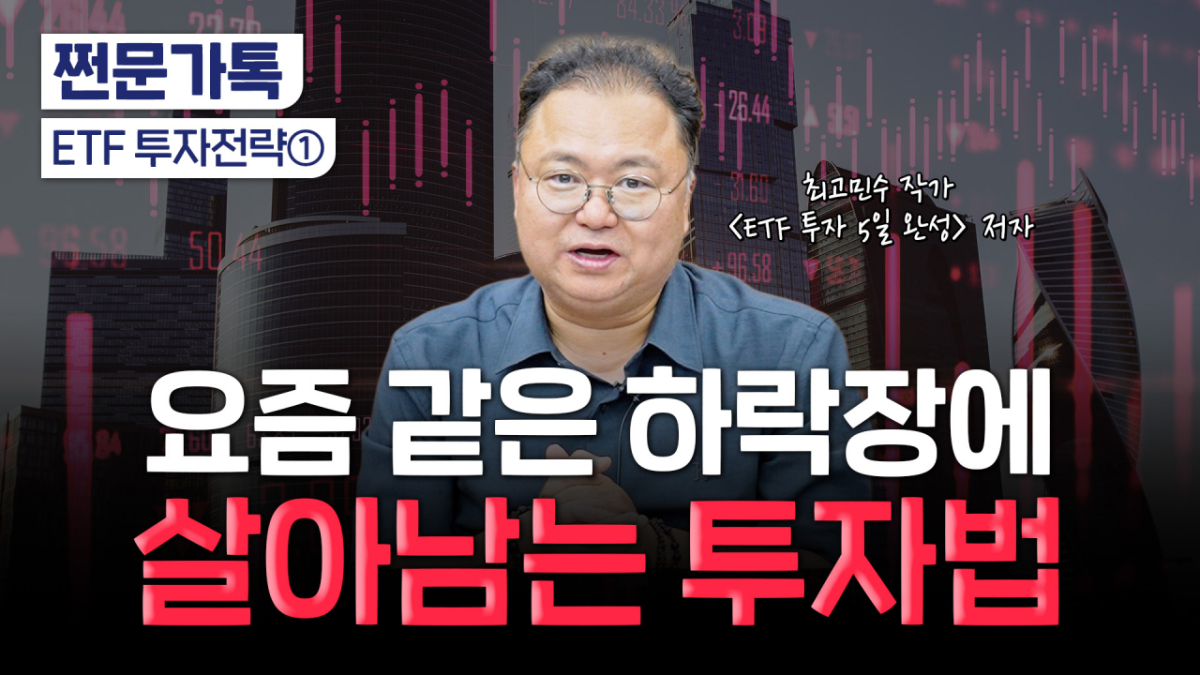
Q. What are the advantages of ETF investing compared to individual stock investing?
▶The current environment has become somewhat difficult for individual investing. First, the global environment is quite challenging. The war with Iran has not ended, which is causing oil prices to rise. Rising oil prices are stimulating inflation, and interest rates are being raised to address inflation. These interest rate hikes and rising inflation are also affecting the Japanese yen. The unwinding of yen carry trades and other factors are becoming sources of instability for our stock market. While high-volatility market conditions can lead to high returns, losses can also become very large. Therefore, the biggest advantage of ETFs is that they "fall less." An equity ETF portfolio consists of 10 or more stocks. Even if an individual stock hits its lower price limit, it is difficult for the ETF to hit its lower price limit. Because volatility is relatively low, one can find psychological stability in market conditions where external variables are unstable, which is a major advantage. Also, delisting rarely occurs unless there are exceptional circumstances. Furthermore, ETF portfolios are managed periodically. They automatically rebalance. If you are pursuing medium risk and medium return, I would like to emphasize ETF investing.
Q. What should be noted when investing in ETFs?
▶ You must check what the underlying index is. For example, there are many ETFs with "semiconductor" in their names. However, when you actually compare the constituent stocks within the portfolios, they are all different. This is because the underlying indices are different. You should definitely know what the underlying index is and at least the top three constituent stocks. Even if the names of the underlying indices are similar, the constituent stocks may differ. I might have bought a semiconductor ETF, but it may not include Samsung Electronics and SK Hynix. That would be the case for a semiconductor materials, components, and equipment (soobu-gang) ETF. If the underlying index is the same, there may be differences in fees. For instance, the fees of ETFs tracking the KOSPI 200 index vary widely. If the underlying index is the same, lower fees may be better from a long-term investment perspective. However, rather than focusing primarily on fees, one should also look at returns. It is possible to achieve high returns that offset the fees. In particular, in a bull market, active ETFs have higher fees than passive ETFs but are achieving higher returns. Also, changes during ETF rebalancing should be monitored. One should also check whether it is a currency-exposed product or a currency-hedged product.
Q. Covered call ETFs are particularly popular these days. Are there any points to note when investing in this type of ETF?
▶Covered call ETFs have something called a distribution drop. When a distribution is paid, the stock price is lowered by the amount of the distribution on the following day, known as the ex-dividend date. Because the stock price drops in this way, if there is not some degree of stock price appreciation, the ETF's stock price will continue to decline. As a result, dividends also decrease accordingly. From that perspective, for covered call or other dividend-focused ETFs, one should look at ETFs that have the potential for some stock price appreciation. First-generation covered call ETFs have a particularly high proportion of sold call options. This makes it difficult to participate in index gains. On the other hand, second-generation covered call ETFs have a sold call option ratio of 10% to 30%. It would be good to approach investing with a focus on such ETFs.
Q. Tax-saving methods are also important when investing in ETFs. How should one invest?
▶A tax rate of 15.4% is applied to the combined amount of dividends and capital gains from domestic other-type ETFs up to 20 million won. If it exceeds that amount, it becomes subject to comprehensive taxation, with a tax rate of up to 49.5%. It would be good to utilize tax-saving accounts such as pension accounts and ISA (Individual Savings Account). For pensions, one can invest up to 18 million won per year. Of this, up to 9 million won is eligible for a tax credit. Investing approximately 6 million won in an individual pension and 3 million won in an IRP (Individual Retirement Pension) allows one to receive a tax credit depending on their income. For ISA, one can invest up to 20 million won per year for a maximum of five years. When the account matures, 9.9% is separately taxed on the amount excluding 2 million won. I recommend utilizing active ETFs tracking the NASDAQ 100 in an ISA or pension account.

 in STOCK
