

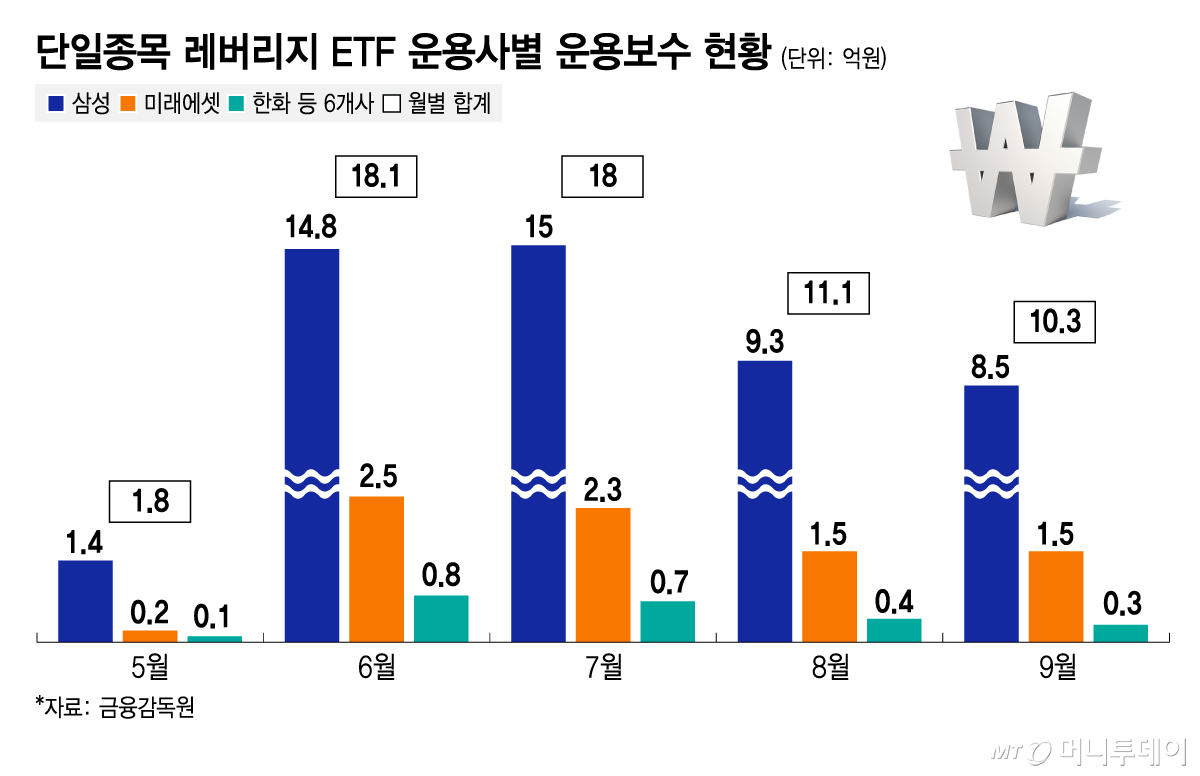
Although the trading volume of single-stock leveraged products in Samsung Electronics and SK Hynix has shrunk to one-eighteenth due to strengthened regulations by financial authorities, asset managers' management fees still exceed 1 billion won per month. Management fees surpassed 5.9 billion won from May, when the products were launched, through September, with 4.9 billion won of that amount concentrated solely at Samsung Asset Management.
According to documents submitted by the Financial Supervisory Service to the office of People Power Party lawmaker Park Jun-tae, a member of the National Assembly's Political Affairs Committee, on the 9th, the total management fees for single-stock leveraged products from eight domestic asset managers in May through September were recorded at 5.93 billion won.
By month, fees surged from 180 million won in May to 1.81 billion won in June and remained at around 1.8 billion won in July. They then decreased to 1.11 billion won in August and 1.03 billion won in September. Management fees in September fell by 42.8% compared to July but still exceeded 1 billion won per month. The management fees generated over the two months of August and September, following the regulatory tightening, reached 2.14 billion won.
Single-stock leveraged products are high-risk instruments that track twice the daily price fluctuation of individual stocks such as Samsung Electronics or SK Hynix. Following their launch on May 27, trading surged amid a boom in semiconductor stock investment, prompting financial authorities to strengthen the basic deposit requirement from 1 billion won (including large-denomination securities) to 30 million won in cash starting July 31.
Subsequently, trading volume plummeted. According to the Financial Services Commission, the daily trading volume of single-stock leveraged and inverse products dropped from 1.24 trillion won on July 30 to 70 billion won on August 11. It shrank to roughly one-eighteenth in less than two weeks.
However, management fees do not necessarily correlate directly with trading volume. Unlike transaction commissions paid each time a trade is executed, management fees are levied based on the fund's net assets. This structure means that even if trading decreases, asset managers continue to generate fee income as long as investors hold the products.
The disparity in fees among asset managers was also pronounced. Samsung Asset Management collected 4.9 billion won in management fees from May through September, accounting for 82.6% of the total. Mirae Asset Management followed with 790 million won (13.3%), while the remaining six asset managers, including Hanwha Asset Management, combined for only 240 million won (4.0%).
Samsung Asset Management's monthly management fees decreased from 1.5 billion won in July to 930 million won in August and 850 million won in September. However, its share of the total remained in the 80th% range during the same period, at 83.3%, 83.8%, and 82.5%, respectively. This indicates that the structure concentrating fees with specific asset managers has not changed significantly even after trading activity contracted.
Park (Rep.) stated, "As a result of hastily introducing single-stock leveraged ETFs, retail investors have borne the losses while only securities firms and asset managers have reaped the profits," adding, "The circumstances of the policy's promotion must be clarified through special prosecution and national investigation, and those responsible for policy decisions must be held accountable to the end."
However, management fees do not equate to an asset manager's net income, and the decline in fees is influenced not only by regulatory tightening but also by changes in underlying asset prices and net asset size. Since the long-term cumulative return of leveraged products may differ from twice the return of the underlying assets, it is also important for investors to fully understand management costs and product risks.

 in STOCK
