

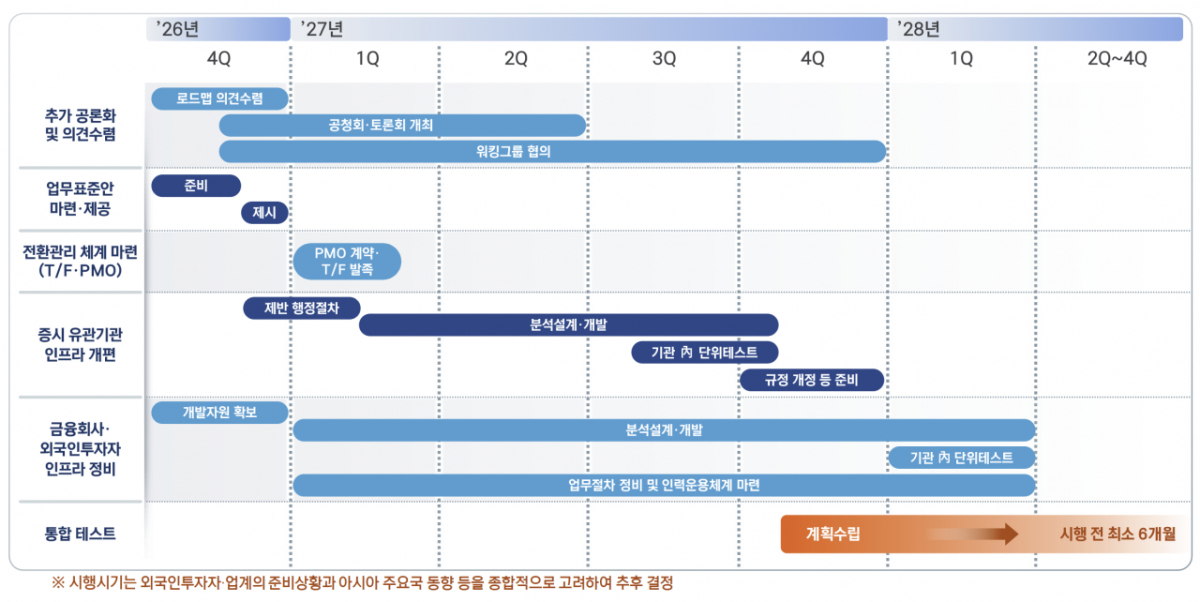
According to the “Roadmap (Draft) for Shortening the Securities Market Settlement Cycle” released by securities-related institutions on Monday, the timing for shortening the stock settlement cycle in the domestic market is expected to be the second half of 2028, approximately one year later than initially anticipated.
This is because there are no few challenges that must be addressed, such as time zone and currency exchange burdens for foreign investors and the risk of settlement failures.
Some overseas investment institutions have stated they will reduce their investment allocation in the Korean market if preparations are insufficient, and reviews regarding the risk of forced liquidation for retail investors also remain. In addition, Hong Kong’s decision to postpone its implementation timing to the second half of 2028 has also influenced the domestic schedule.
Securities-related institutions, including Korea Exchange, the Korea Securities Depository, Korea Securities Finance Corporation, and the Korea Financial Investment Association, plan to shorten the settlement cycle from the current two business days (T+2) to one business day (T+1) by 2028.
The goal is to complete infrastructure restructuring at securities-related institutions by October next year, finish system adjustments for financial companies and others by the first quarter of 2028, conduct integrated testing for a minimum of six months, and then transition in the second half of 2028.
Over 600 institutional investors must coordinate… “Setting a challenging target for the second half of 2028”
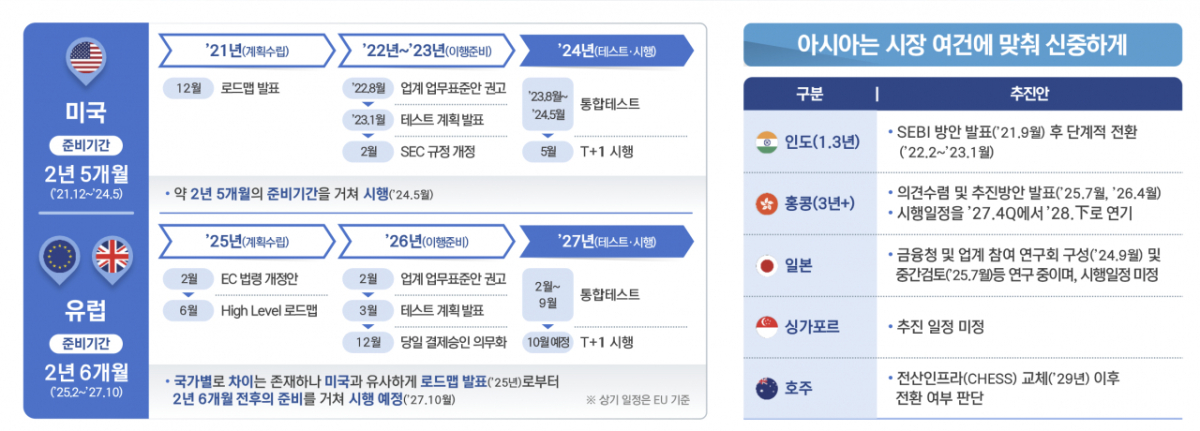
Initially, the market expected the settlement cycle shortening to be implemented in October 2027, aligned with the European Union (EU) transition schedule. This was because financial authorities stated in March that they were preparing in step with Europe and other regions.
Park Sang-wook, head of the Clearing and Settlement Division at the Korea Exchange, who conducted the roadmap briefing on this day, said, “At that time, a specific implementation date had not been confirmed, and this is the first time an official target schedule has been presented.” He added, “After assessing how much preparation period was needed through surveys, we comprehensively proposed the schedule by referring to overseas cases.”
Since implementation is possible only after preparations are completed by various domestic and international institutional investors, a sufficient preparation period is essential. Park explained, “Currently, more than 600 financial institutions must participate, and including foreign-affiliated financial companies, each institutional investor has different preparation capabilities.”
In particular, the settlement workload burden for foreign investors is cited as the biggest constraint factor. This is because there is a 13-hour time difference between New York, USA, and Korea, leaving foreign investors with relatively little time to utilize for actual business operations. If the settlement cycle is shortened by one day, transaction confirmations and currency exchanges must be processed even more urgently.
Park said, “In the worst case, there could also be a burden of pre-funding (advance funding), where won must be secured in advance before the transaction.”
In a survey conducted by the exchange targeting 32 companies including overseas securities firms, custodians, and investors, 33.3% of responding institutions answered that they would reduce their investment allocation in the Korean market if transitioning to T+1 with insufficient preparation. 53.2% of respondents said a minimum preparation period of 18 months or more was needed, while 84.4% preferred implementation after the second half of 2028.
Major overseas countries also introduced the system with sufficient time. The United States took approximately two years and five months from the release of its roadmap in December 2021 to implementation in May 2024 to establish the system.
Europe, the UK, and Switzerland, which are scheduled to implement it in October next year, have also set a preparation period of approximately two years and six months after releasing their roadmaps.
Hong Kong, which has been preparing for settlement cycle shortening since July last year, initially aimed for implementation in the fourth quarter next year but recently postponed its implementation schedule by about one year to the second half of 2028. The preparation period alone is more than three years.
Compared to overseas cases, Korea’s preparation period of just over two years is not particularly long. Park said, “There was a need to present visible goals during the preparation process, so we presented the schedule challengingly,” adding, “The final transition timing will be concretized through consultations with domestic and international financial companies and foreign investors in the future.”
When determining the implementation timing, the schedules of major Asian countries such as Hong Kong were also considered. This is because global investors trade the Asian market on a regional basis, so if settlement cycles differ by country, costs such as funding may increase. According to a survey by securities-related institutions, 60% of overseas investors answered that they prefer simultaneous transition on a regional basis, such as Asia or Northeast Asia.
Park said, “The Hong Kong schedule was not entirely without influence (on the decision of Korea’s schedule),” adding, “Hong Kong is a major competing market in the same region as us, and from the perspective of global investors, it is desirable to transition at a similar time.”
More than 10 steps required until settlement… Difficult to omit or change order, and stability must also be managed

The reason much time is needed for shortening the settlement cycle is that domestic and international financial institutions currently process more than 10 steps of settlement work over 37 hours, but they must complete all of it in just 13 hours, from 8 p.m. when the stock market closes until 9 a.m. the next day when the regular session opens.
Settlement tasks such as confirmation, correction, guarantee, netting, allocation, matching, currency exchange, approval, and settlement cannot have any step omitted or processed in a different order. To this end, not only the exchange and the Korea Securities Depository but also more than 600 financial institutions must restructure their computer systems and establish night and early morning work schedules.
Park said, “Shortening the settlement cycle is not something that can be achieved by securities-related institutions alone; it is possible only after preparations are completed by all institutional investors participating in the ecosystem.” He added, “In addition, we must consider currency exchange and funding for foreign investors, organizing response systems for settlement failures, and integrated testing involving the entire industry.”
It must also be considered that the risk of settlement failure may increase during the process of shortening the settlement cycle. Currently, the settlement failure rate in the Korean stock market is close to 0%, but it is around 2-3% in the United States and approximately 7% in Europe. Concerns are emerging that cases where securities or funds cannot be secured on time may increase as settlement preparation time decreases.
Park said, “Korea places great importance on settlement stability, so the level is such that only one or two settlement failures occur per year,” adding, “Even if we shorten the settlement cycle, we must prepare sufficient risk management measures to maintain the low settlement failure rate, which is a strength of our market.”
Additional reviews are also needed for the protection of retail investors. If T+1 is implemented, stock sale proceeds can be received one day earlier, but the payment timing for investors in unsettled trades is also moved up by one day. If unsettled funds are not paid, the timing of forced liquidation will also move up from the existing T+3 to T+2, reducing the time investors have to respond.
During the briefing, there were also points raised regarding the possibility of increased forced liquidations due to the shortening of the settlement cycle and measures to protect investors. The intent is that the benefits and risks for retail investors should be comprehensively analyzed, and based on those results, adjustments to the implementation timing or even a re-examination of the introduction of the system itself should be considered.
Park said, “We have not yet conducted a detailed analysis regarding the benefits for retail investors, but we plan to review it in depth in the future,” adding, “However, regarding the utility of shortening the settlement cycle, we must also comprehensively consider the effect of reducing settlement risks and transaction costs for the entire market, not just for retail investors.”

 in STOCK


