

The financial authorities have moved to expand the size of the Securities Market Stabilization Fund. While assessing how much additional commitment is possible from 25 banks and securities firms, they are also accelerating practical procedures, including revising operational guidelines to determine the timing and scale of fund deployment.
However, despite a series of market stabilization measures, the KOSPI has plunged by more than 6% in a single day, amplifying investor demands for faster and more effective countermeasures. Critics point out that authorities' response falls short of market expectations, as it remains undecided when and how much of the fund will actually be deployed.
According to financial authorities and the financial investment industry on the 25th, the Financial Services Commission is assessing through the Korea Development Bank whether 25 private financial institutions (including banks and securities firms) can make additional commitments to the Securities Market Stabilization Fund and how much they can contribute.
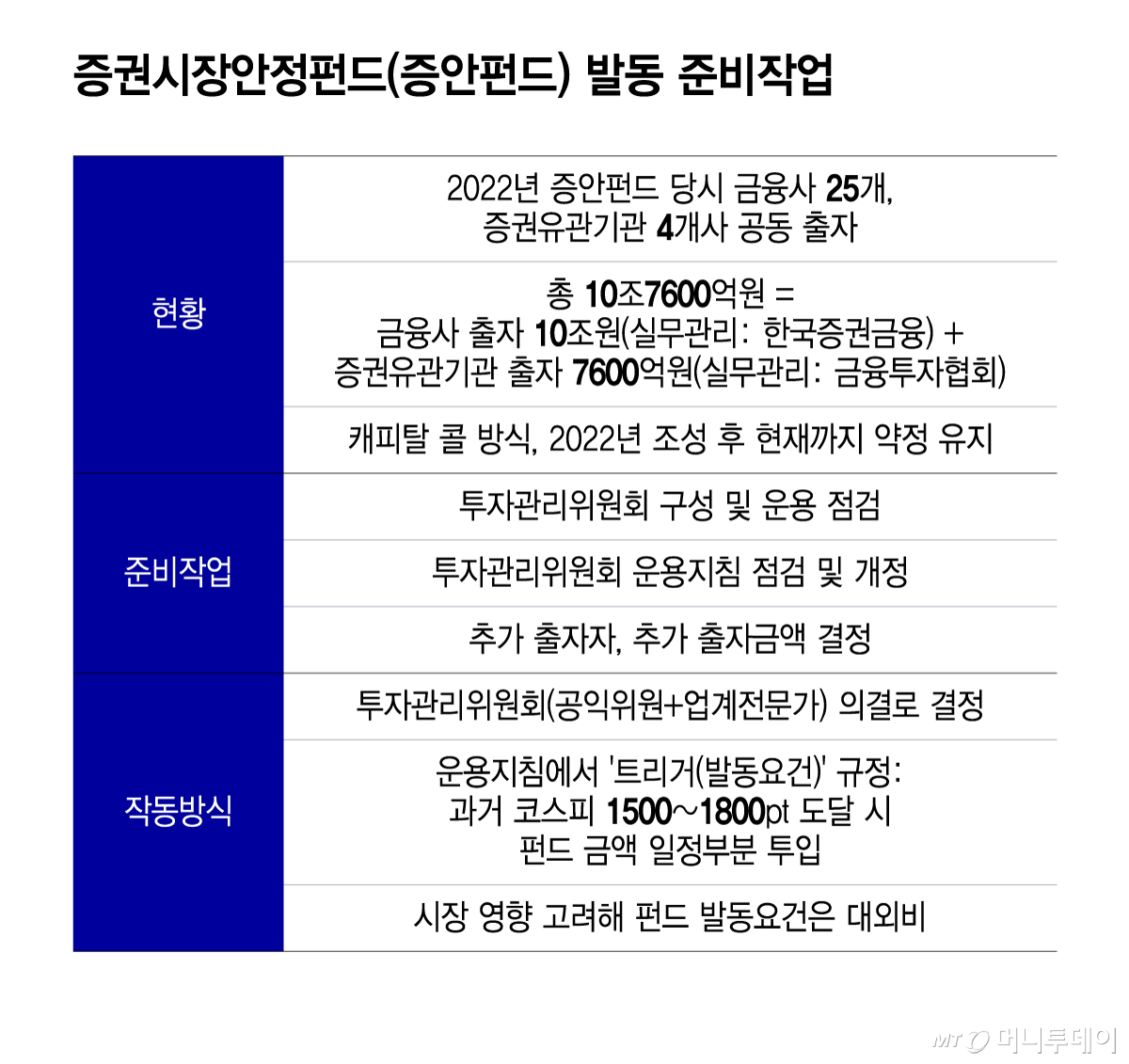
The plan involves accepting additional commitments for the 10th trillion won portion of the existing 10.76 trillion won fund that is allocated to financial firms, thereby increasing the total size to "10.76 trillion won + alpha." According to multiple industry officials, these financial institutions received an official letter from the Korea Development Bank on the 23rd regarding additional formation of the fund and are currently reviewing whether they can make additional commitments.
The 10 trillion won fund that the financial authorities are considering expanding was established by 25 financial institutions, including KB Kookmin Bank, Shinhan Bank, Hana Bank, Woori Bank, Industrial Bank of Korea, and IBK Industrial Bank of Korea. It was formed in 2020 and re-committed in 2022, utilizing a capital call method where contributions are committed under specific conditions.
The 760 billion won fund established by related agencies such as the Korea Exchange has not yet entered the additional formation process. One industry official said, "It appears that priority is currently being given to expanding the size of the 10th trillion won fund," adding, "The scale of the 760 billion won related-agency fund is relatively small, so additional formation work has not yet begun."
Among industry players who received the official letter, there is a sentiment that making large-scale additional contribution commitments will not be easy.
This is because financial conditions are not favorable for committing to large additional contributions, especially as securities firms' performance has deteriorated since the third quarter of this year. However, given that the banking sector committed to larger contributions when the fund was first formed in 2020, the Securities Market Stabilization Fund is expected to expand depending on the scale of additional commitments from banks.
The Investment Management Committee, composed of investor representatives and private public interest commissioners, must move to revise operational guidelines that determine the execution index (at what KOSPI point level funds will be deployed) and the amount to be invested.
Since the authorities decided on "immediate activation preparation" on the 22nd, revisions need to be expedited, but physical time is required for the committee to convene and amend the guidelines.
The financial authorities have also deployed all three measures of the "market stabilization package" implemented during the 2022 stock market crash.
Following a regular meeting of the Financial Services Commission on the 23rd, they relaxed the limit on listed companies' daily self-tender orders to "the total number of shares in the acquisition report." On the 24th, they began operating a joint inspection task force for illegal short selling. Since the 9th, they have temporarily exempted securities firms from the obligation to maintain a 140% collateral ratio for credit lending.
Some voices suggest that partial restrictions on short selling could also serve as a market stabilization measure, but considering the authorities' policy direction of pursuing inclusion in the MSCI developed country index, the likelihood of further regulating short selling is low.
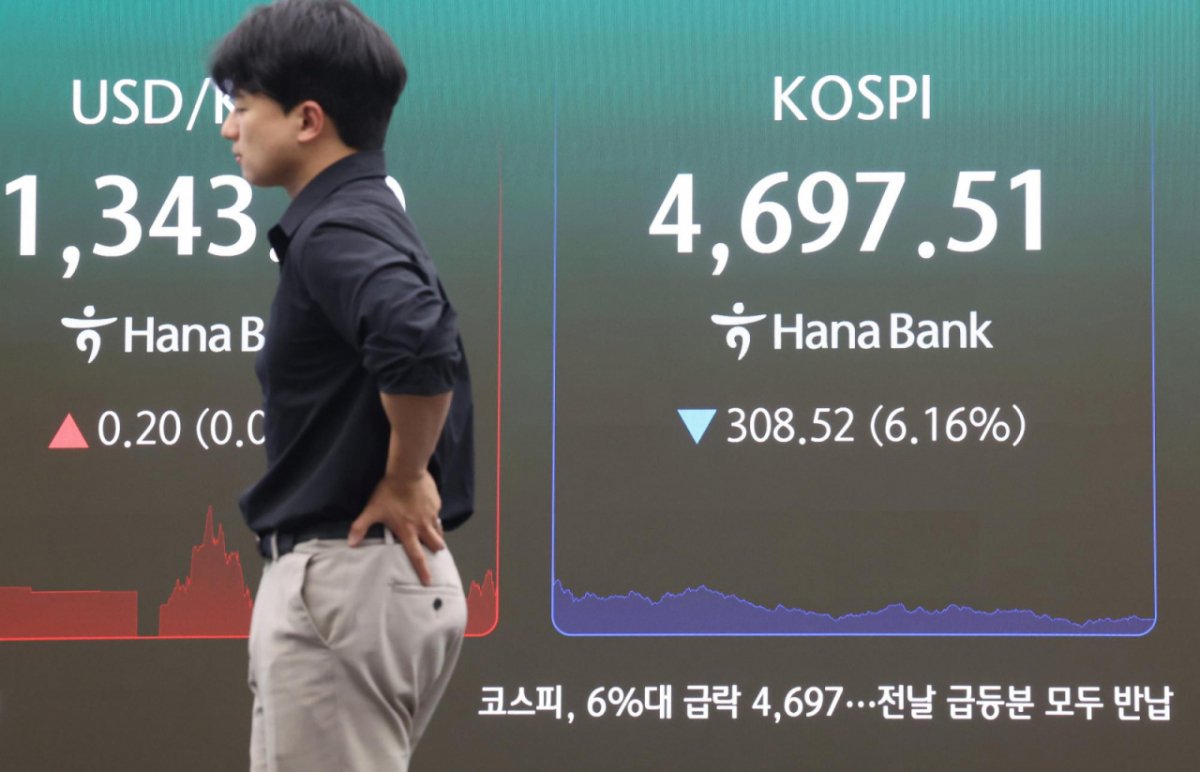
On this day, the KOSPI closed at 4,697.51, down 308.52 points (6.16%) from the previous trading day, marking its lowest level in 212 trading days since January 13. Foreigners' cumulative net selling for November reached 15.8 trillion won as of this day, making it difficult to defend against index declines caused by foreign outflows even if the entire existing Securities Market Stabilization Fund were deployed. On June 29, when foreign net selling was highest this year, 7.733 trillion won flowed out in a single day.
Analysis also suggests that the timing of deployment is more critical than the actual ammunition size of the Securities Market Stabilization Fund. Since the fund itself is not an "endless fountain," the skill of operation is considered more important than its scale.

 in STOCK

