

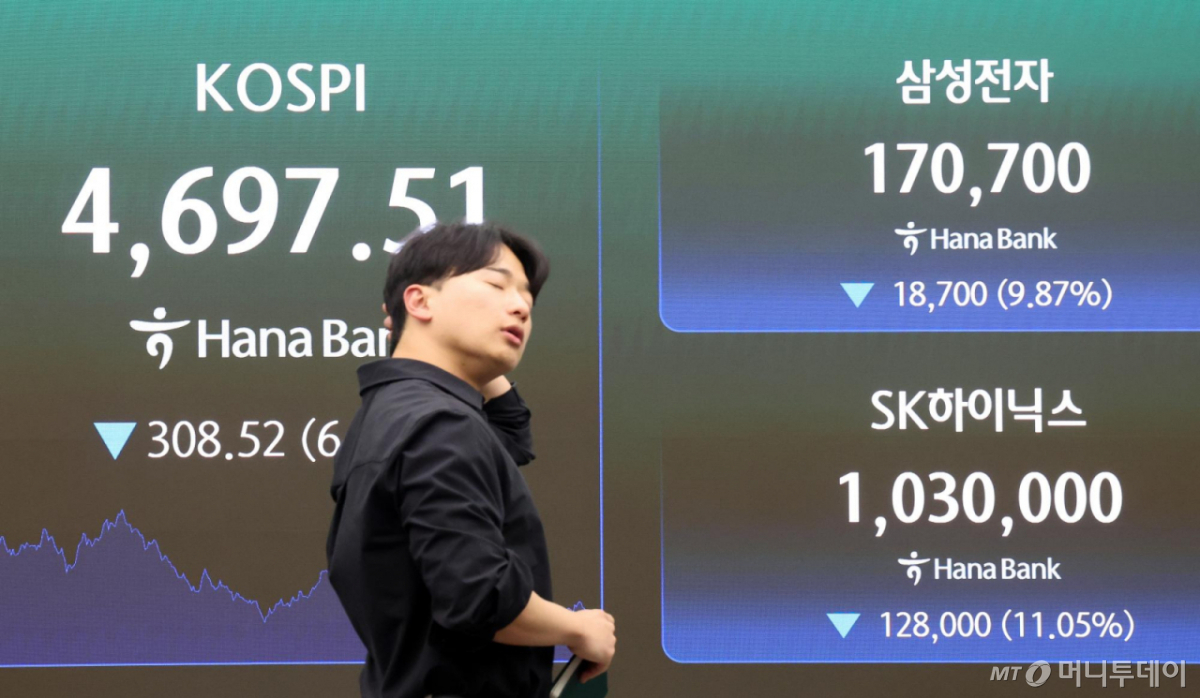
The KOSPI, which fell below the 4,700 mark for the first time in 212 trading days amid concerns over a slowdown in the memory industry, is now on edge ahead of U.S. inflation indicators.
With the market assigning a high probability to a December rate hike by the U.S. Federal Reserve (Fed), if the U.S. October Personal Consumption Expenditures (PCE) price index exceeds expectations, tightening concerns could intensify, potentially expanding volatility in the domestic stock market.
On Nov. 25, the KOSPI closed at 4,697.51, down 308.52 points (6.16%) from the previous trading day. This marked the first time since January 13 that the KOSPI closed in the 4,600 range, a span of 212 trading days. The index opened at 4,809.00, down 197.03 points (3.94%), and widened its decline during the session. A sell-side sidecar (futures market circuit breaker) was also triggered early in trading. This is the 102nd sidecar of the year. The KOSPI dropped nearly 6.7% intraday, falling as low as 4,672.55.
In the KOSPI market, retail investors made net purchases of 1.4231 trillion won, while foreign investors and institutional investors made net sales of 1.9085 trillion won and 700 million won, respectively. Foreign investors, who had switched to net buying on the previous day after eight trading days, reversed back to net selling within a single day.
Among top market capitalization stocks, Samsung Electronics and SK hynix, ranked first and second by market cap, suffered significant hits. Samsung Electronics closed at 170,700 won, down 18,700 won (9.87%) from the previous trading day, while SK hynix ended at 1,030,000 won, down 128,000 won (11.05%). Samsung Electronics fell more than 10% intraday at one point, dropping to 170,000 won. Based on the closing price, its market capitalization also fell below 1,000 trillion won for the first time since February 4.
Driven by weakness in Samsung Electronics and SK hynix, Samsung Electro-Mechanics fell in the 12% range, SK Square dropped in the 11% range, Samsung Life Insurance declined in the 10% range, and Samsung C&T fell in the 8% range. Conversely, rotating buying flows entered Samsung Biologics and Celltrion, pushing them up by 5% and 3%, respectively.
Amid rising concerns over additional tariffs from the U.S. Trump administration, securities firms advised preparing for volatility driven by macro risks.
Kang Jin-hyuk, a researcher at Shinhan Investment Corp, stated, "Overnight in the U.S., the October PCE price index, October new home sales, and the U.S. Fed Beige Book (a report on recent economic trends in the jurisdictions of 12 Federal Reserve Banks) will be released, and the final Monetary Policy Board meeting of the year is scheduled for the 26th."
He added, "We are seeing continued position adjustments in major assets alongside a reassessment of AI growth expectations." Fifty-four percent of bond market participants predicted that the Monetary Policy Board would raise the base rate.
The KOSDAQ closed at 650.64, down 15.24 points (2.29%) from the previous trading day.
In the KOSDAQ market, foreign investors made net purchases of 1.9 billion won and institutional investors bought a net 26.8 billion won, while retail investors sold a net 34.5 billion won.
Among top market capitalization stocks, Alteogen rose in the 6% range, Pharma Research and Samchundang Pharmatics climbed in the 5% range, and HLB gained in the 1% range. Rainbow Robotics and Robotis fell in the 1% range, Ecopro BM dropped in the 4% range, Ecopro, Rino Industrial, and HPSP declined in the 5% range, Simtech fell in the 6% range, Iotechneics dropped in the 8% range, Wonik IPS fell in the 10% range, and Jusung Engineering declined in the 11% range.
In the Seoul foreign exchange market, the won-dollar exchange rate closed daily trading at 1,343.2 won, up 0.8 won from the previous trading day.

 in STOCK
