

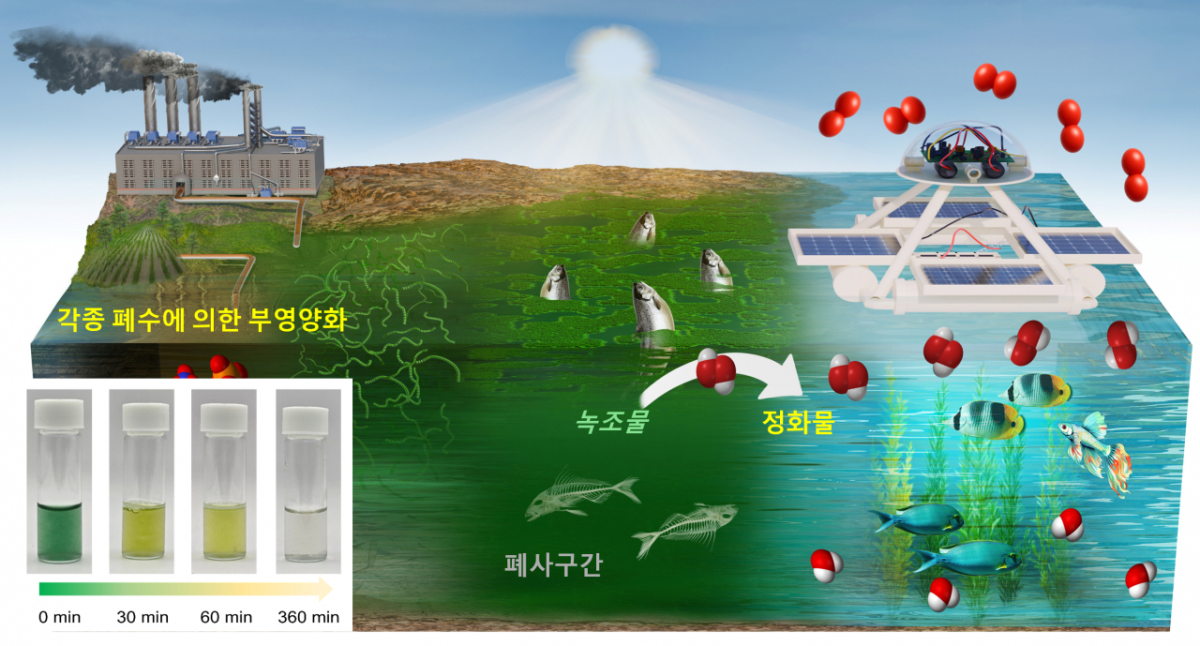
As algae blooms, which cause foul odors, fish deaths, and threaten water quality with toxic substances, continue to worsen annually, the Korea Institute of Science and Technology (KIST) has developed a 'solar-powered autonomous Bang Je (수상) robot' that removes algae using only sunlight.
On the 2nd, KIST announced that its Clean Energy Research Center Oh Hyeong-seok (Dr.) research team, in collaboration with teams from the Extreme Physical Properties Materials Research Center Kim Nam-dong (Dr.) and the Ultra-High Performance Materials Research Center Jo Hye-seong (Dr.), has successfully developed the world's first 'solar-powered autonomous Bang Je (수상) robot' capable of operating solely on sunlight without external power supply or chemical transport.
Previously, algae removal primarily involved workers manually spraying hydrogen peroxide from boats. This method had limitations, including the need to repeatedly traverse large water areas. Additionally, stabilizers added for long-term chemical storage reduced the efficiency of algae removal.
The research team developed a single-atom catalyst with cobalt atoms dispersed one by one onto carbon materials, enabling the on-site synthesis of hydrogen peroxide using only oxygen from the air and water. Using this technology, the resulting hydrogen peroxide was found to improve algae removal speed by up to 1,760 times compared to commercial hydrogen peroxide.
The team integrated this catalyst system with solar panels and a floating device to complete the autonomous Bang Je (수상) robot. KIST confirmed that testing in its internal pond verified the robot's algae removal performance.
This technology can be applied even in reservoirs and dams lacking power infrastructure. By producing hydrogen peroxide on-site as needed without separate chemical transport, it reduces transportation costs and the risk of chemical leaks. KIST plans to expand the scale of the device in the future and broaden its application range to rivers, large urban water bodies, and other diverse environments.
Oh Hyung-seok, a senior researcher at KIST, stated, "This is the result of a collaborative research effort by KIST teams possessing expertise in water purification catalysts, advanced composite materials, and robot control technologies," adding, "We hope it will become a new alternative for future smart water management technologies."
This research was conducted under the support of the Ministry of Science and ICT through KIST's major projects and carbon upcycling initiatives (RS-2022-NR068684), as well as the National Research Council of Science and Technology's Creative Convergence Research Program (GTL25021-210, CAP21011-100). The research findings were published in the latest issue (Volume 386) of the international journal 'Applied Catalysis B: Environment and Energy' (IF 21.1, top 0.6% in JCR field).

 in TECH
