

"G-Star 2026," South Korea's largest gaming exhibition, does not have a game company as its main sponsor. Instead, it is Lyton Technologies, the operator of the AI chat app "Crack." This marks the first time in the event's history that a non-game company has served as the main sponsor.
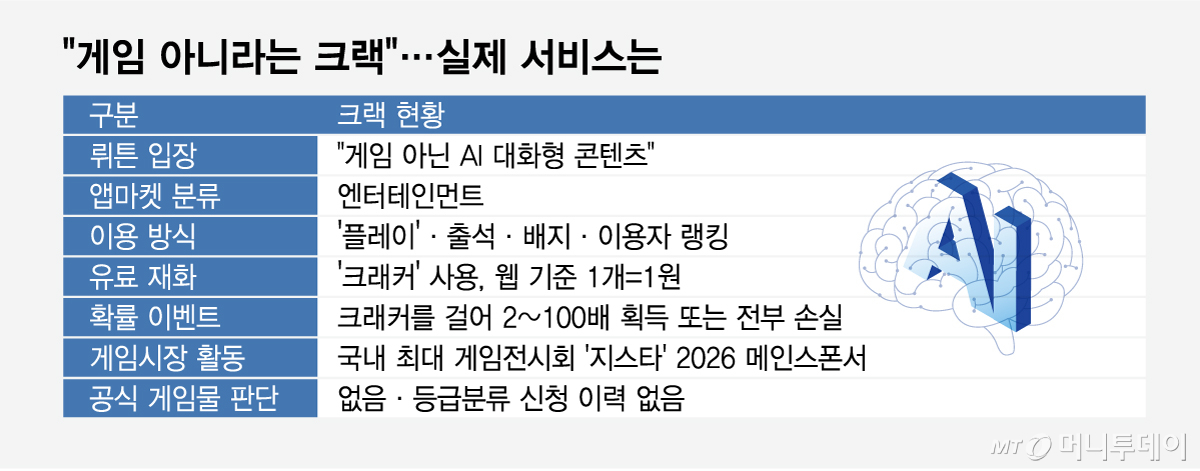
"Lyton defines Crack as an 'AI conversational content service,' not a game. The app is also distributed as 'entertainment' rather than a game on app stores. While sponsoring G-Star alone does not make Crack a game, the fact that a service claiming to be non-gaming has become the face of South Korea's largest gaming event highlights the blurred boundaries."
"The service's grammar also resembles that of games. Crack refers to user actions as 'play,' operates attendance rewards, badges, and user rankings, and uses paid currency called 'Crackers' for conversations, image generation, and advanced chat modes. On the web, one Crack costs 1 won."
"In December last year, the app launched a 'Cracker Baking' event where users could win 2 to 100 times their stake or lose everything based on probability. The event started without age restrictions but was shut down just 19 hours later after receiving user complaints about gambling-like behavior. Lost paid Crackers were refunded not as cash, but as additional Crackers."
"The Game Rating and Administration Committee stated that AI chat functionality alone is unlikely to qualify as a game. However, if paid currencies are used and the acquisition or loss of those currencies is determined by probability, there is a possibility it could be classified as a game. The committee also noted that if financial gains or losses occur, further review would be needed to determine whether it constitutes a gambling-type game."
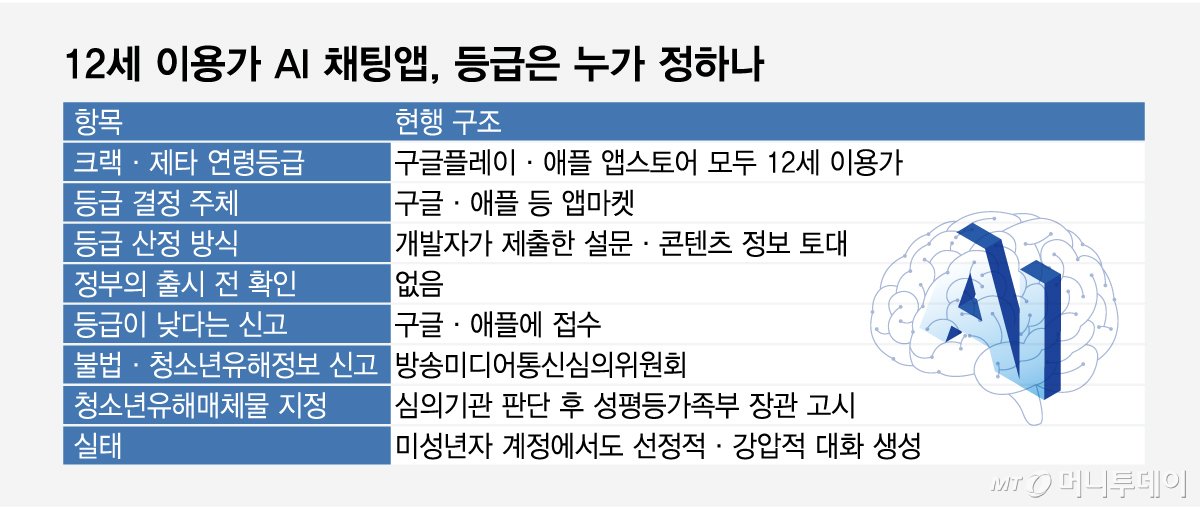
"Crack has never applied for a game rating classification. Neither the Game Rating and Administration Committee nor any other institutional investor has ever evaluated whether the combination of dialogue, storylines, paid currencies, badges, rankings, and probability events qualifies as a game. The current structure means that if a business launches an app as 'entertainment,' there is no trigger for the committee to investigate unless a report or complaint arises."
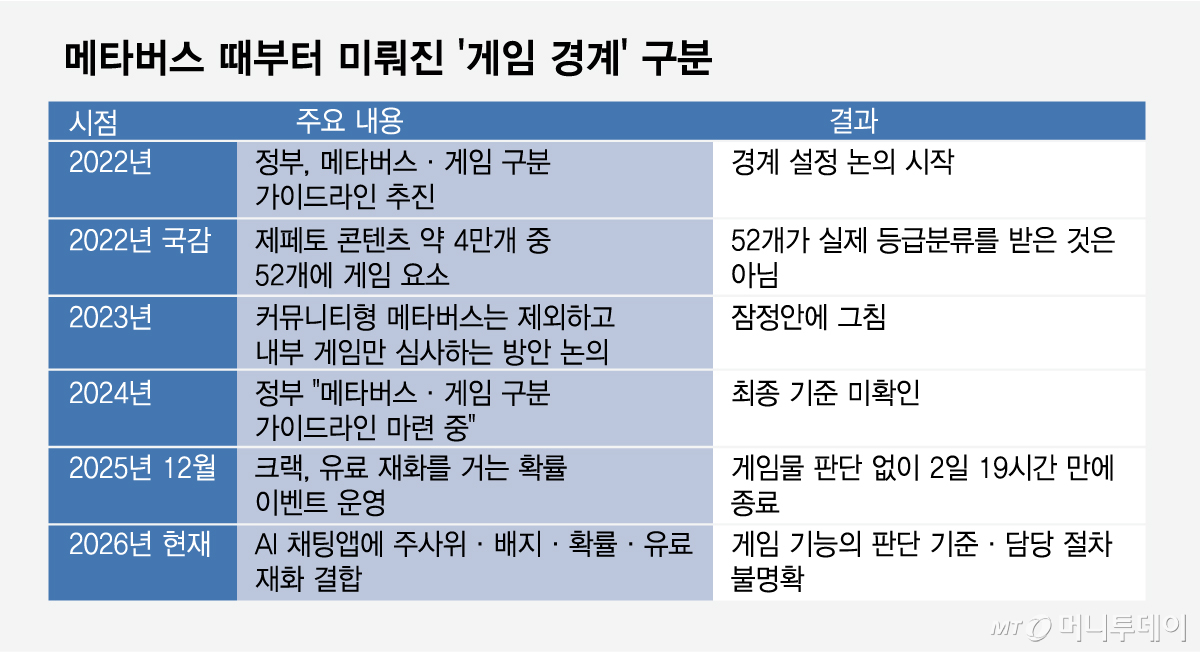
"A similar debate occurred in the metaverse. In 2022, the government announced plans to create guidelines determining whether entire platforms like Zepeto should be classified as games or if only internal game content within them would be reviewed. At the time, Naver Zepeto revealed that out of approximately 40,000 Zepeto contents, only 52 contained game elements, but this did not lead to formal rating classifications. The government stated in 2024 that it was still developing guidelines, and no final public criteria have been confirmed to date."
"There is no need to classify all AI chat apps as games. However, there must be clear criteria for evaluating them based on specific functions: whether they have defined goals and rules, use probability to determine success or failure, involve gaining or losing paid currencies, or encourage repeated participation through rankings and rewards. The 'boundary of games' left unresolved in the metaverse has returned as a task for AI chat apps."

 in TECH


