

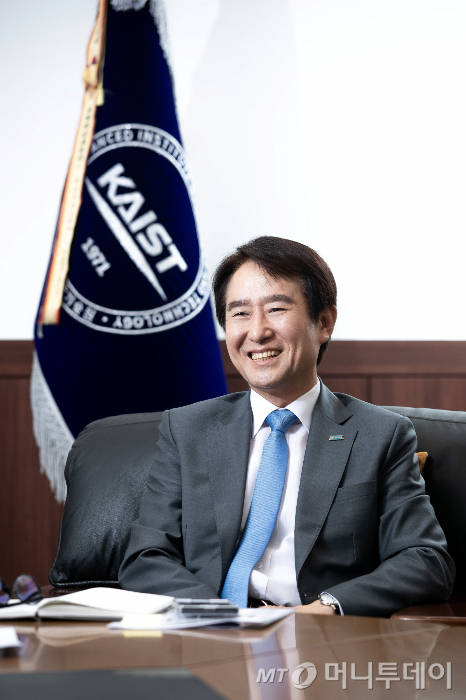
"We will transform the entire KAIST (Korea Advanced Institute of Science and Technology) into an AI-driven institution. All 750 professors at KAIST will become adjunct faculty members of the AI College."
Bae Chung-sik, the 18th President of KAIST, stated during his first press conference held on the 25th in Jung-gu, Seoul, that "a major transformation toward AI will occur across all aspects of KAIST's education and research," previewing a shift to an "AI native campus."
A new system rating AI utilization for all courses will be introduced to expand AI as a common foundation across all disciplines. Additionally, AI autonomous laboratories will be rapidly expanded to strengthen collaboration between research labs and industries. AI will also be integrated into administrative processes to automate complex procedures.
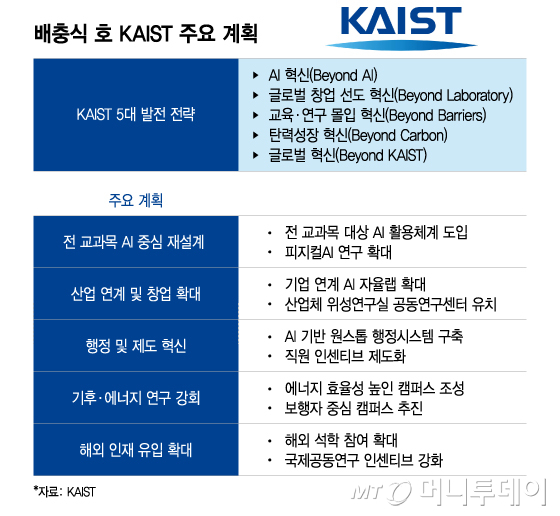
Especially, restructuring the entire undergraduate curriculum around AI, as seen in the AI utilization rating system, marks the first such attempt since KAIST's founding. Courses will be categorized into three levels based on AI usage: "AI Not Used (Free)" to "Fully Utilized with AI."
The "AI Not Used" level excludes AI use to cultivate students' independent thinking abilities. Using AI for assignments and other tasks is prohibited in this category. President Bae explained the rationale by stating, "If students continue to delegate assignments to AI as they do now, they will become people who cannot ask questions. To become autonomous individuals, one must first distance themselves from AI." However, he added that methods of utilizing AI will also be taught toward the end of the semester.
For courses categorized under "AI Extended Area" and "AI-Driven Area," the entire teaching system will be restructured to allow students to learn major subjects using AI. President Bae noted, "Most departments are currently reforming their teaching methods around AI," and added, "The changes will take effect starting from the spring semester next year in March."
Regarding concerns that establishing a specialized AI college last year might have become redundant with the introduction of AI across all courses, President Bae responded, "The AI College will focus on core subjects related to AI." He further stated, "Currently, there are 20 full-time professors and 200 adjunct faculty members in the AI College. In the future, all 750 KAIST professors will become adjunct faculty of the AI College," adding, "There will be no KAIST professor who does not engage with AI going forward."
Additionally, the university plans to expand AI autonomous laboratories through partnerships with domestic and international companies. AI autonomous laboratories are facilities where experimental design, execution, data analysis, and other tasks are automated using AI. President Bae remarked, "Similar cases, such as the AI Technology Center jointly established with NVIDIA, will continue to emerge," noting that agreements are being finalized at a very rapid pace. He also mentioned that a memorandum of understanding (MOU) for establishing autonomous laboratories has recently been signed with a global company in the biochemistry field, though he did not disclose the company's name.
President Bae stated, "The 'first goal' I aim to achieve within my four-year term is 'AI transformation,'" and added, "I will lead all KAIST departments and research laboratories to strive for global excellence."

 in TECH

