

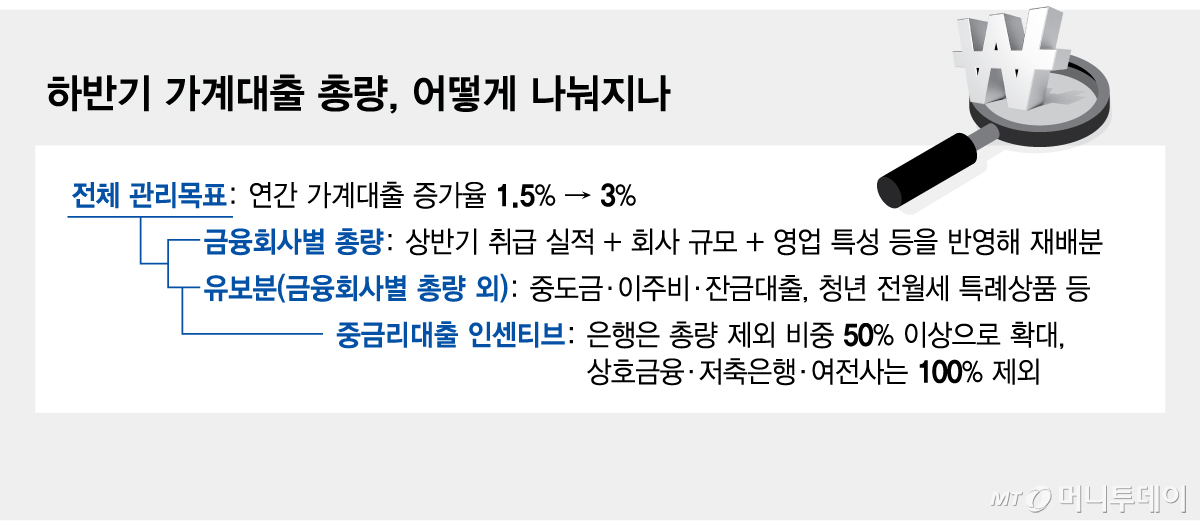
Financial authorities are set to finalize adjustments to the second-half household loan volume targets for each bank this week. This follows the government's decision to expand its management target for household loan growth in the financial sector this year from 1.5% to 3%. The move will allocate additional lending capacity by reflecting first-half loan origination performance, while separately managing funds for actual demand such as group loans and special rental products for youth.
According to the financial sector on the 25th, financial authorities are currently negotiating household loan management targets with individual banks and plan to complete adjustments by the end of this month. As the contours of additional lending capacity per bank take shape, changes are expected from next week in the current trend among banks to curb general mortgage-backed loans and credit loans.
When setting new targets, each bank's first-half household loan origination performance will serve as a key criterion. Banks that relatively faithfully managed their-assigned targets may receive additional capacity, while those that significantly exceeded their targets may see reduced allocations. Discussions will also reflect company size and industry-specific characteristics, meaning more total volume can be allocated to industries with high demand for mortgage-backed loans.
A financial authority official stated, "When setting the total volume, we negotiate based on prior origination performance, company size, and industry-specific characteristics, applying the same criteria this time as well," adding, "We take into account how much each industry handles mortgage-backed loans."
In the financial sector, it is anticipated that KB Kookmin Bank and Shinhan Bank, which have effectively managed total volume controls, will receive relatively more additional lending capacity. However, financial authorities do not disclose how much volume any specific bank will receive. There are also concerns that this could trigger so-called "open runs," where borrowers flock to institutions with greater lending capacity.
Group loans such as interim payment, relocation cost, and final payment loans, along with special rental products for youth, will be managed as policy-reserved funds rather than under each financial company's total volume limit. This aims to prevent loan approvals from being blocked due to individual financial companies' total volume management.
Total volume incentives to increase lending supply to medium- and low-credit borrowers will also be expanded. In the banking sector, the proportion of private mid-rate loan increases excluded from total volume calculations will be raised from 30% to over 50%, with plans to flexibly adjust this ratio according to actual supply trends.
Stronger incentives will apply to the second-tier financial sector. Starting this month, financial authorities have decided to fully exclude private mid-rate loan increases from household loan total volume management targets for savings banks, mutual financial institutions, and specialized credit finance companies. Previously, 80% of mid-rate loan increases were excluded for savings banks and mutual financial institutions, and 40% for specialized credit finance companies; these ratios will now all be raised to 100%.
As a result, even if mid-rate loans increase, the total volume per financial company will not be exhausted, increasing incentives to supply loans to medium- and low-credit borrowers while also allowing some additional capacity for other loan types such as general mortgage-backed loans and credit loans.
Financial authorities plan to continue regularly monitoring household loan origination by each financial company even after completing target adjustments this month, with plans to flexibly manage mid-rate loan incentives and similar measures.

 in FINANCE
