

[For more diverse information on startups mentioned in this article, visit the Unicorn Factory big data platform 'Data Lab'.]
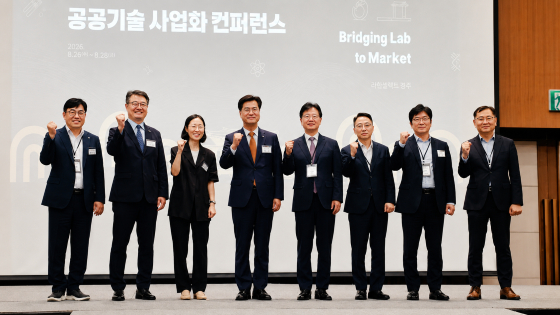
"Public research institutes should not remain merely as entities that transfer technology but must become 'venture builders' that create companies." (Choi Chi-ho, Korea Science & Technology Holdings)
Held over three days starting from the 26th at LaHan Select in Gyeongju, North Gyeongsang Province, the '2026 Public Technology Commercialization Conference (PTC Korea 2026)' featured ongoing discussions identifying barriers to technology transfer and commercialization of public R&D outcomes and exploring new solutions.
Hosted jointly by the National Research Council of Science and Technology (NST) and the Korea Association of Technology Transfer from Research Institutes (KARIT), this event brought together representatives from the Ministry of Science and ICT, TLOs (Technology Transfer and Commercialization Dedicated Organizations) of 23 government-funded research institutes under NST's jurisdiction, universities, technology holding companies, commercialization-focused institutional investors, and private sector executives.
The conference operated eight tracks: Value Design, Policy Cooperation, Entrepreneurship, IP, Intelligent Innovation for TLOs, TLO-led Technology Commercialization, Technology Convergence Innovation, and Collaboration. Topics included activating deep-tech startups, establishing academic-industry-private collaboration governance, responding to the Unified Patent Court (UPC), and supporting AI-based commercialization initiatives.
During the first-day presentation themed 'Redesigning Technology with Market Language,' participants consistently emphasized that "it should not end merely at creating technology."
Min Byung-kwon of NST Yeon Gu-jeon-ryak (Head) proposed a model where researchers do not become CEOs directly but instead form startup teams with professional managers and postdoctoral fellows. Having led major technology transfers while researching artificial photosynthesis and carbon dioxide conversion technologies at the Korea Institute of Science and Technology (KIST), he suggested, "Let us establish tracks for entrepreneurship starting from the graduate school level to create a structure where excellent researchers' technologies naturally flow into companies."
Choi Chi-ho, CEO of Korea Science & Technology Holdings (KST) , stressed that public research institutes must evolve beyond being 'technology transfer institutional investors' into 'engines for company creation.' Choi (CEO) questioned, "Why are there so many technologies but no global champions?" and proposed 'Lab to Impact,' a strategy of building companies based on research institutes' technologies, patents, and human resources for long-term growth.
Lim Moon-taek, Director of the Daejeon Research & Development Complex Headquarters, identified 'connectivity' as a key condition for deep-tech startups to survive after founding. He explained, "Since deep-tech commercialization takes several years to over a decade, technology, human resources, capital, trust, on-site validation, and industrial ecosystems must interlock. The core lies in the flow where research institute technologies are transferred to companies, companies invest, and these efforts connect back to on-site industrial validation."
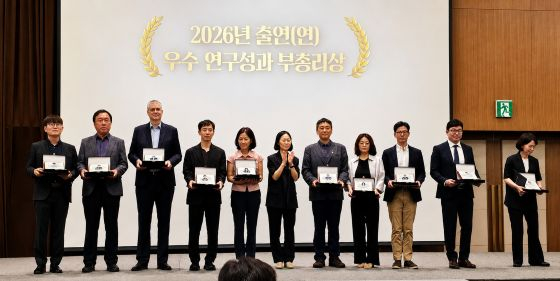
The 'Public Research Institutes' Outstanding Achievements Award Ceremony,' which honors outstanding research outcomes and technology commercialization achievements of public research institutes, was also held. The Ministry of Science and ICT's Deputy Prime Minister Award was given to 10 'Representative Research Outcomes of Public Research Institutes,' while NST Lee (President) Awards were presented to 7 Ji Yeok-jo-jik (CEO) research outcomes and 2 outstanding technology commercialization achievements.
Selected as 'Representative Research Outcomes of Public Research Institutes' were: development of a next-generation nano-body-based precision cancer treatment platform (Korea Research Institute of Bioscience and Biotechnology), development of core materials for next-generation green hydrogen production (KIST), and fabrication technology for large-area perovskite solar cells using printing processes (Korea Research Institute of Chemical Technology).
Selected as 'Ji Yeok-jo-jik (CEO) research outcomes' were: removal technology for non-biodegradable trace pollutants in industrial discharge water based on low-energy underwater plasma (Plasma Technology Research Institute, Korea Fusion Energy Research Institute), AI-based new drug candidate exploration platform (KIST Gangneung Branch Natural Products Research Institute), and protein aggregation control technology to overcome intractable diseases (Ochang Bio & Environment Research Institute, Korea Basic Science Institute).
In the Outstanding Technology Commercialization Achievements category, two institutional investors were recognized: K-APEX humanoid technology transfer (KIST) and IP monetization through non-patent IP sales (Korea Atomic Energy Research Institute).
Kim Young-sik of NST Lee (President) stated, "We will actively support the dissemination and commercialization of outstanding research outcomes from public research institutes so they do not remain confined to laboratories but lead to new value for industry and society." Yoon Kyung-sook, Director of Basic and Frontier Research Policy at the Ministry of Science and ICT, added, "We will strengthen institutional foundations to enable researchers to actively challenge activities such as laboratory startups and technology transfer for outcome dissemination, and reinforce the commercialization support system."
[MoneyToday startup media platform Unicorn Factory]

 in TECH

