

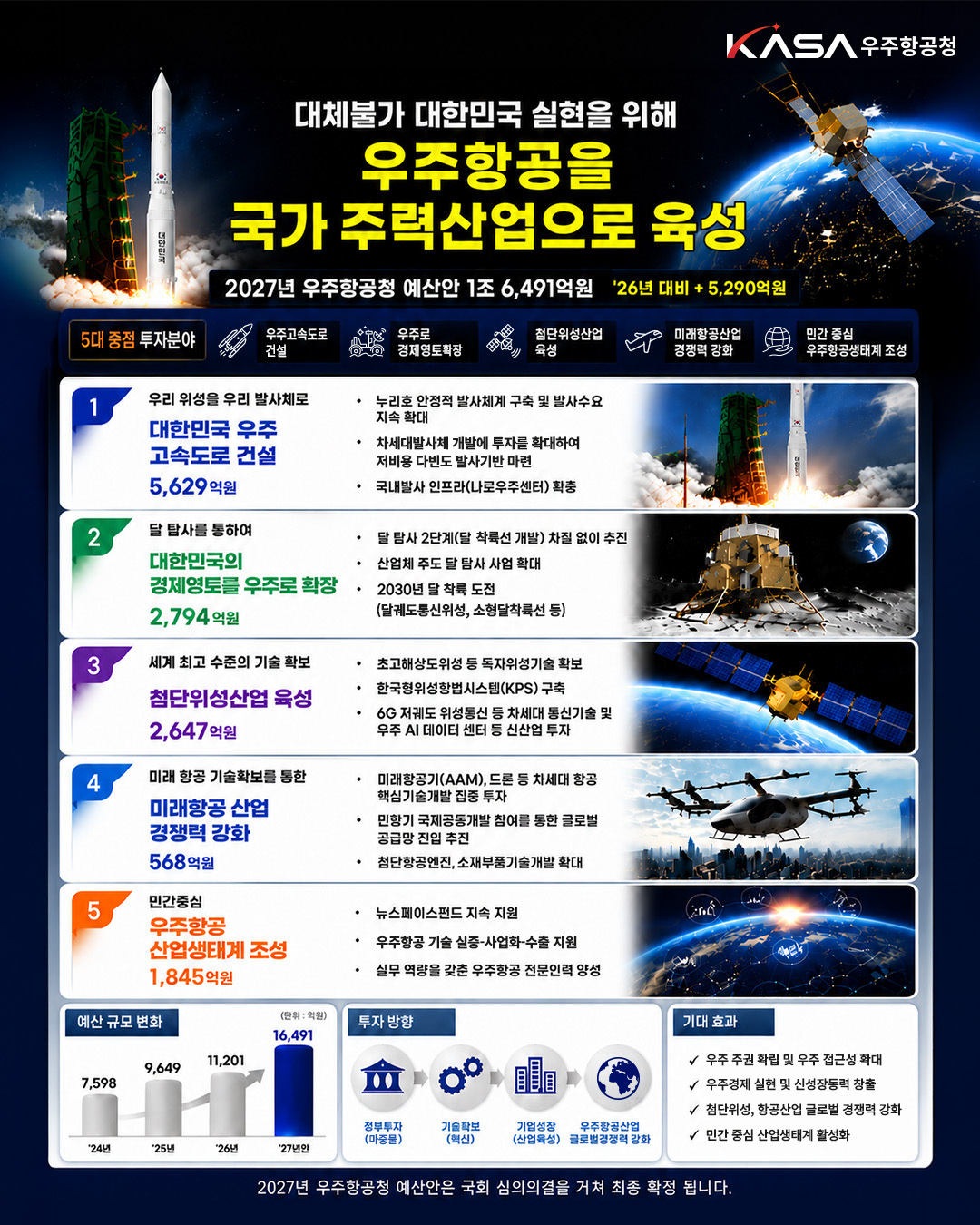
The government will invest 1.6491 trillion won in space and aviation next year to strengthen capabilities in launch vehicles and lunar exploration.
The Space Agency announced on the 1st that it has compiled the 2027 government budget proposal at 1.6491 trillion won, an increase of 529 billion won compared to the previous year.
The five key investment areas for the Space Agency are: △launching our satellites with our launch vehicles (launch vehicles), △expanding space economic territory (lunar exploration), △fostering advanced satellite industries, △strengthening competitiveness in future aviation industries, and △creating a private-sector-centered industrial ecosystem. The goal is to connect accumulated technological capabilities in launch vehicles, exploration, satellites, and aviation into industrial competitiveness.
A total of 562.9 billion won will be invested in the launch vehicle sector, representing a 113.8% increase from the previous year. First, 75 billion won will be allocated to support follow-up launches for Nuriho. This project aims to resolve launch gaps after the 6th Nuriho launch in 2027 by proceeding with the 7th and 8th launches. Through this, the agency plans to establish a regular launch system of at least once per year and challenge the medium-to-long-term goal of conducting two to three or more launches annually.
Next year, 291.6 billion won will also be invested in the Next-Generation Launch Vehicle Development Project, which transitions existing disposable launch vehicles into reusable ones. Additionally, 25.3 billion won is planned for the Naro Space Center Modernization Project (Phase 3), which involves replacing aging equipment at the Naro Space Center launch pad and newly constructing a large assembly hall and test building.
The budget for lunar exploration has also increased significantly. The 2027 lunar exploration budget proposal stands at 279.4 billion won, approximately three times (180.1%) higher than the previous year.
Development of a 500kg-class demonstration lunar orbit communication satellite scheduled for launch in 2029 will begin with an investment of 130 billion won. In addition, 5.6 billion won will be newly invested in 'Lunar Surface Mission Payload and Mobility Technology Development' to advance mobility technologies on the lunar surface. Next year, 106.3 billion won will also be allocated to initiate development of a privately-led 'small lunar lander' scheduled for launch in 2030. The second phase of the lunar exploration project, which began in 2024, will continue with an investment of 93.7 billion won next year.
Furthermore, 264.7 billion won will be invested to secure advanced satellite technologies and build an industrial ecosystem. A new project for developing geostationary orbit environmental and marine satellites to strengthen national security and precision monitoring capabilities for climate and disasters will receive 28.5 billion won. The Multi-Purpose Practical Satellite No. 8 and the Korean Positioning System (KPS) will continue with investments of 56.5 billion won and 46.5 billion won, respectively, next year. Additionally, 2.1 billion won will be invested to develop high-efficiency large-capacity heat dissipation technologies and core power control technologies aimed at building a 'Space AI Data Center.' This is also part of the strategic research project of the Korea Aerospace Research Institute.
56.8 billion won will be invested in the aviation industry. The focus is on supporting domestic companies to enter the global aircraft supply chain and securing core technologies for future mobility. Next year, 2 billion won will be newly allocated to prepare a foundation for participation in 'International Joint Development of Civil Aircraft.' A total of 12.7 billion won will be invested in 'Development of Core Materials and Components Manufacturing Technology for Advanced Aviation Engines' to achieve domestic production of aviation engines, and in 'Development of Electric-Turbine HYBRID Propulsion Systems' to secure eco-friendly and high-efficiency propulsion systems. Additionally, 3.1 billion won will be invested in developing core technologies for drones based on public demand and counter-drone (drone detection and tracking) technologies.
For growth funding for the domestic space and aviation industry, 184.5 billion won has been allocated. The New Space Investment Support Project for space and aviation startups will receive 100 billion won next year, the same amount as the previous year. Additionally, plans include investing 1.5 billion won in space technology demonstration support and 6.1 billion won in cultivating talent in the space sector.
Oh Tae-seok (Commissioner) stated, "The 2027 budget proposal focuses not only on government-led technological development but also on connecting it to corporate growth and industrial competitiveness." He added, "We will do our utmost to strengthen competitiveness in space transportation, space exploration, advanced satellites, and future aviation fields, and to achieve a great leap forward for the Republic of Korea's space and aviation industry."
The 2027 Space Agency budget proposal will be finalized through approval by the National Assembly plenary session after undergoing review.

 in TECH

