

Hundreds of billions in fines overturned by courts... IT companies miss the 'golden time' due to regulations
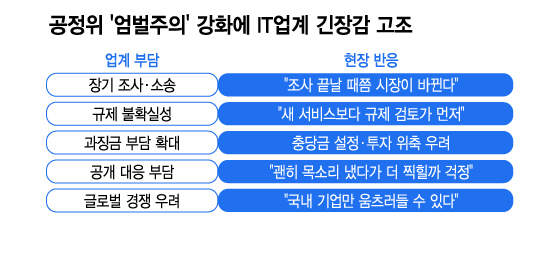
"Platforms change monthly, yet the impact of regulations from years ago remains. When launching new services, there is a trend of prioritizing regulatory risk over innovation."
This was said by an executive at an IT company. The Fair Trade Commission's strict punitive stance is spreading across the platform and AI markets. Even when hundreds of billions in fines are overturned by courts, it takes years to reach a conclusion. Industry voices say that during this time, investments and new business ventures come to a halt.
According to the IT industry on the 6th, the Korea Fair Trade Commission has been conducting market surveys since May against 29 AI developers and 17 companies providing products equipped with AI. In July, it also began consumer surveys. A bill to amend the Fair Trade Act, raising the cap on fines for abuse of market dominance from 6% to 20% of sales and collusion from 20% to 30%, has been submitted to the National Assembly.
IT companies that clash with the Korea Fair Trade Commission lose time regardless of whether they win or lose. Naver received a fine of 267 billion won in October 2020 for allegedly favoring its own products in shopping search results. The Seoul High Court sided with the Korea Fair Trade Commission, but the Supreme Court last October sent the case back, noting that algorithm adjustments could be considered normal business activities. The retrial has been ongoing for five years and ten months since the penalty was issued.
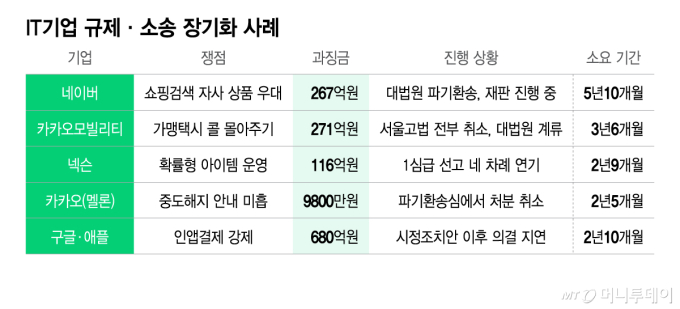
Kakao Mobility received a fine of 271 billion won in February 2023 for allegedly funneling calls to franchise taxis, which accounted for 70% of its operating profit that year. The Seoul High Court overturned the entire penalty last May, but the Korea Fair Trade Commission appealed. Three years and six months after the penalty was issued, no conclusion has been reached yet. Nexon was assessed a fine of 116 billion won in January 2024 over issues with probability-based items in MapleStory. Controversy arose regarding retroactive application, questioning whether operations were judged by current standards before the mandatory disclosure of probabilities was introduced. The Seoul High Court's verdict has been postponed four times since last December and is now scheduled for October 28. It has been two years and nine months since the penalty was issued.
According to industry sources, the Korea Fair Trade Commission returned a total of 106.5 billion won in fines to companies from January to July this year, surpassing last year's annual refund amount of 69.8 billion won. The amount withheld by courts pending collection stands at 453 billion won, 2.4 times the figure for last year (187.6 billion won). The total amount assessed during the same period was 1.3527 trillion won, four times that of last year.
An IT industry official stated, "Large-scale fines and long-term investigations and lawsuits have placed a significant burden on new business investments and global expansion strategies," adding, "During the period when investigations continued, technological advancement stagnated, and time to build future AI competitiveness was lost." Another platform industry official said, "The problem is that while regulatory standards and boundaries remain unclear, only the intensity of post-facto sanctions continues to increase."
"There's a risk of bankruptcy" under severe sanctions... National Assembly joins 'fine hike' relay
While President Lee Jae-myung has called for strict responses to corporate unfair practices, the political sphere's "severe punishment" stance is also becoming stronger. The government maintains that it will pursue support for advanced industries such as semiconductors and AI separately from sanctions against market unfair practices, but concerns are being raised that a "mismatch" between policies could emerge as the burden on companies to respond to regulations grows.
According to Cheong Wa Dae on the 6th, President Lee Jae-myung has repeatedly warned since taking office that severe sanctions must follow without exception for corporate unfair practices such as collusion. He also issued instructions to relevant ministries emphasizing the need to thoroughly recover ill-gotten gains from illegal acts, significantly increase fines, and apply a zero-tolerance principle.
During the State Council meeting on March 10, there was strong criticism of unfair practices such as corporate collusion and price gouging using monopolistic positions, with warnings that "companies could go bankrupt." In response, the Fair Trade Commission strengthened its system last June by abolishing the cap on reward money for whistleblowers and allowing rewards up to 10% of fines. At the senior officials' meeting on the 20th of last month, President Lee again emphasized that practices such as hoarding, collusion, stock manipulation, and improper use of national funds should be classified as "economic order disruption acts" because they cause very serious harm to people's lives and require more concentrated responses.
In addition to strengthened regulation and supervision by authorities, the National Assembly is also accelerating legislation to raise fine amounts. A representative case is the amended Personal Information Protection Act, which passed the National Assembly last December and took effect on the 11th of this month. It allows for fines of up to 10% of sales if violations are repeated within three years or if personal information of more than 10 million people is leaked. From a corporate perspective, if a fine amounting to 10% of sales is imposed, it would be large enough to raise concerns about the very survival of the business.
The so-called "three laws" containing provisions to raise fines for unfair trade practices are also drawing attention from companies. Representative examples include the amended Advertising and Display Act, Subcontracting Act, and Large-Scale Retail Business Act, all proposed by the Democratic Party of Korea. The amendment to the Advertising and Display Act includes raising the fine cap from 2% to 10% of relevant sales. The amendment to the Subcontracting Act allows for fixed fines of up to 10 billion won for unfair practices where subcontracting payment calculations are difficult. The amendment to the Large-Scale Retail Business Act also primarily focuses on raising fine amounts.
There is little disagreement that companies violating laws despite causing massive harm to consumers should face strengthened sanctions simply because "fines are cheap." The problem arises when the political sphere's competitive severe punishment stance combines with excessive investigations or penalties by regulatory agencies. A ruling party official stated, "When fine amounts become large, it is true that companies become nervous at the slightest gesture from regulatory agencies," adding, "Just hearing news of an investigation review requires deploying personnel and costs to respond, and if administrative lawsuits proceed, business uncertainty increases further."
Companies argue that these costs can become a burden in situations where they must 'go all-in' on innovation. The Lee Jae-myung government emphasizes active corporate investment in advanced industries such as AI and semiconductors and strengthening global competitiveness. From the companies' perspective, funds and personnel that should be invested in research and development (R&D) could be tied up in responding to regulations and preparing for lawsuits. A business association official said, "Simply raising fine amounts does not create a fair market," adding, "It is time for policies of mutual prosperity that thoroughly recover profits gained through illegal acts while encouraging companies to compensate victims themselves and improve internal control systems."
Beyond 'squeezing corporate cash flow' toward victim recovery... Solutions to reform fine administration

There are many voices calling for regulatory agencies such as the Fair Trade Commission to move beyond the so-called "squeezing corporate cash flow" and "stigmatization" driven by fines, and instead lead to actual victim recovery and structural improvements. The logic is that while fines serve as a means to deter legal violations and recover ill-gotten gains, they cannot directly lead to victim compensation or concrete measures to prevent recurrence on their own.
According to the legal community on the 6th, the Korea Fair Trade Commission imposed administrative fines totaling 93 cases, amounting to 1.352795 trillion won from January to July this year. This is approximately four times last year's annual assessment of 340.173 billion won and about 2.3 times the average annual assessment from 2021 to 2025. In April, the Korea Fair Trade Commission revised its fine announcement to strengthen economic sanctions by raising the lower limit of assessment rates and the weighting criteria for repeated violations. This is based on the judgment that if the profit gained from violating the law is smaller than the loss from sanctions, it will be difficult to eliminate corporate incentives to violate the law.
Some in the legal community argue that the effectiveness of sanctions should not be judged solely by the amount and number of fines imposed. While sufficient fines are necessary for serious violations, the mere fact that a fine has been imposed does not mean that damage has been recovered or that improper trading practices have been corrected.
In reality, since fines go into the national treasury, they are not paid directly to affected companies or consumers. If companies appeal, the finalization of penalties is delayed, and victim recovery measures related to them must inevitably be delayed as well. Fine collection can also be delayed, and litigation costs can increase. As of the end of July, the amount of fines imposed by the Korea Fair Trade Commission that has been withheld from collection due to court orders suspending enforcement stands at 453.078 billion won.
Baek Kwang-hyun, a lawyer at Baem Law Firm specializing in the Fair Trade Act, stated, "If the profit gained from violations exceeds sanctions, illegal acts may be repeated, so sufficient deterrent power is needed," while adding, "Fines should be determined considering the circumstances of each case, such as the nature of the violation and the company's financial status." The point is that imposing maximum-level fines uniformly without examining individual circumstances could raise issues regarding corporate survival and the fairness of sanctions.
One proposal to complement the limitations of fine-centered sanctions is to activate the consent resolution system. Consent resolution is a procedure where a company under investigation by the Korea Fair Trade Commission proposes measures for victim relief and trading structure improvements, and the Korea Fair Trade Commission reviews their validity to close the case. Once consent resolution is finalized, the Korea Fair Trade Commission does not determine whether the company violated the law. Instead, the victim relief and prevention measures proposed by the company become legal obligations. If the company fails to fulfill its promises, the Korea Fair Trade Commission can revoke the consent resolution and resume deliberation on the previously suspended case.
Chae Yong-hyun, managing partner of Pentagon Legal, Tax & Accounting, stated, "Fines are not a system for collecting money but an auxiliary means to fulfill the objectives sought by the Fair Trade Act, so there is no disagreement that they should be as heavy as necessary for deterrence," while adding, "The problem is that their weight flows only into the national treasury and does not branch out into victim relief or prevention of recurrence. It is important not just for the amount of fines to be high or low, but for companies to rebuild systems so that the same incidents do not repeat."
Overseas regulatory authorities are also utilizing agreement-based case closure methods that make corporate corrective commitments legal obligations instead of disputing legality. In the United States, Meta (formerly Facebook) recently agreed to settle a civil lawsuit with the government over alleged harm to teenagers' social media use. Had the trial continued, it was expected that four states including California would demand civil penalties totaling approximately 200 billion dollars (about 274.8 trillion won). However, Meta has agreed to pay between a minimum of 12.1 billion dollars (about 16.6254 trillion won) and a maximum of 17.1 billion dollars (about 23.4954 trillion won). Additionally, it has committed to limiting teenagers' usage time to two hours per day, blocking nighttime access, verifying ages, and implementing independent audits.

 in TECH


