

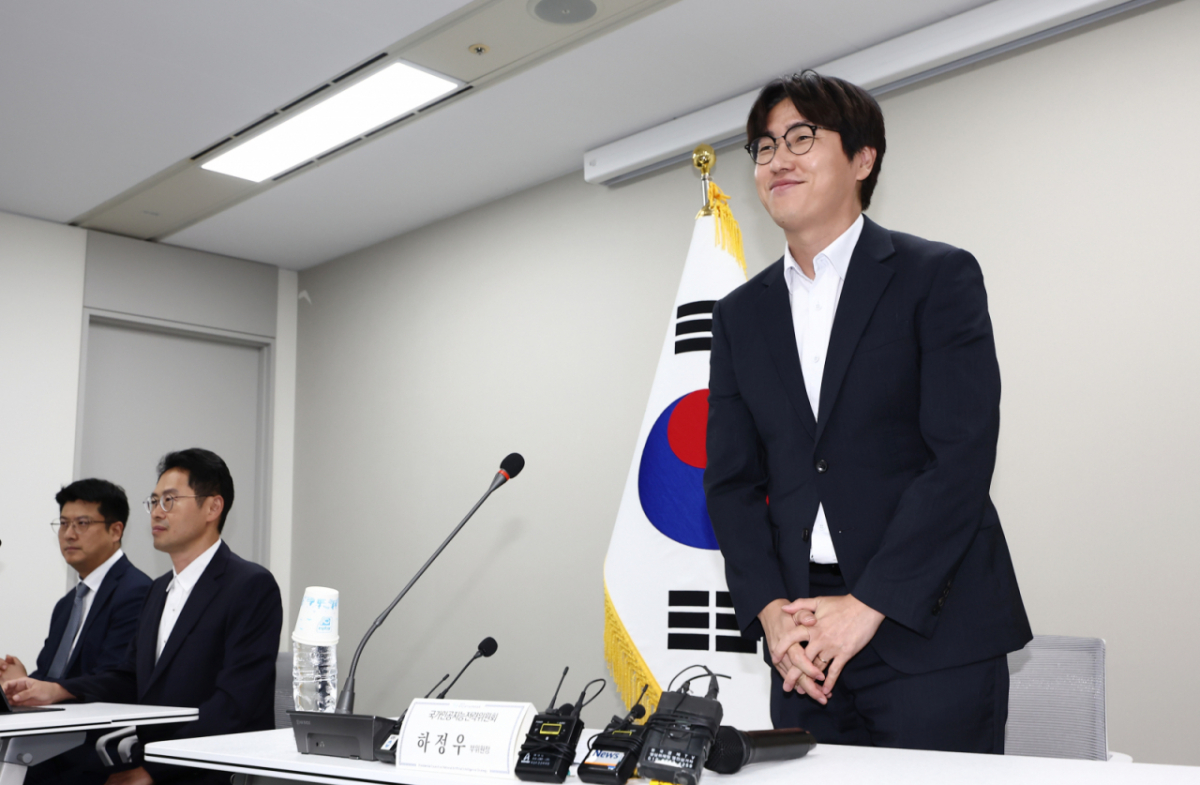
"The second-term committee will work harder to connect capabilities across ministries and sectors and resolve obstacles faced on the ground."
On the 8th, Ha Jeong-woo, permanent deputy chairperson of the National Artificial Intelligence Strategy Committee, stated at the "One-Year Performance Report on the Inauguration of the Committee" held at Seoul Square that "it is important to turn the foundations established over the past year into changes that citizens and businesses can feel," expressing his ambition.
This performance report was organized to inform the public of the committee's achievements on its first anniversary and to share future policy directions for building an AI Daejeon-hwan in the Republic of Korea. Attending were Ha Jeong-woo, permanent deputy chairperson; Lee Hae-min, AI Future Planning Chief; Im Moon-young, a member of the National Assembly; 10 division committee chairs; two special committee chairs; TF leaders; and over 150 private members.
The National AI Strategy Committee was launched on September 8 last year as the command tower directing South Korea's AI policy. Rather than serving merely as an advisory body, it was established under the direct authority of the President to oversee and coordinate cross-ministerial AI strategies, policies, and projects. The deputy chairperson has been responsible for inter-ministerial collaboration and committee operations.
Following Im Moon-young's candidacy for a seat in the National Assembly, the position of permanent deputy chairperson for the second term remained vacant until Ha Jeong-woo, former inaugural Cheong Wa Dae AI Chief, was selected at the end of last month. With former Chief Ha taking on the role of deputy chairperson alongside figures symbolizing the AI policies of the Lee Jae-myung administration, expectations are high that the scope of activities for the AI Strategy Committee will expand further.
For one year since its launch, the AI Strategy Committee has served as the highest command tower for South Korea's AI policy, connecting private-sector expertise with government policy capabilities and supporting the formulation of national AI strategies and the coordination and implementation of key policies across ministries and sectors.
A representative example was the confirmation in February of the "Republic of Korea Artificial Intelligence Action Plan," which consists of 99 execution tasks and 326 policy recommendations under three major policy axes and 12 strategic areas aimed at achieving "Leap to Three Major AI Powers." Additionally, over the past year, each division, special committee, and TF monitored progress on their respective tasks and further refined policy measures.
On this day, Ha Jeong-woo, permanent deputy chairperson, evaluated that "as global AI competition expands into a nationwide all-out effort influencing industry, security, and growth, South Korea has the potential to build an AI full-stack ecosystem based on its AI technology, infrastructure, and manufacturing competitiveness." He further explained that over the past year, the committee has laid the groundwork for implementing the AI Daejeon-hwan through the establishment of the "Republic of Korea AI Action Plan" via the AI Strategy Committee, coordination of government-wide AI policies, and planning and verification of government AI fiscal investments.
Looking ahead, he plans to continuously enhance the "Republic of Korea AI Action Plan" under the second-term committee, expand new growth opportunities through AI for regions and youth, and focus on global cooperation. In particular, the committee will strengthen coordination and collaboration between policies and projects to ensure that large-scale cross-ministerial AI projects such as the three mega-projects and seven SEED projects are implemented organically, and will operate the committee with a focus on projects and outcomes.
Deputy Chairperson Ha stated, "The committee will support South Korea's leap to become an 'Irreplaceable Global AI Core Supply Chain Nation' while realizing an 'AI for All' where every citizen of the Republic of Korea can share in the opportunities and benefits of AI."

 in TECH
