

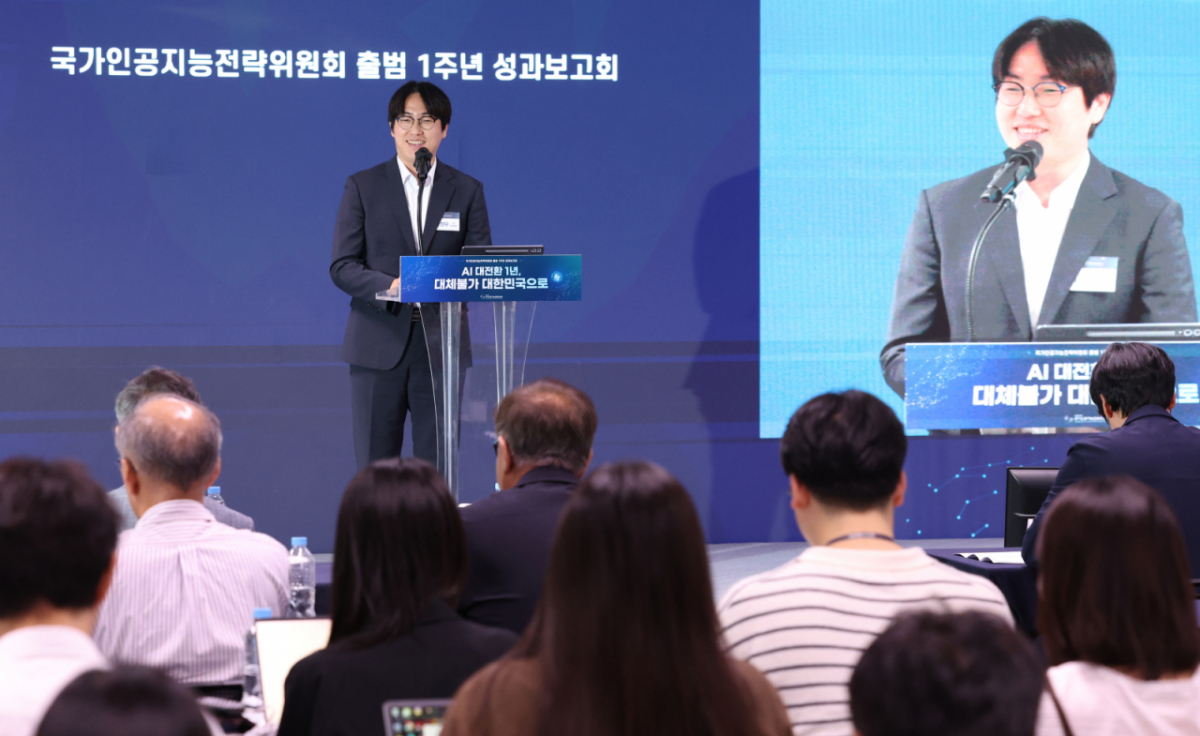
"Over the past year, securing GPUs (graphics processing units) has been the most impactful achievement. Many startup founders who struggled due to the high cost and scarcity of GPUs are now extremely pleased."
Ha Jeong-woo, Permanent Deputy Chairman of the National Artificial Intelligence (AI) Strategy Committee, identified GPU supply as the most impactful strategy over the past year during the 'One-Year Performance Report Meeting' held on the 8th at Seoul Square to mark the committee's first anniversary.
Deputy Chairman Ha stated, "While we may not have achieved visible results that citizens can directly feel after one year of building foundational infrastructure, many developers who previously wanted to conduct research but could not due to GPU shortages are now experiencing tangible benefits." Shin Jin-woo, professor at KAIST and head of the Technology Innovation and Infrastructure Sub-committee of the AI Strategy Committee, strongly agreed with this assessment.
Sub-committee Chairperson Shin remarked, "This year, we developed a robot foundation model that surpassed NVIDIA's capabilities. If more GPU support is provided, we can achieve even more beyond just robotics foundation models," eliciting laughter from the audience as he addressed Deputy Chairman Ha.
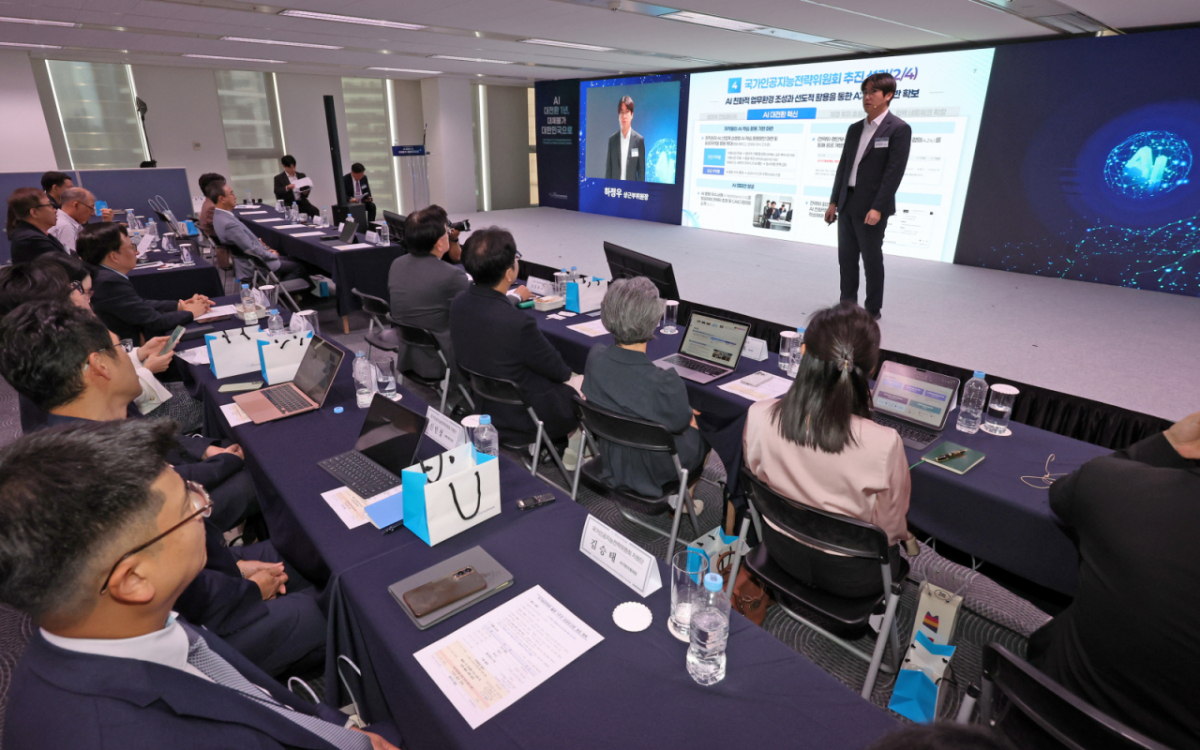
One year after launching as a direct institutional investor under the National AI Strategy Wi Won-hoe-ga (President), the committee has grown to include 10 sub-committees, 2 special committees, and 1 task force (TF). Deputy Chairman Ha emphasized, "Even if ministries develop excellent plans, technical support or implementation processes may encounter disputes. In such cases, the AI Strategy Committee can resolve disagreements by leveraging the experience and capabilities of private sector experts to co-create results."
He further highlighted that unlike other advisory bodies such as the Digital Platform Government Committee, the AI Strategy Committee possesses actual policy execution power. "I served as a sub-committee chairperson during the Digital Platform Government Committee era," he noted. "Unlike then, the current AI Strategy Committee has systems in place to evaluate other organizations and review budget planning procedures, enabling effective implementation."
He also expressed his ambition for South Korea to leapfrog as an irreplaceable global AI core supply chain nation capable of exporting AI full-stack solutions. Deputy Chairman Ha stated, "The idea of exporting AI full-stack solutions is being pursued not only by the U.S., China, France, and UAE but also by us. What matters most is accelerating commercialization through industrial applications, and rapidly integrating our strength in manufacturing with AI."
Following National Assembly Member Im Moon-young, he assumed the role of the second-term AI Jeon Ryak-wi (Director). Previously serving as the inaugural AI Future Planning Chief Strategist under President Lee Jae-myung's administration, Deputy Chairman Ha ran for a special election to the National Assembly but was unsuccessful. He was appointed deputy chairman of the AI Strategy Committee at the end of last month and has resumed leading the government's AI policies. "I view 2030 as the golden window for AI diffusion," he said, emphasizing that maintaining consistent policies until then is critical.
Regarding intensifying global AI competition, he stressed that beyond government efforts, corporate initiatives to expand AI adoption are also necessary. Deputy Chairman Ha noted, "Among independent AI foundation model companies, some have already uploaded their models to 'OpenRouter' for global use. We cannot rely solely on the government; we must consider a direction of expanding AI through collaboration with enterprises."
On the topic of "AI for All," he argued that initially, the government should nurture industries by providing vouchers, followed by citizens gradually paying small fees (e.g., 1,000 or 2,000 won) once they find the services beneficial, enabling self-sustainability.
He also shared his busy schedule since becoming deputy chairman of the AI Strategy Committee. Although appointed only about a week ago, he has been holding daily morning meetings with sub-committee chairpersons starting at 7 a.m. to quickly grasp operational details.
On this day, each sub-committee shared its achievements over the past year and outlined future goals.
△The Technology Innovation and Infrastructure Sub-committee proposed securing advanced GPUs for building global frontier AI models and "AI for All." It also supported establishing systems for efficient use of national AI computing resources, included domestic NPUs (neural processing units) in the AIDC national strategic industry plan for three mega-projects, and legislated incentives to attract AIDCs outside the capital region.
△The Science Sub-committee formulated the "National Strategy on Science and Technology × AI" last November and established the "K-Shot Promotion Strategy" in February this year. It also supported the launch of the National Science-AI Research Center (NAIS). Within the sub-committee, the Basic Medical AI subgroup supported the formulation of an "AI Basic Medical Strategy," planning to demonstrate and expand a one-stop AI platform for securing golden time for emergency patients and extend public medical AI highways in the future.
△The Industry AX & Ecosystem Sub-committee developed the "Manufacturing AI 2030 Strategy," "Humanoid Industry Ecosystem Creation and Expansion Plan," and "Autonomous Driving AI Demonstration and Commercialization Roadmap." Notably, it increased autonomous driving demonstration cities from one to six. In the future, it will support the "2030 Global AI Decacorn (startups valued over $10 billion) Enterprise Incubation Plan" and the "Daejeon Hub Plan for Transportation and Logistics AI Centered on Autonomous Driving."
△The Public AX Sub-committee supported early implementation of an AI-based integrated citizen service platform, while the Data Sub-committee established guidelines for AI-friendly management of public data, including converting HWP files (which AI cannot recognize) into HWPW format.
△The Social Sub-committee formulated the "Basic Plan for Employment Stability During Industrial Transition" and plans to strengthen policies for inclusive, human-centered AI in the future. △The National Defense & Security Sub-committee built a national defense data catalog and expanded the Ministry of National Defense's AI organization. It will support the prompt enforcement of the National Defense AI Act going forward.
△The Global Cooperation Sub-committee launched an inter-ministerial consultation body for global AI governance in June and began establishing a national AI standardization governance system. It will continue AI policy cooperation with foreign countries. △The Education & Talent Sub-committee is promoting AI talent development programs, while the AI Democracy Sub-committee supports strategies to realize the world's best AI democratic government and plans to lead global discussions on AI democracy by developing a prototype of the "AI Public Forum."
Deputy Chairman Ha concluded, "I am grateful to citizens who have shown interest in AI. Over the past year, we have built foundations that will translate into tangible changes for citizens and enterprises. We will break down barriers between ministries and sectors to connect necessary capabilities."

 in TECH

