

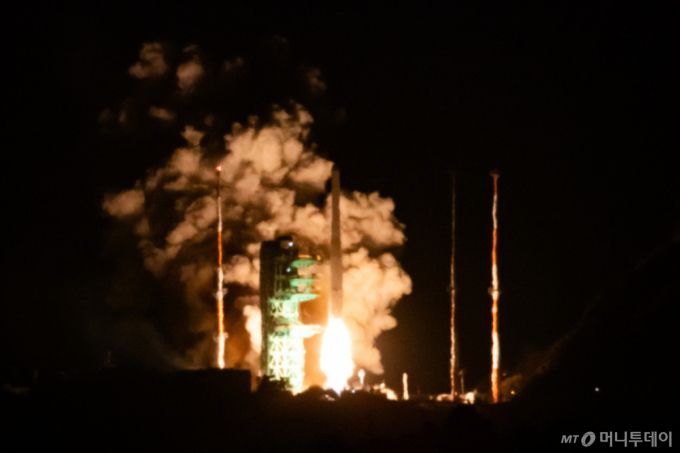
With the 'Korean Launch Vehicle' Nuri-5 set for launch on October 7, all 15 payload satellites have arrived at the Naro Space Center in Goheung, Gwangju, Jeollanam-do, and are mounted on the main body of Nuri. This marks the largest number of payloads ever carried by Nuri.
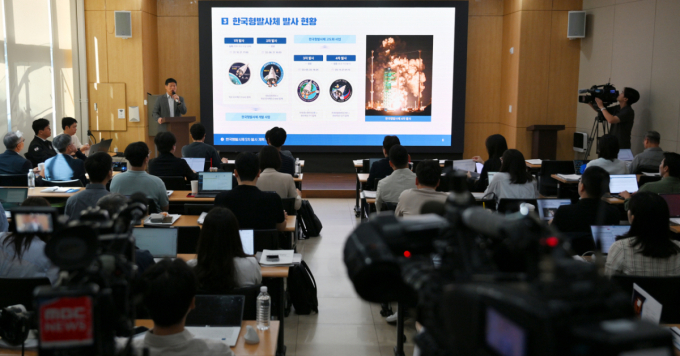
On the 15th, the Korea Aerospace Administration and KARI held a press briefing near Seoul Gwanghwamun regarding the fifth launch plan of Nuri, revealing its target orbit and key specifications. The target orbit for Nuri-5 is a sun-synchronous orbit at an altitude of 570 km above ground with an inclination of 97.67 degrees. Alongside five primary payloads—the 'Nano Constellation Satellites 2–6'—ten cube satellites developed by domestic companies, universities, and research institutions will be carried as secondary payloads.
The Nano Constellation Satellites 2–6, developed by the Korea Advanced Institute of Science and Technology (KAIST) Satellite Research Center, are satellites designed to conduct high-density, precise observations of the Korean Peninsula and surrounding seas from low Earth orbit. Following the launch of prototype models in 2024 and verification models in 2025, this is the first satellite group launched using the Yangsan configuration. By 2027, a full constellation of ten satellites will be established to capture images of the Korean Peninsula at least three times daily.
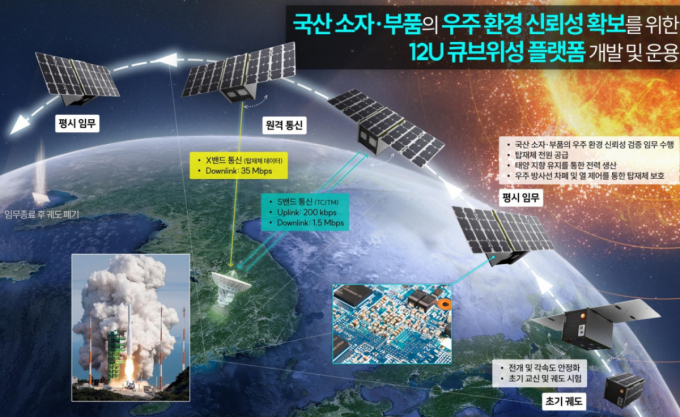
The ten cube satellites each serve different purposes and functions. Cube satellites are small satellites with a basic unit (1U) defined as a cube measuring 10 cm in width, height, and depth. 'Daejeon Sat-1', developed by Daejeon City, will verify payload technologies developed by local SMEs (small and medium-sized enterprises) in orbit.
The unmanned exploration institute's 'Ulysses' (UEL-Y-Sys) monitors fine dust. O&V Space is launching the Earth atmosphere satellite 'SLEDGE'. Space & Bin's 'SD-1 SAT' will collect radiation data from the South Atlantic. KAIST's 'GBSAT' also observes the space radiation environment.
There are also satellites demonstrating space optical communication technology. Chosun University's 'CPSat' will experiment with a technology that transmits data using laser light. Space LinTech is launching 'BEE-1012', which carries onboard AI based on MobileIn's NPU (Neural Processing Unit). KARI's 'E3 Tester' will carry six types of domestic semiconductor devices and components.

 in TECH


