

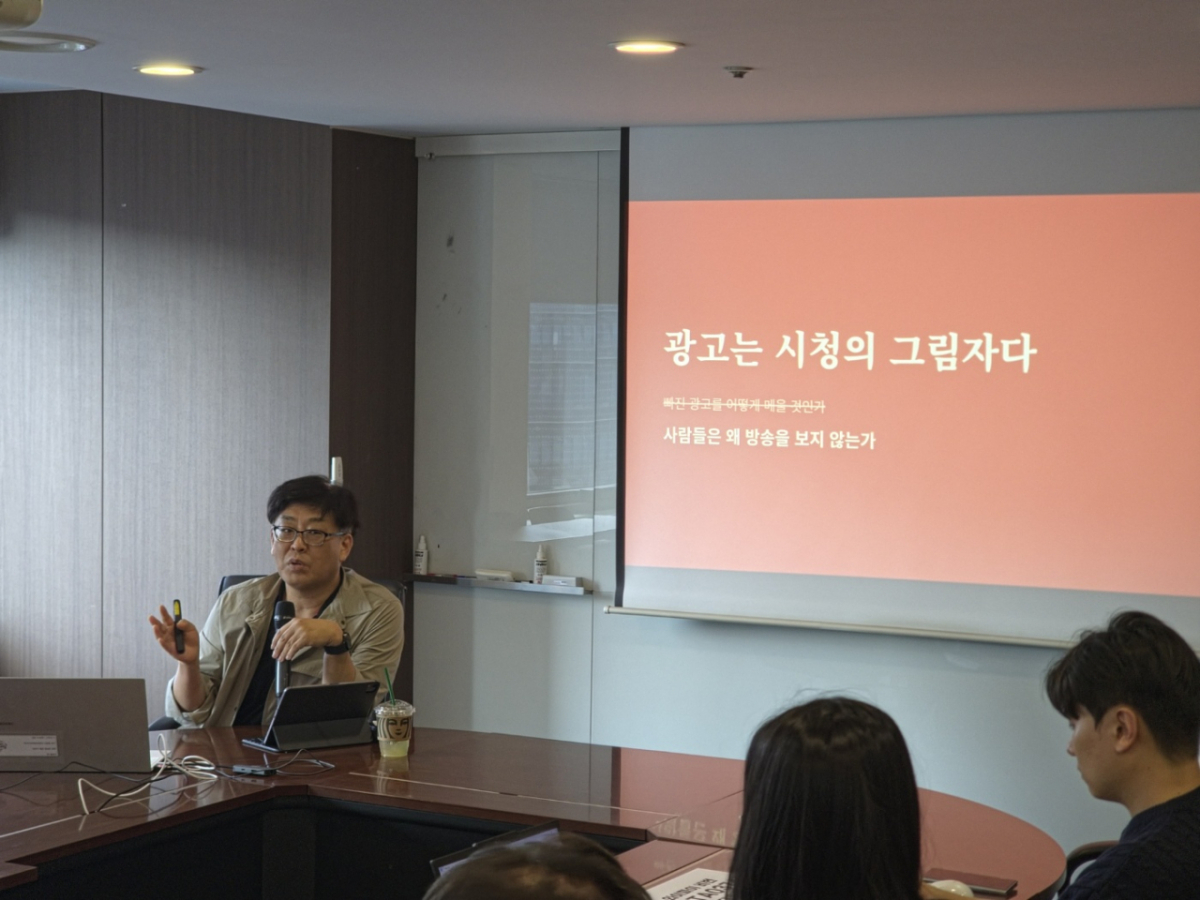
It is widely accepted that the entire Korean paid broadcasting market has faced difficulties due to the introduction of overseas OTT (over-the-top video streaming service) platforms such as Netflix. However, an analysis emerged suggesting that domestic paid broadcasting industry players should also strengthen their own competitiveness rather than blaming Netflix.
Jo Young-shin, President of Media & Entertainment Research Institute, conducted a study session on the 29th at the grand conference room of the Korea Cable Television Broadcasting Association under the theme “The Shadow of K-Content Success: The Production Cliff for PPs and Survival Challenges.” He stated, “It is common for dramas ranked No. 1 on Netflix to have TV viewership ratings in the 2nd% range,” emphasizing that “the problem with the domestic paid broadcasting market lies not in quality content, but in service.”
In fact, both JTBC’s drama “Seoul: The Story of Kim Buchang, a Middle Manager at a Large Corporation (hereinafter ‘Kim Buchang’)” and “Everyone Is Fighting Their Own Worthlessness” had initial TV viewership ratings in the 2nd% range. The argument is that while it is the same content, consumer preferences vary significantly by channel due to “service.”
For example, if a viewer comes home after work and turns on “Kim Buchang,” but 15 minutes have already passed, they would simply watch it in the past. However, now, if they wait just a little, Quick VOD is uploaded to Netflix immediately after the live broadcast. The need to stay up for the live broadcast has disappeared.
This does not mean that consumers have completely abandoned paid broadcasting. According to a 2025 survey by the Broadcasting and Communications Commission of Korea, the subscription rate for paid broadcasting in Korea reaches 97.5%. Almost every household is a subscriber to IPTV, cable, or satellite TV. Jo (CEO) noted, “Korea has become a ‘quasi cord-cutting’ market where paid broadcasting subscriptions have not been canceled, but people no longer watch broadcasts via TV,” pointing out that “because no one watches TV, terrestrial broadcast advertising has shrunk to one-third of its level over the past 10 years.”
He stated, “While many countries have introduced Netflix, only Korea and China have seen their TV advertising markets collapse,” criticizing that “this is because PPs (content producers) rely on distribution revenue from reception fees and cannot break free from the paid broadcasting market.” In “cord-cutting” markets such as the United States, the United Kingdom, and Japan, where people do not watch paid broadcasting at all, PPs have entered the FAST and broadcaster VOD markets to compete in improving service quality. In contrast, Korea remains fixated solely on distribution revenue through paid broadcasting.
Therefore, he argued that to revitalize the broadcast production market, the focus should shift from “Why aren’t they buying TV ads?” to “Why aren’t they watching TV?” He claimed that services must be established to compete with OTT platforms that allow viewers to watch content anytime and in any desired order, offering unlimited content for the whole family for around 10,000 won per month. In reality, domestic paid broadcasting VOD services charge around 1,000 won per episode for dramas and over 10,000 won for the latest movies.
To this end, he said that the PP industry and paid broadcasting channels must jointly introduce content subtitles, Quick VOD services, lower VOD prices, and real-time rewind functions. He stated that there is no hope if they proceed with a “every man for himself” approach.
He pointed out, “Japanese PPs absolutely do not provide their own content to YouTube,” adding, “In contrast, in Korea, terrestrial broadcast content is consumed almost for free on YouTube, Wave has failed to unify, and the merger between Tving and Wave has been stalled for three years.” He further added, “Instead of merely calling for regulatory deregulation, we must rewrite the grammar of broadcasting.”

 in TECH
