

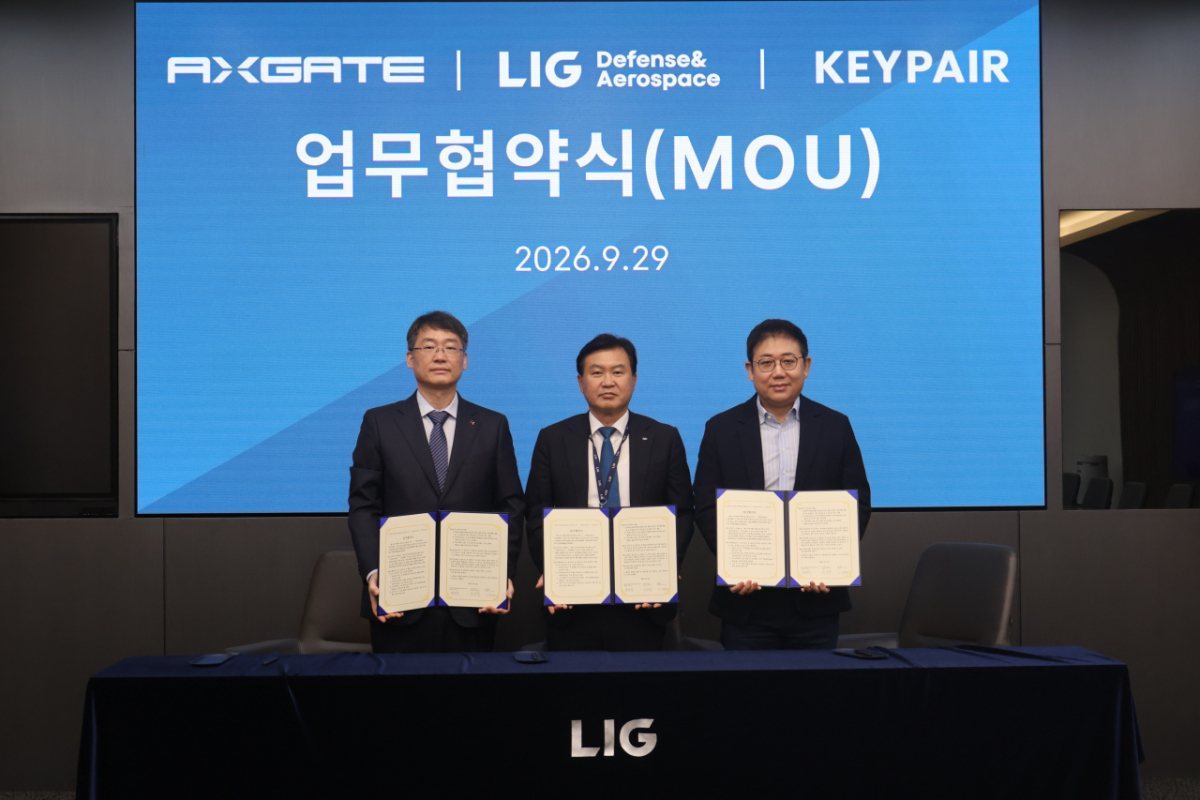
Network security specialist Xgate is moving forward with a collaboration to apply quantum security technology to the missile and military satellite communications sectors.
Xgate announced on the 1st that it signed a memorandum of understanding (MOU) titled "Business Cooperation for Advancing Missile Security Technology and Strengthening Competitiveness in Military Satellite Communications" with LIG Defense & Aerospace and Keyfair on the 29th of last month.
Through this agreement, the three companies will combine their capabilities in defense, network security, and encryption technology. They plan to build a high-performance, high-reliability secure communication system optimized for future missile operational environments and to advance joint research and development utilizing next-generation cryptographic technologies such as post-quantum cryptography (PQC).
Leveraging its accumulated expertise in VPN and encrypted communication technologies and PQC capabilities as a network security specialist, Xgate will participate in the transition to quantum security in the defense sector. The company will provide VPN, encrypted network security technology, and data protection technology optimized for military communication environments, and take charge of developing a security architecture that can stably link existing network environments with next-generation cryptographic systems.
LIG Defense & Aerospace will specify defense operational environment requirements and information protection needs based on its system expertise in the missile and military satellite communications fields. The company will analyze and design the security requirements demanded by missile programs and military satellite communications, and support integration to ensure that the technologies of the three companies can be applied to actual weapon systems and military communication environments.
Keyfair is responsible for PQC security chips, hardware-based encryption technology, and the integration and optimization of KMS (Key Management System) and HSM (Hardware Security Module). Keyfair has independently developed HSMs and supplied more than 4 million security chips based on verified cryptographic modules. The company plans to implement a consistent cryptographic system from weapon systems to ground control infrastructure by linking hardware-based PQC technology.
The three companies are paying attention to the fact that missile and military satellite communication systems are becoming increasingly network-centric. Accordingly, they intend to jointly research a security architecture that considers not only data protection in communication segments but also next-generation cryptographic systems required in future quantum computing environments.
Joo Gap-soo, CEO of Xgate, stated, "In the future defense environment, high-level security reliability for communication data, along with network connectivity, will be a core element." He added, "Through this collaboration, we will optimize the network security and next-generation cryptographic technologies accumulated by Xgate for military communication environments and contribute to strengthening the competitiveness of domestic defense secure communication technology."
Lee Chang-geun, CEO of Keyfair, said, "Long-term operational weapon systems, including missiles, are difficult to have their hardware replaced once deployed over long periods, making it important to consider PQC from the introduction stage." He added, "We will collaborate so that the secure communication system jointly developed by the three companies can become a representative application model for the transition to PQC in the defense sector."
Starting with joint research and development and technology integration, the three companies plan to continue exploring additional collaborative projects in the fields of defense security and communications.

 in TECH
