

Google will restrict access to high-performance models for free and low-cost users of its generative AI service, 'Gemini.' Previously, free users could partially use top-tier models within certain limits, but going forward, the specific models available will be determined by the subscription plan. It is assessed that AI services have entered an era of formal 'paid subscription barriers.'
According to a Google announcement on the 6th, the company will change the model access policy for the Gemini app starting from the 9th (local time). Free users will only be able to use the 'Flash-Lite' model going forward. The 'Flash' and 'Pro' models, which were previously accessible to some extent, will be excluded from free accounts.
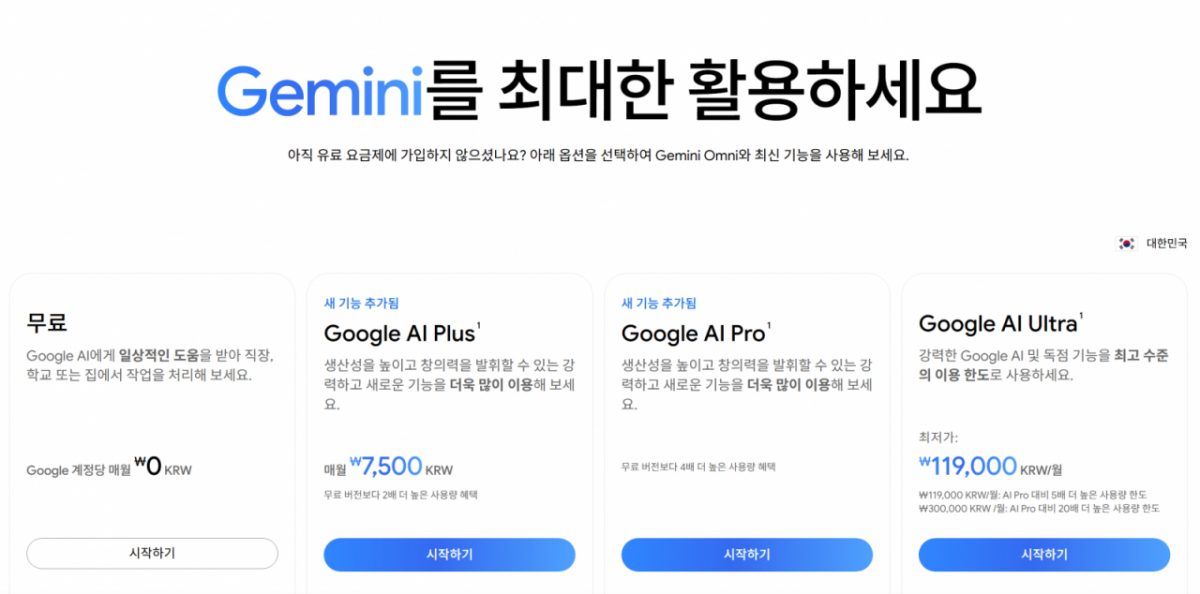
Users of the low-cost paid plan, Google AI Plus, will also be affected. While AI Plus users can continue to use Flash-Lite and Flash, they will be removed from the access list for the Pro model. Low-cost subscribers paying around 7,500 won per month under domestic pricing standards will need to sign up for a more expensive plan to use advanced reasoning models.
The Pro model is a top-tier model that excels in complex reasoning, coding, mathematics, and long-document analysis. Google's official help documentation also describes Gemini Pro as "the most advanced model, strong at complex requests such as math and programming." In contrast, Flash-Lite is a lightweight model focused on fast responses. For free users, while simple queries and summarization may remain possible, perceived performance for high-difficulty tasks could decrease.
This overhaul is less of a simple feature adjustment and more akin to a de facto price increase. Previously, differences lay in usage limits while using the same models, but going forward, accessible models will be divided by subscription plan. In other words, users must pay higher subscription fees to use better AI.
Google's push for its premium plans has also become clear. Users of AI Pro and AI Ultra can continue to use the Pro model, and it is known that a 'Deep Think' option, a high-difficulty reasoning feature, will be added to AI Pro. Google's official pricing page also highlights expanded access to Gemini 3.1 Pro and Deep Research, as well as 5TB of storage space, as key benefits for AI Pro.
The background includes the burden of AI operating costs. High-performance AI models consume significant computational resources even for a single response. As the number of users increases, server and GPU costs also rise. It is structurally difficult to keep high-performance models open to free users indefinitely. This is why Google is reducing model selection options for free users and guiding low-cost subscribers toward higher-tier plans.
The timing is also intriguing. On the 30th of last month, Google unveiled 'Argon,' a core model within its top-tier AI model group, 'Gemini 4.' According to Reuters, this model is larger in scale than existing Pro-series models, and Google is providing it to selected cybersecurity partners. A general public release schedule has not yet been announced.
Google's message is clear: while continuing to provide free AI, it intends to more tightly bundle high-performance AI as a paid product. Advanced models that were offered for free or at low prices in the early stages of the AI market to attract users are now transitioning into a full-fledged monetization phase.
The impact on domestic users is also not small. Gemini is integrated with the Google ecosystem, including Google Search, Gmail, Docs, and Drive. In a situation where more users are utilizing it as a work tool beyond a simple chatbot, model restrictions could immediately lead to differences in productivity.

 in TECH
