

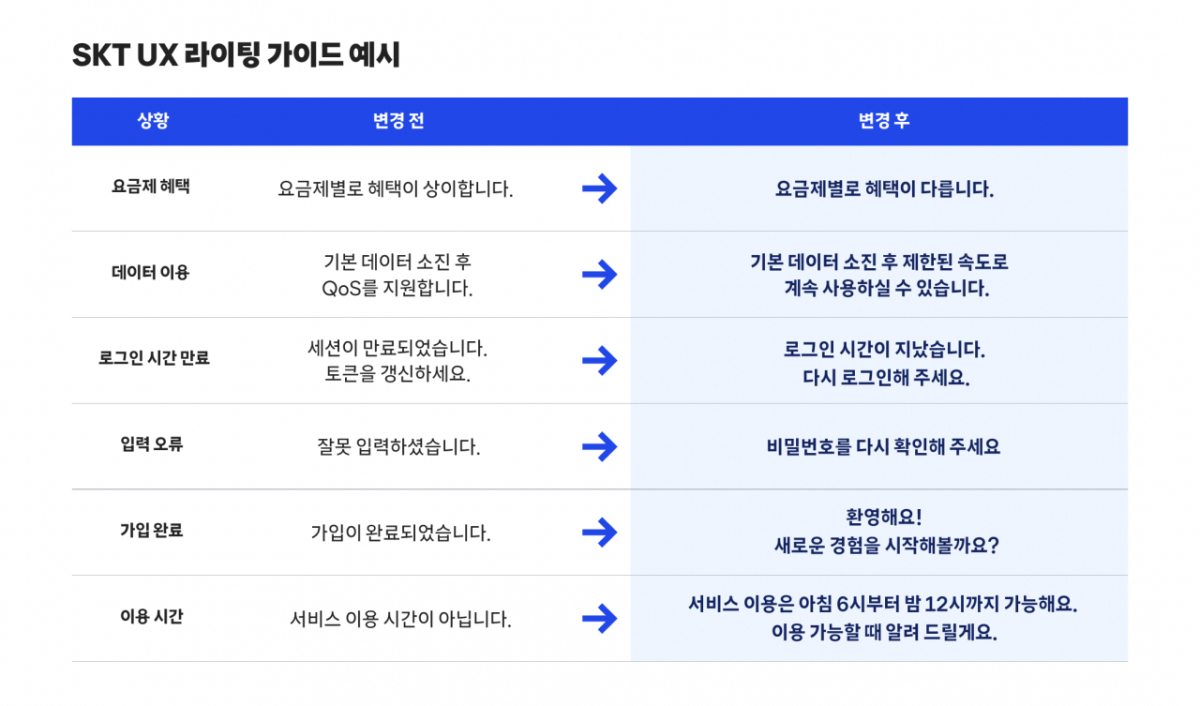
SK Telecom announced on the 6th that, ahead of Hangul Day, it has developed a "UX (User Experience) Writing Guide" that takes into account not only easy-to-understand Korean but also the emotions customers may feel during service use, and will apply this guide to its operational field.
The guide focuses on helping customers easily understand the phrases they encounter while using mobile services and naturally proceed to their next actions.
SK Telecom's Customer Language Research Team developed the guide through surveys of customers and employees, as well as consultations with language experts. The guide places emphasis on carefully considering the emotions customers feel during service use. In particular, through expert consultation, it introduced a "Customer Emotion Map" that allows for an at-a-glance view of the service journey and emotional flow, recommending phrases tailored to emotions such as expectation, anxiety, surprise, doubt, and satisfaction.
For example, when a password is entered incorrectly, instead of pointing out the customer's mistake with a phrase like "You entered it incorrectly," the guide suggests saying "Please check your password again" so that customers can resolve the situation. Additionally, rather than using vague phrases such as "It is not service hours," it presents specific information and follow-up guidance together, such as "Service is available from 6 a.m. to 12 p.m. We will let you know when it becomes available," thereby alleviating customer frustration.
In the guide, SK Telecom presents four principles for communicating more closely with customers: △easy, △helpful, △trustworthy, and △empathetic.
First, to facilitate easy and smooth communication, it recommends using expressions that customers frequently use in daily life rather than difficult Sino-Korean words or foreign terms. For example, "Benefits vary by rate plan" is changed to "Benefits differ by rate plan," and "The session has expired" is changed to "Your login time has passed."
This guide also includes expression standards that align with current social sensibilities, taking into account how the Korean language has evolved over time. It refines expressions that may generalize or exclude specific groups, such as using "popular product" instead of "filial piety product" and "guardian consent" instead of "parental consent."
In addition, an emoji guide was prepared to express emotions that are difficult to convey through text alone and to approach customers in a friendly manner. It also provides guidelines on usage precautions, such as ensuring emojis do not replace text so that all customers, including those with disabilities, can understand the guidance content, and avoiding specifying skin color or gender.
Furthermore, SK Telecom has enabled employees to review and revise or supplement phrases in real time through its self-developed AI agent "Sotong-i," rather than searching through the vast volume of the guide.
"Sotong-i" was trained on 23 internal communication guides, including the UX Writing Guide, and over 50,000 language review data entries. It checks the appropriateness of using neologisms that quickly emerge and disappear by linking with external data, and inspects not only text but also potential risks contained in images.
Any SK Telecom employee can review customer guidance phrases with "Sotong-i" and receive suggestions for better expressions. The scope of application covers all touchpoints where customers interact with SK Telecom, including banners, product and event pages, and notices.
Lee Hye-yeon, Director of the Customer Value Innovation Division at SK Telecom, stated, "A single line of text that a customer encounters in a service is a word passed from SK Telecom to the customer," adding, "Through this guide and 'Sotong-i,' unveiled on Hangul Day, we will transform the customer experience with empathetic language that first considers the customer's feelings."

 in TECH
