

[For more diverse corporate information on the startups mentioned in this article, please visit the Unicorn Factory big data platform 'Data Lab'.]
"We have no chance if we compete on scale. But because we are small, we can move faster."
Among the four major science and technology institutes, DGIST's undergraduate admission quota is 200 students per year, less than one-quarter of KAIST (Korea Advanced Institute of Science and Technology). The Innovation Startup Center has fewer than 20 staff members, and there are still not many professionals with experience in startup support.
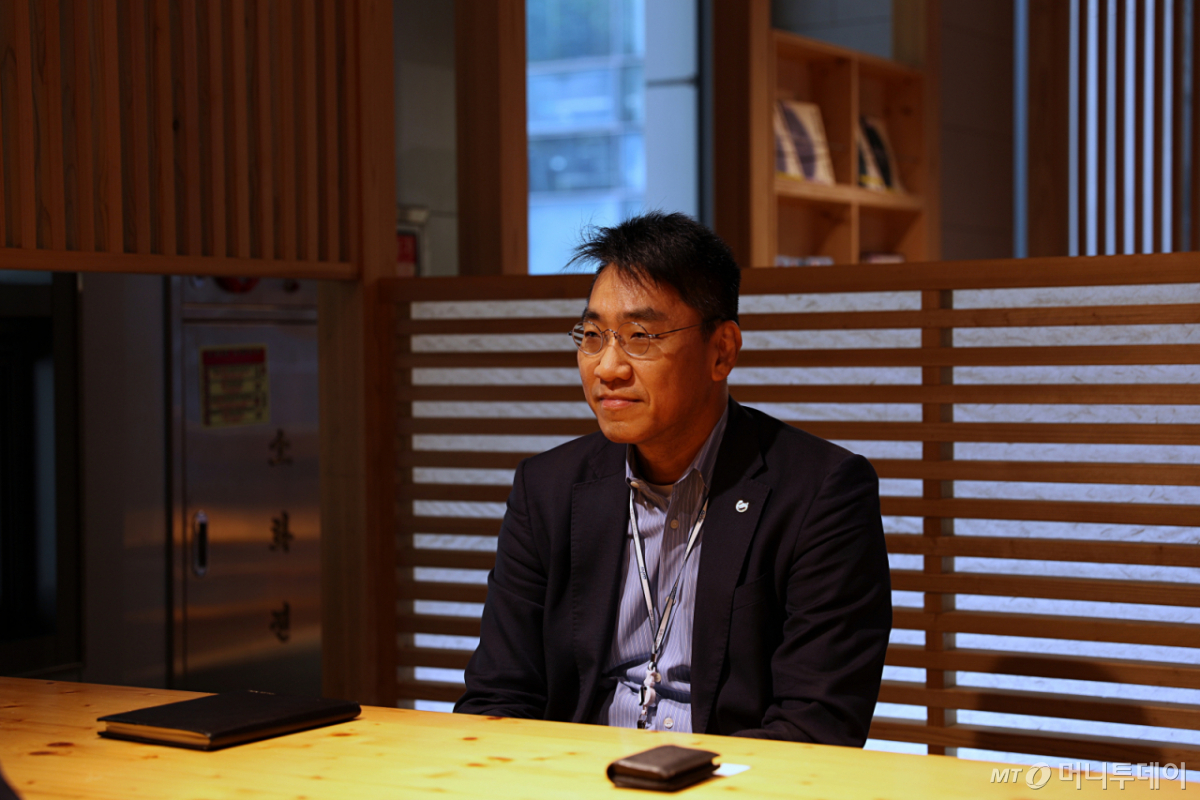
Kwon Oh-sang, who took office as Director of the Daegu Gyeongbuk Institute of Science and Technology (DGIST) Innovation Startup Center last June, recently met with Money Today's startup media platform "Unicorn Factory" and said, "I believe we can produce results that are on par with, or even surpass, KAIST in the few areas we have chosen." He added, "We will make DGIST a prestigious deep tech startup university that represents Daegu."
Director Kwon's move to the university was also a topic of discussion in the industry. He had previously been a co-founder and co-representative of venture capital (VC) firm Prime Sage Partners. His career includes roles such as △Researcher at Kia Motors, △Senior Manager at Samsung SDS, △Manager at Barclays Capital's London and Singapore branches, △[Position] at the Financial Supervisory Service and Director of the Complex Financial Supervision Bureau, and △Global [Role] at Chai University of Science and Technology. He has worked across industry, finance, academia, and regulatory institutions. It was inevitable that questions of "why?" would follow when he took charge of a startup organization just laying its foundations at a regional university where he had no prior ties.
Director Kwon said, "VC investment is very rewarding, but I wanted to go further upstream." He explained, "I wanted to take one step beyond the stage of investing in startups and directly build the startup ecosystem from the starting point where companies are born and grow."
The strength of DGIST that Director Kwon focused on after taking office is the flexibility of its students. DGIST allows students to explore their majors without a designated department until the end of their second year, and thereafter they choose "tracks" rather than departments. Students can also combine various subjects to create their own unique tracks. He stated, "DGIST students break boundaries not permitted by traditional departmental concepts by working backward from the problems they are interested in to find what is needed and connecting the dots." He evaluated this as "a very important quality from an entrepreneurship perspective."
The first project Director Kwon is pushing forward is "entrepreneurship education for all freshmen." While its introduction into the curriculum has not yet been finalized, the plan is concrete. It will be a one-credit seminar where all 200 freshmen attend for one hour each week over one semester. The course name is "Entrepreneurship and Exploration."
It is not a class on writing business plans or forming companies. Director Kwon explained, "To use an analogy, students will go through the process of drawing their own map while encountering unexpected showers in an uncharted sea." He added, "It is like giving first-year students a preventive inoculation so they realize that entrepreneurship is not as scary as it seems and that if someone else is doing it, maybe I should try getting on board too."
Next year, he is also planning a project tentatively called "20Q," which will select around 20 undergraduates to provide intensive support for one year. The approach involves exploring the questions each student holds and digging into the root of the problem to create their own unique outcomes. Establishing a company is not mandatory.
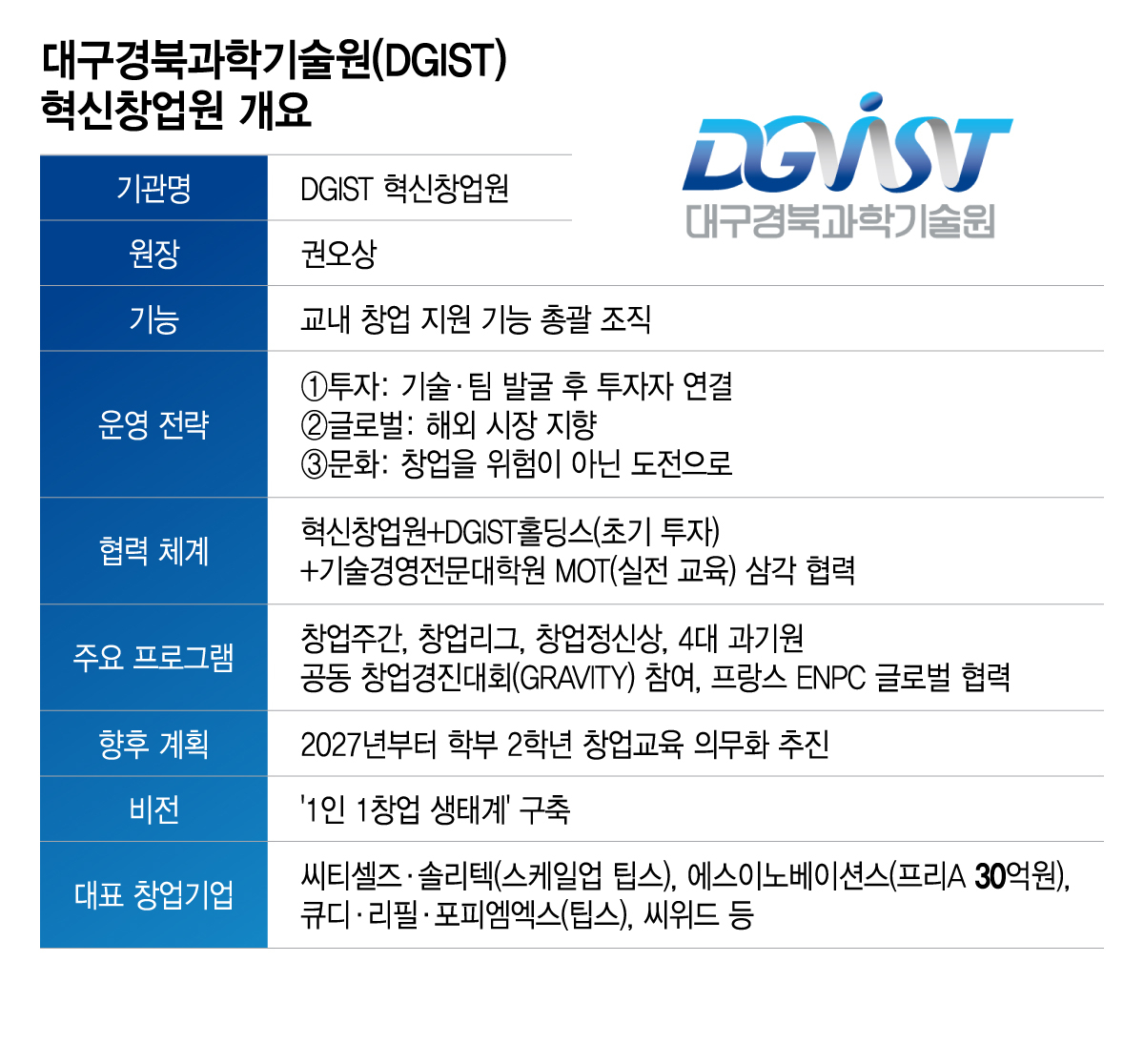
He also presented a plan to expand the startup ecosystem beyond the campus to the region. The "2026 DGIST Startup Week" held last month was its first attempt. Seven venture investors and entrepreneurs gave special lectures, and 250 entries were received for the slogan contest. He actively promoted the event to regional universities and research institutes affiliated with the National Research Foundation of Korea. Director Kwon said, "The mission scope of the Innovation Startup Center is not inside DGIST, but the Daegu and Gyeongbuk region." He expressed hope, saying, "DGIST does not yet have any unicorns or listed companies, but we can realize such dreams together with regional entrepreneurs."
Efforts to build startup infrastructure on campus are also being intensified. The plan is to establish test infrastructure capable of testing various types of robots and to make "physical AI" a new battleground. Director Kwon noted, "Looking around, there are surprisingly many good robot startups in faculty-founded companies and research institutes that have not yet surfaced." He added, "We will strive to build test infrastructure where these companies can test various forms of robots so they can grow."
Director Kwarn warned against the existing approach of using the number of startups or investment amounts raised as key performance indicators (KPIs). Instead, he plans to evaluate how richly the startup ecosystem has been developed, focusing on investment, global expansion, and culture. He said, "For example, we could set goals such as achieving global results in more than 30% of startup companies and raising undergraduate participation in entrepreneurship to 30%."
The role models Director Kwon cited for realizing his vision are the Technion in Israel and the Swiss Federal Institute of Technology Zurich (ETH Zurich). Both schools are located outside their capital cities and are not large in scale, but they are known as universities that connect world-class research with entrepreneurship. According to data from U.S. investment information firm PitchBook, the Technion ranks 10th globally in startup performance by undergraduate graduates. More than 1,000 companies have been founded by its alumni. ETH Zurich produced 46 new companies last year alone, including 24 spin-offs based on research outcomes. The total investment raised by these companies over the past year reached 540 million Swiss francs (approximately 940 billion won).
He said, "The schools that do entrepreneurship best are MIT and Stanford, but considering their scale and regional advantages, it is difficult to set them as direct targets." He added, "We will acknowledge our disadvantage in scale, but we will compete using the flexibility of DGIST students, expansion of the regional ecosystem, and physical AI as our weapons."
[Money Today startup media platform Unicorn Factory]

 in TECH

