
AI Automated Translation.

Font Size

Share

“Record-High 14 Satellites” on 5th Nuri Rocket, Delivering to Space

“Record-High 14 Satellites” on 5th Nuri Rocket, Delivering to Space

[MT Report - The 5th Nuri Rocket Takes Flight] ① Successful Delivery of Record-High Number of Satellites
Launched from the Naro Space Center at 12:25 p.m. on the 7th
First launch to maintain scheduled time without “plan changes”
Nine out of five microsatellite constellations and 10 CubeSats placed in orbit

The Nuri rocket successfully completed its fifth space flight. This launch, which carried a record-high 15 satellites for the first time, is regarded as an important test stage in South Korea’s launch vehicle market. We examine the scene of the 5th Nuri launch and key points to watch regarding the future Nuri project.
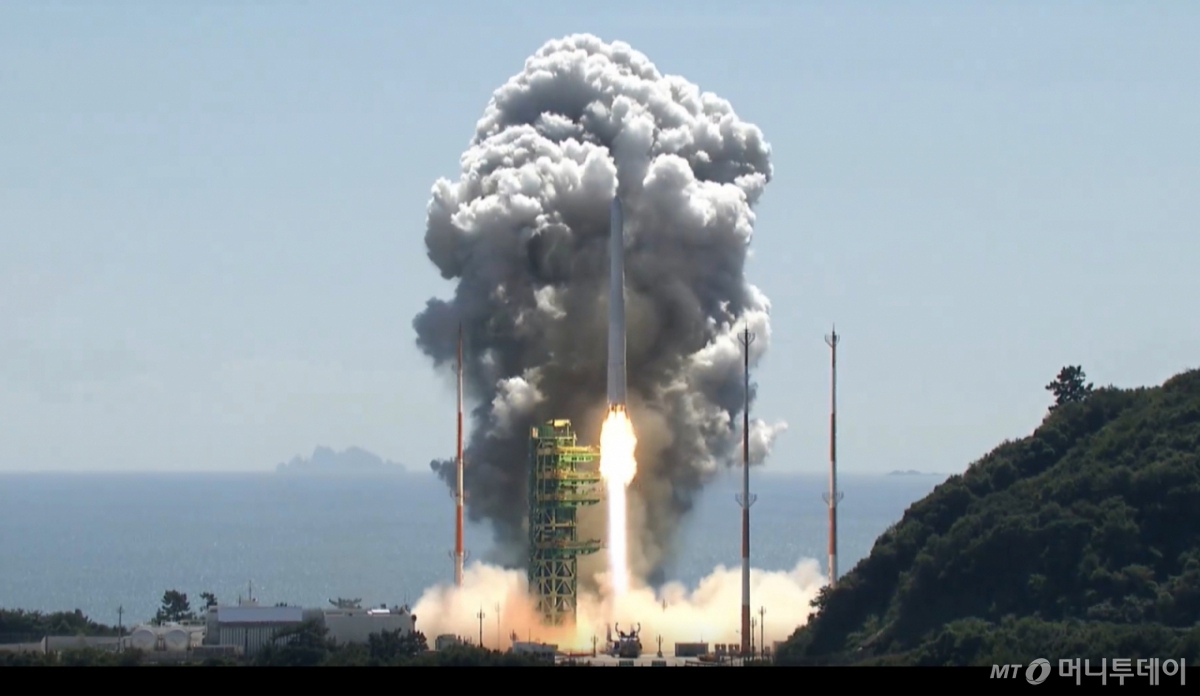
The Korean-made launch vehicle Nuri is being launched from the Naro Space Center in Goheung County, Gwangju, South Jeonnam Province on the afternoon of the 7th. The Nuri rocket, marking its fifth launch, heads to space carrying a total of 15 satellites, including five microsatellite constellations (Nos. 2–6) and 10 CubeSats developed by domestic companies, universities, and research institutions. (Provided by the Korea Aerospace Research Institute. Resale and database use prohibited.) October 7, 2026 / NEWS1 Copyright © NEWS1. All rights reserved. Unauthorized reproduction and redistribution, as well as use for AI learning, are prohibited. /Photo=NEWS1)

The “Korean-made launch vehicle” Nuri successfully completed its space flight on the 7th, fulfilling its mission. It is the first case of launching exactly at the scheduled time while carrying a record-high number of satellites. President Lee Jae-myung praised it on social media that day, stating, “We have moved one step closer to space sovereignty, pioneering space with our own power.”

The Korea Aerospace Administration and the Korea Aerospace Research Institute officially confirmed the success of the 5th Nuri launch at the Naro Space Center in Goheung, South Jeonnam Province on the 7th. The 5th Nuri rocket was launched from the second launch pad at the Naro Space Center at 12:25 p.m. that day. This is the first time since its initial launch in 2021 that the Nuri rocket has been launched as planned without changing the launch time.

The Nuri rocket reached a target altitude of approximately 575 km and succeeded in the consecutive deployment of five microsatellite constellations (Nos. 2–6), which was the success criterion for the 5th launch and considered the highest difficulty level. It debuted the high-difficulty technology “separation sequence,” which involves rotating the upper stage of the Nuri rocket by 30° and 50° in sequence at intervals of approximately 35 to 40 seconds to deploy satellites one by one without them colliding with each other. Among these, No. 6 successfully established its first communication with the Sejong Station in Antarctica at 1:08 p.m.
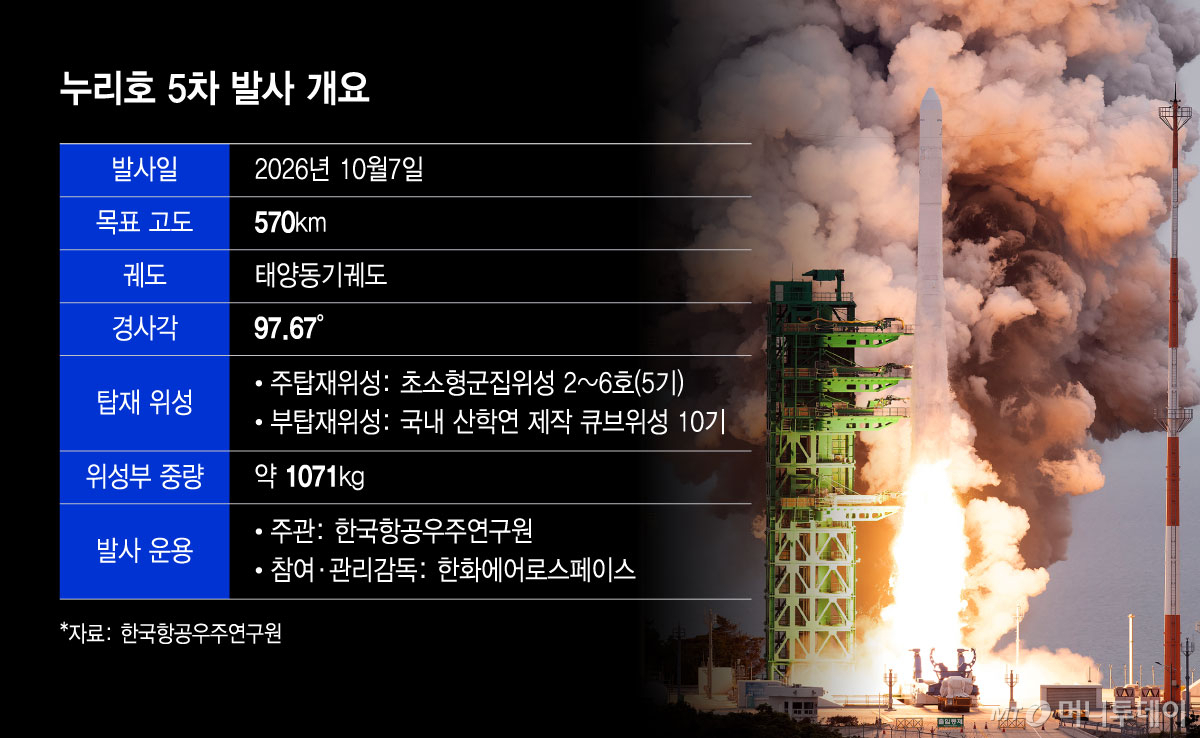
Overview of the 5th Nuri Launch / Graphic = Yoon Sun-jung

For the secondary payload satellites, nine out of a total of 10 were successfully deployed. Only Quaternian’s “Fusshat-02” was not deployed. It was analyzed that the cause was that the cover of the satellite deployment tube did not open.

The 5th Nuri launch is evaluated as having comfortably exceeded the success criteria as a launch vehicle. This is because it achieved the target altitude and velocity and successfully deployed the primary payload of the launch vehicle. Oh Tae-seok Woo Ju-hang-gong (Commissioner) stated, “With this launch, we have raised the success rate of domestic launch vehicles from 75% to 80%.”

"This article was translated using AI and may differ slightly from the original."