

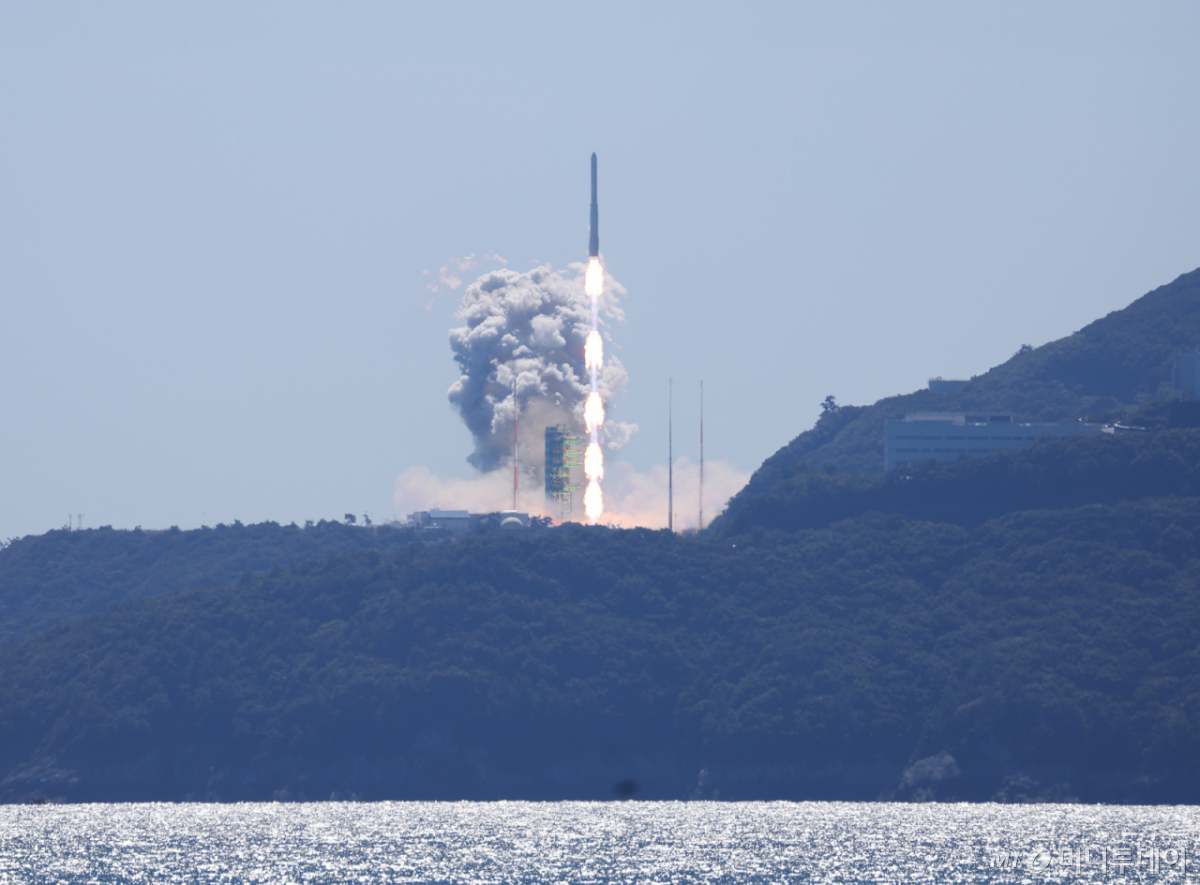
The 5th Nuri launch was the first to adhere to both its scheduled launch date and time. It carried the largest number of satellites in history and was evaluated as the most technically advanced. The failure to deploy one co-passenger satellite remains a regrettable point.
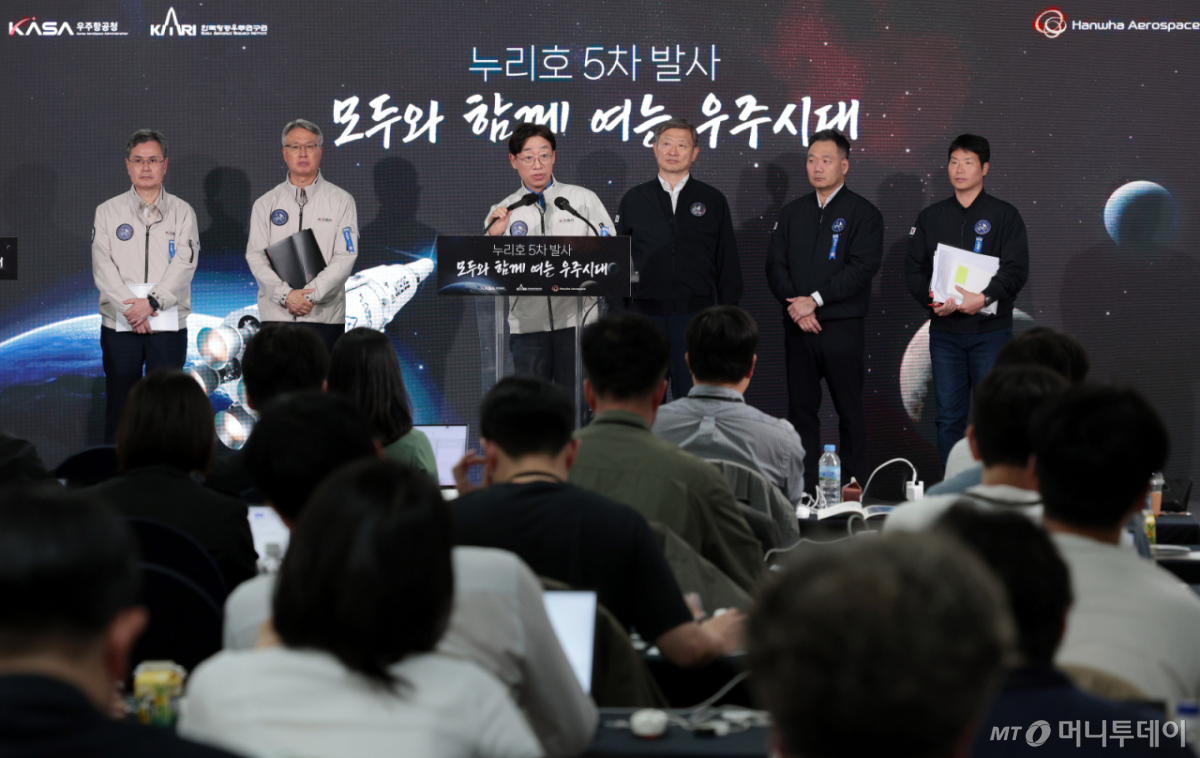
At a briefing on the results of the Nuri launch held at the Naro Space Center in Goheung, South Jeonnam Province, on the 7th, Oh Tae-seok, Woo Ju-hang-gong (Commissioner), stated that it was "the first launch where not only the date but also the time was not delayed," and highlighted its significance by saying it "demonstrates that (Nuri) has grown technically compared to the fourth launch."
The 1st Nuri launch in 2021 was delayed by one hour from the originally scheduled time of 4 p.m. After the launch, it failed to place a satellite simulator into orbit. The 2nd launch in 2022 was postponed from the originally scheduled date of June 15 to June 21 due to a sensor malfunction. The 3rd launch in 2023 was also delayed by one day. In last year's 4th launch, a sensor malfunction was detected, and the actual launch occurred 18 minutes later than the scheduled time.
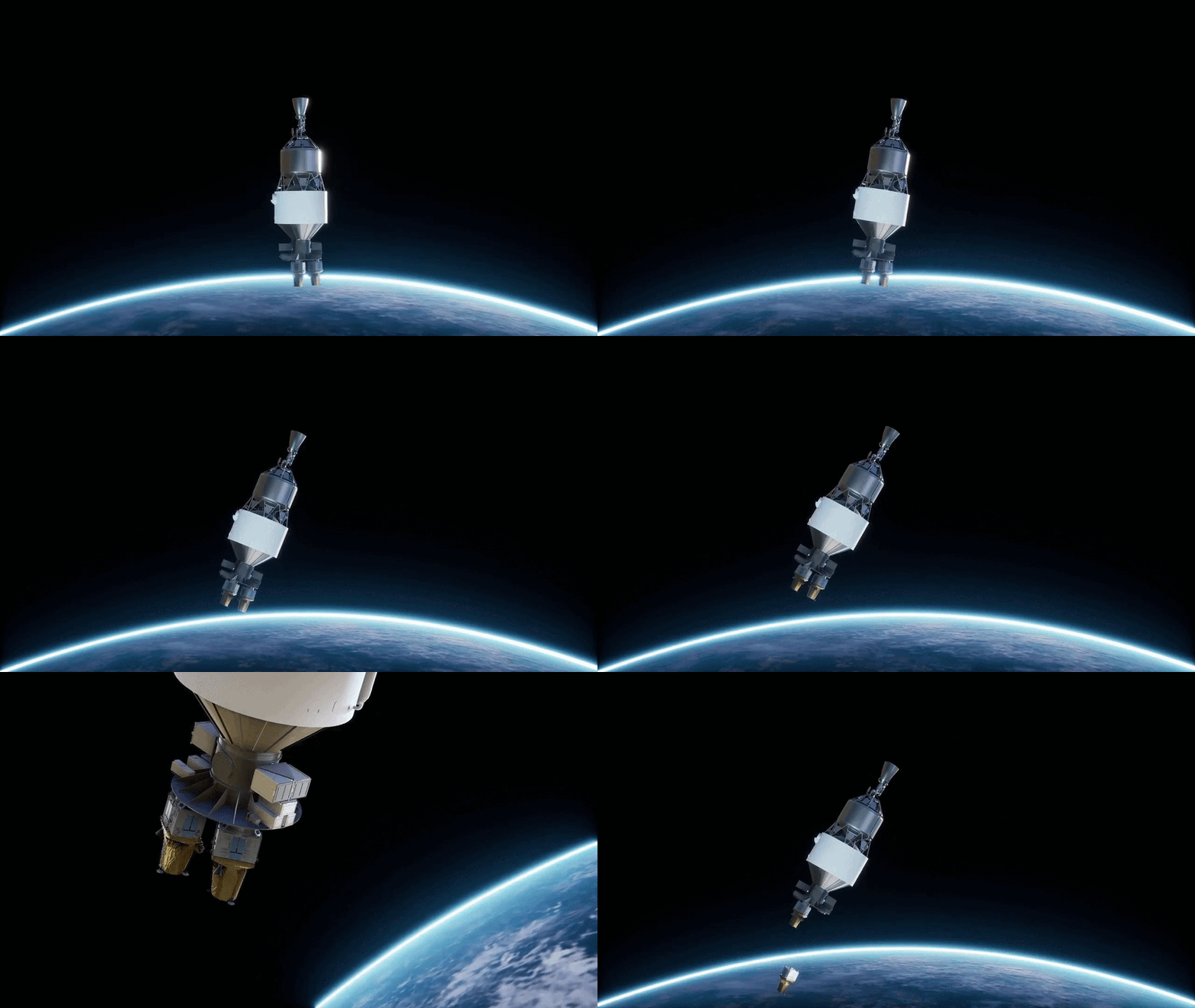
The Nuri rocket, which took off on schedule, reached its target altitude that day and successfully deployed five main payload satellites, which are micro-constellation satellites. The deployment of micro-constellation satellites is a core factor determining the success of Nuri as a 'launch vehicle.' The criteria for launch vehicle success are △whether it reaches the target altitude and speed, and △whether the main payload satellite deployment is successful; the 5th Nuri achieved all of these. Furthermore, it is evaluated that the mission of the main payload satellites has come closer to success, as Satellite No. 6, which was deployed last among micro-constellation satellites Nos. 2 through 6, successfully established initial communication with the South Pole Sejong Station around 1:08 p.m.
In the case of Quaternian's 'FusSat-02,' the only one among the 10th co-passenger satellites to fail deployment, it appears that a more precise analysis of the cause of failure is needed. FusSat-02 failed to reach orbit because its deployment tube cover did not open. Oh (Commissioner) explained, "Unlike main payload satellites, for which the launch vehicle is responsible up to the separation device, co-passenger satellites have their deployment tubes manufactured and purchased independently by each institutional investor and company," adding that "further analysis is needed on whether there was an issue with Nuri's deployment signal or other causes."
A meaningful launch where Hanwha Aerospace 'grabs its first console'
The fact that the level of private participation, including Hanwha Aerospace, the system integrator for Nuri, was significantly expanded in this launch is also a factor in the 5th Nuri launch being evaluated as a success. Hanwha Aerospace operated and directly participated in 20 out of 22 consoles at the Launch Control Center (LCC), excluding the payload computer and propulsion supply system consoles. HD Hyundai Heavy Industries also supported pre-launch inspections and tests, as well as the operation of the launch pad system.
Kim Sun, Senior Vice President and Head of Space Business at Hanwha Aerospace, stated, "(The 5th launch is) the first case where Hanwha Aerospace directly operated consoles." He then predicted that "in the 6th launch, the scope will expand to the point where we participate in most operations."
Vice President Kim said, "The success of the 5th launch is not a goal but a process," adding, "Once the Nuri enhancement project is completed, we will be able to properly begin commercial space transport services." Director Lee Sang-cheol of KARI also stated, "By effectively using national resources, we will contribute to both the security and economic sectors of our country."
Vice Minister and Minister of Science and ICT Baek Gye-hoon, who visited the Naro Space Center that day to observe the entire process of the Nuri launch, said it was "a day when another meaningful milestone was set in South Korea's space development history," adding, "We will actively support the development of the space industry."

 in TECH


