

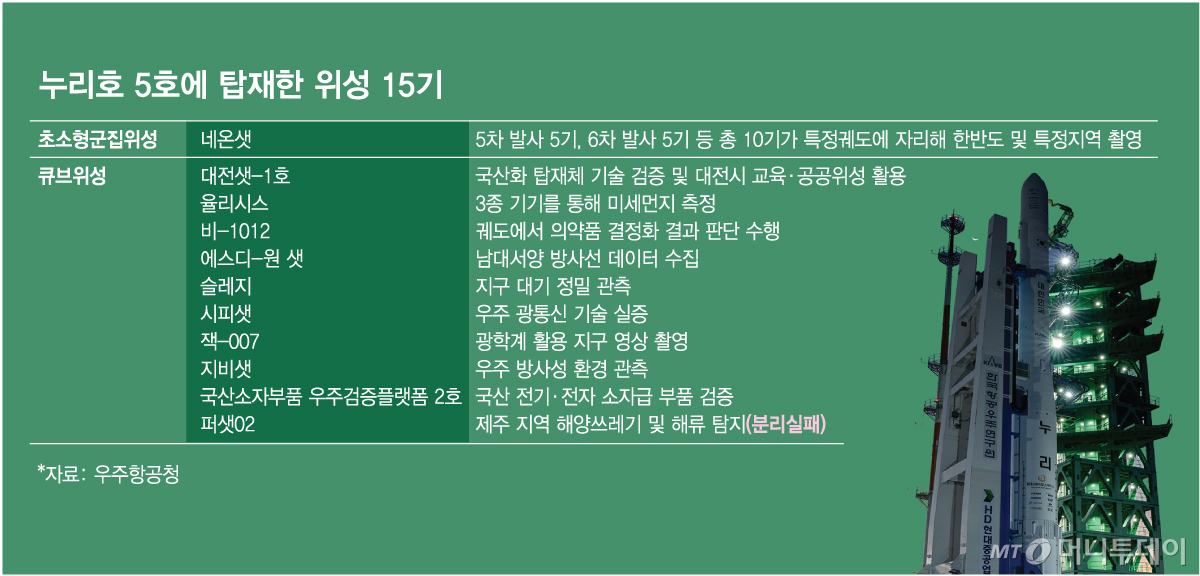
A total of 15 artificial satellites were aboard the Nuri rocket that headed into space on the 7th. The Nuri was tasked with separating these satellites in different directions so they could reach their target locations. With the successful deployment of the Nuri's satellites, it is predicted that South Korea can now fully enter the "satellite launch" market.
This Nuri carried a total of 15 satellites, including microsatellites No. 2 through No. 6 and 10 CubeSats developed by domestic industry-academia-research institutes. It carried the largest number of satellites in the history of the Nuri rocket.
The Nuri was responsible for separating these satellites at different angles so they would not collide with one another, sending them to their target locations. After adjusting the angle and launching the five bundled microsatellites in a different direction, it sequentially deployed the remaining 10 CubeSats. This is the first time the Nuri has attempted to deploy "constellation satellites," which involves placing multiple satellites with the same objective into a specific orbit.
The primary mission of the Nuri was to send five microsatellite constellation satellites to their designated positions. Microsatellite constellation satellites No. 2 through No. 6 are satellites developed by the KAIST (Korea Advanced Institute of Science and Technology) Satellite Research Center that conduct high-density, precise observation of the Korean Peninsula and surrounding waters from low Earth orbit. They are the first satellite group launched as the Yangsan type, following the launch of a prototype in 2024 and a verification model in 2026. Including the five to be launched on the 6th Nuri mission in 2027, the full constellation will consist of 10 satellites, with plans to photograph the Korean Peninsula region more than three times a day for three years. Compared to operating a single medium-to-large satellite, constellation satellites have the advantage of being distributed across an orbit to observe specific areas more frequently.
The 10 CubeSats carried as secondary payloads each have different purposes and functions. A CubeSat is a small satellite that uses a cube with dimensions of 10 cm in length, width, and height as its basic unit (1U). They are scheduled to carry out their respective missions, including △technology verification for payloads, △fine dust monitoring, △Earth atmospheric observation, △data collection on the South Atlantic and cosmic radiation, △optical communication data transmission technology experiments, △space environment experiments, and △domestic semiconductor device experiments. The CubeSat "PERSAT02" built by startup Quartian was scheduled to be responsible for analyzing marine debris and ocean current directions in the Jeju region, but it failed to separate from the launch vehicle.
The government is considering expanding its business into actual launch services that meet satellite demand, depending on the results of this Nuri No. 5 satellite launch mission. The plan is for the Nuri to handle satellite launch demand that currently relies on foreign launch vehicles such as SpaceX.
Lee Sang-cheol, [Director/Head] of the Korea Aerospace Woo Ju-yeon-gu (Director), stated in a briefing after the launch that "launch vehicles are large, heavy, and time-consuming projects, so how well South Korea can utilize its resources is a key issue." He added, "As hundreds of thousands to millions of satellites will be placed in low Earth orbit in the future, we will develop the space industry in both security and economic fields by efficiently using national resources to prepare for a shortage of launch vehicles and to advance our economy."

 in TECH
