

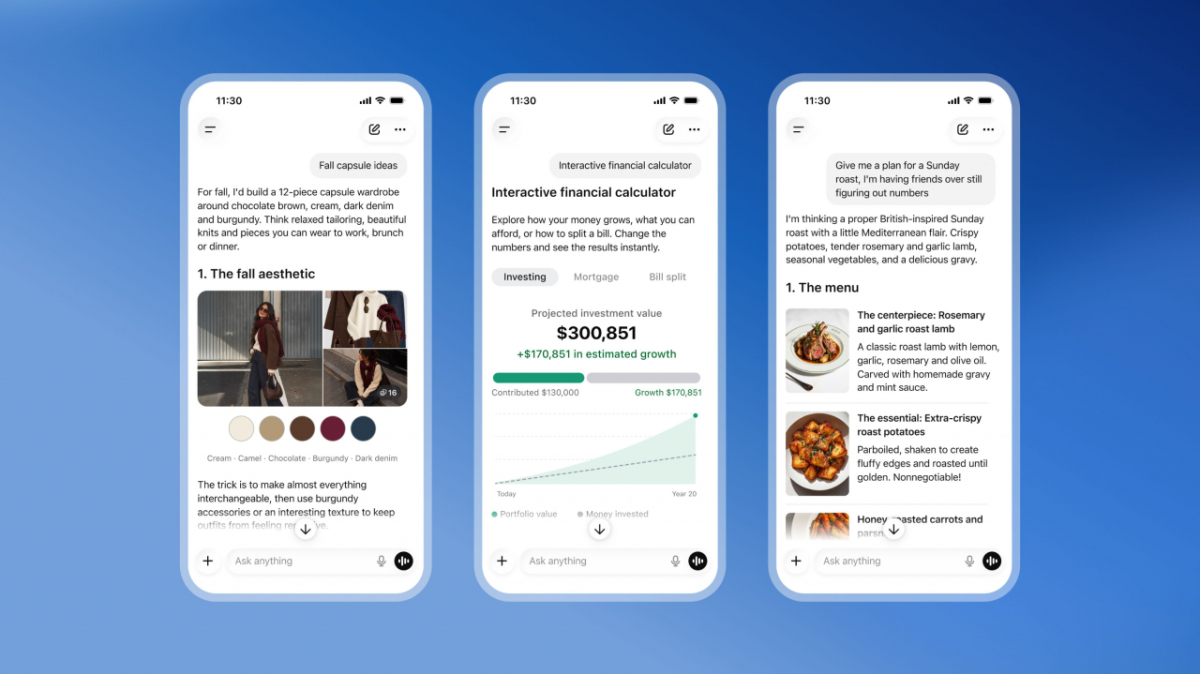
OpenAI will expand GPT-6 to all of ChatGPT, including free users. The company is also newly introducing "Intelligent UI," which generates screen layouts in real time—such as maps, charts, and buttons—to match the question, in addition to the answer content itself.
On the 8th, OpenAI announced that it will sequentially apply GPT-6 and Intelligent UI to ChatGPT's chat feature. GPT-6 Sol will be applied to Plus, Pro, Business, and Enterprise users, while GPT-6 Luna will be applied to Free and Go users. The rollout targets more than 1.2 billion weekly active ChatGPT users.
The biggest change is in the response method. While existing ChatGPT primarily output text in the chat window, it will now alter the format of the answer itself depending on the nature of the question.
If asked about travel plans, it will display destinations and routes on a map; when comparing multiple subjects, it will arrange information side by side. Complex concepts can be explained through graphs or interactive charts. Users can also immediately verify within the chat window how results change when input values are modified.
Even simple tools like calculators can be created with just a question. For example, users can directly execute functions within ChatGPT responses to calculate how savings grow over time or split meal costs among multiple people.
To achieve this, OpenAI trained GPT-6 to determine not only the answer content but also the need for information layout and visual materials, as well as elements that users can manipulate directly. Instead of fitting every question into the same chat screen, the interface is configured to match what the user is trying to do.
Response speed has also been improved. Rather than displaying results all at once after completing complex tasks, GPT-6 can convey confirmed content to the user first while continuing additional work.
In OpenAI's internal evaluations, the time it took for a GPT-6 instance to begin answering questions requiring web searches was on average 44% shorter than that of a GPT-5.6 Instant instance. This figure compares the point at which the first answer begins to appear, not the time when the entire response is completed.
Web search capabilities have also been strengthened. The company explained that it improved the ability to determine whether a question requires searching and to find information that supports the answer. OpenAI stated that in internal evaluations targeting difficult questions, GPT-6 more frequently and accurately addressed the core content actually requested by users compared to GPT-5.6.
Safety has also been addressed. Training to prevent misuse in high-risk areas such as cyberattacks, biology, and violence has been strengthened, and the model's ability to respond to attempts to bypass safety mechanisms through multiple consecutive conversations has been improved. The model's ability to recognize and explain its own limitations when it lacks necessary information or tools has also been enhanced.
GPT-6 and Intelligent UI will be sequentially applied to the chats of Plus, Pro, Business, and Enterprise users starting from the 8th in Korea time. They will be sequentially expanded to Free and Go users after the 9th.
This change applies only to ChatGPT's "Chat." The models powering Work and Codex will not change with this update. OpenAI plans to develop Intelligent UI in a direction where, if a user describes what they want to do, ChatGPT directly configures the interface necessary for that purpose.

 in TECH
