

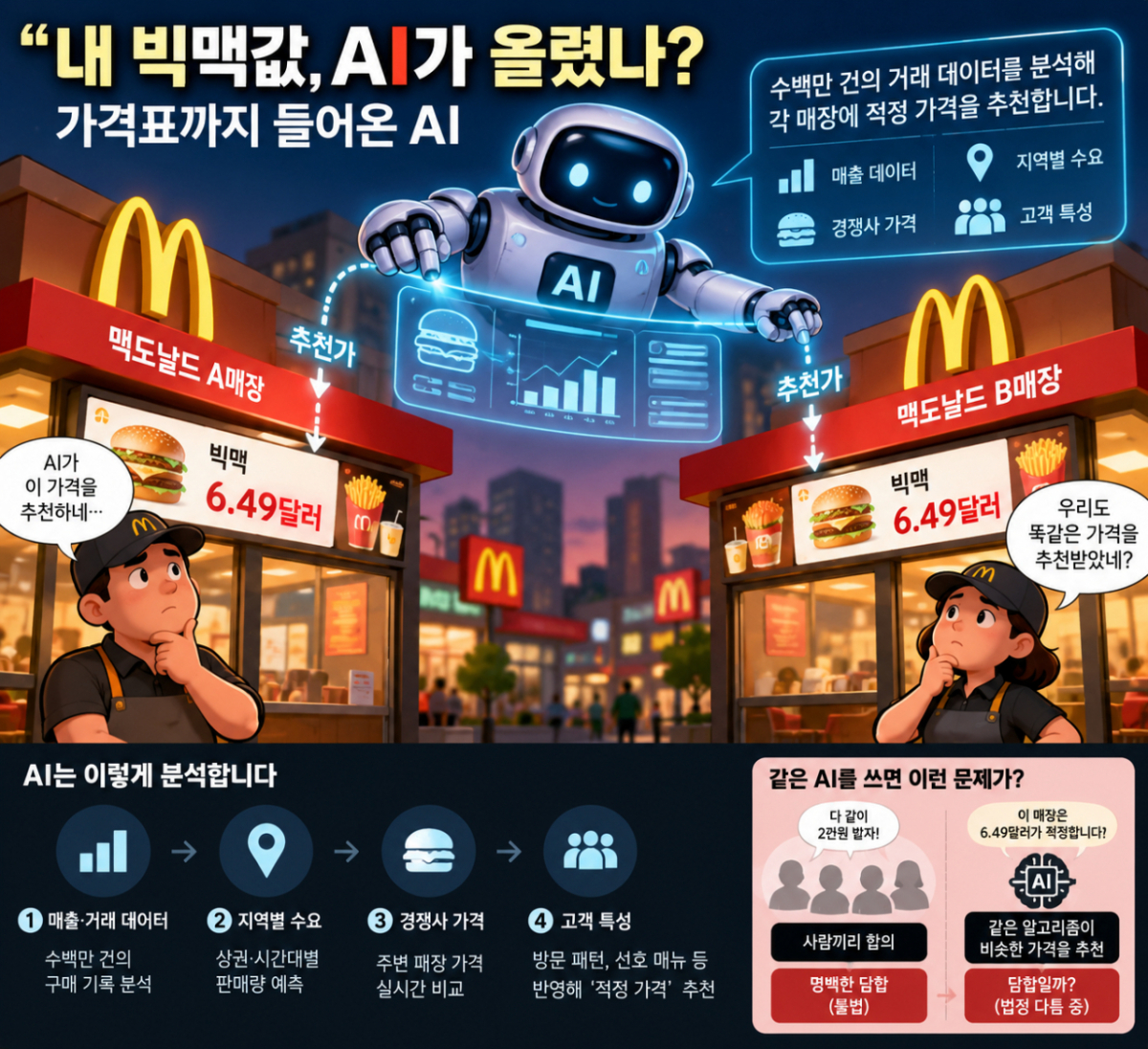
Imagine two McDonald's locations facing each other across a single street. If they are competing stores, it is natural for each to set its own prices. But what if both stores ask the same AI, "How much should I charge?" The situation changes.
This issue has gone to court in the United States. Consumers filed a class-action lawsuit against McDonald's. They claim that McDonald's effectively coordinated menu prices at franchisees through an AI-based pricing recommendation system that analyzes transaction data from approximately 14,000 stores. McDonald's countered by stating, "AI does not set prices; it only suggests recommended prices, and the final decision is made by the store owner."
The issue is not whether AI decided the prices. The problem is that when competing businesses use the same pricing recommendation system, the function of price competition may be weakened.
In the past, store owners directly judged based on the prices and sales of nearby stores. Now, AI can analyze millions of transaction records and regional demand at once to recommend, "This store can charge up to this amount without losing many customers."
The problem arises when multiple businesses use the same algorithm. If people meet and agree, "Let's all charge 20,000 won," it is collusion. But how should it be viewed if they do not meet each other, yet the same system recommends similar prices and everyone follows them?
Similar controversies have already occurred in the United States regarding apartment rents and hotel room rates. There are concerns that algorithms which gather non-public information from multiple businesses to recommend prices can weaken competition.
Taking it one step further, AI could present different prices to each consumer. This is a method of analyzing purchase history and behavioral data to determine, "This person will pay up to this amount." However, McDonald's has drawn a line by stating that it does not implement customer-specific pricing or real-time price fluctuations.
AI pricing recommendation itself is not a bad technology. If inventory remains, prices can be lowered; if demand surges, prices can be adjusted to increase efficiency. The issue is whose data is gathered and on what basis prices are recommended.
Whether McDonald's actually violated the law is for the court to decide. However, it is clear that AI has already entered the price tags of hamburgers, monthly rent, and hotel rooms, answering the question of "how much should be charged."

 in TECH
