

[For more diverse corporate information on the startup featured in this article, please visit the Data Lab of the Unicorn Factory Big Data Platform 'Data Lab'.]
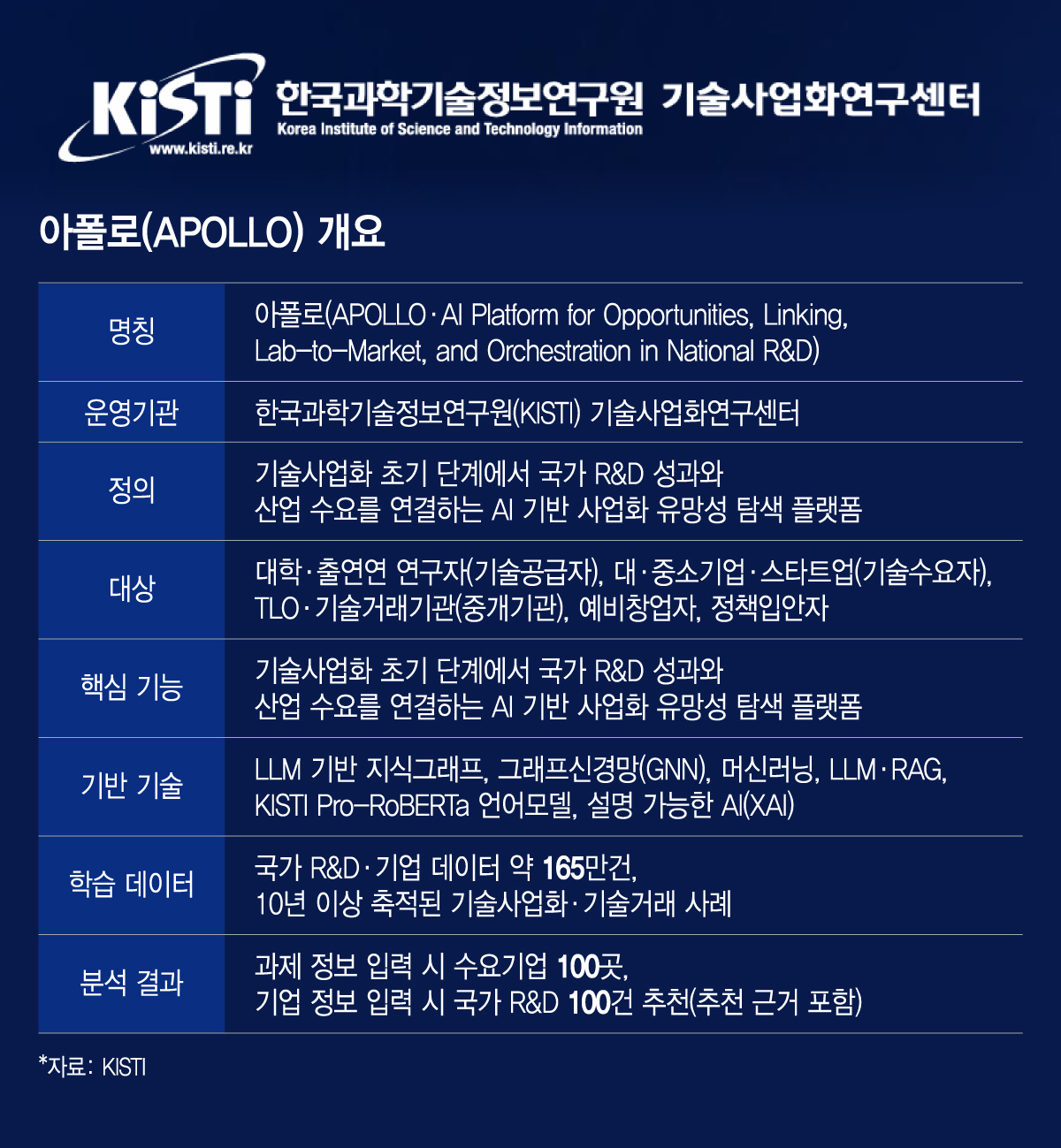
Artificial intelligence (AI) is stepping in to address the biggest challenge for promising technologies developed in research labs: identifying demand-side companies. MoneyToday’s startup media platform, ‘Unicorn Factory,’ will deploy KISTI’s commercialization-specialized AI, ‘Apollo,’ at the ‘K-Premier Deep Tech Festa (Technology Transfer and Commercialization)’ scheduled to be held on the 29th at Hall B of COEX. Apollo analyzes national R&D (research and development) and corporate data, among other things, and plans to conduct precise analyses of technologies presented by the four major science and technology institutes, including KAIST, to recommend demand-side companies and drive actual business cooperation and technology transfer outcomes.
From Expert Intermediation to AI-Based ‘Screening, Judgment, and Matching’
According to survey data from the Korea Institute for Technology Evaluation and Planning (KITEP) and others on the 12th, the biggest obstacle to technology transfer and commercialization was a ‘lack of specialized capabilities’ in technology transfer organizations (TLOs), cited by 55.0%. This was followed by ‘limitations in identifying demand-side companies’ (52.5%) and ‘a lack of marketable technologies’ (44.2%). This indicates that information between research institutional investors and companies is not sufficiently connected, and there is a shortage of specialized personnel to bridge the two sides. It is also why researchers and companies still rely on personal networks or trade fairs to find commercialization partners.
KISTI viewed a specialized AI that understands both technology and the market and can identify commercialization potential from vast data as an alternative solution. While general-purpose AI is useful for answering general questions, technology commercialization requires the ability to interpret specialized technologies in the language of the market and comprehensively judge factors such as technology readiness level, market fit, and corporate financial soundness.
Based on more than 10 years of accumulated experience in technology transfer and commercialization, along with approximately 370 million data points related to technology, companies, products, and markets, KISTI developed the specialized AI ‘Apollo’ in-house. While existing methods merely compared how similar research outcomes and corporate technologies were to make connections, Apollo analyzes various histories between technologies and companies, ranging from participation in research projects to patent applications, technology transfer, and startup formation. Through this, it predicts not only the characteristics of the technology itself but also what technologies companies need and whether there is a likelihood of leading to actual commercialization. It was explained that even for new technologies with almost no past technology transfer cases, Apollo can identify potential demand-side companies that have yet to emerge by analyzing related data and relationships.
The usage is simple. When a researcher selects a research project or patent, or inputs/uploads technical materials, Apollo analyzes the core technical information and recommends 100 demand-side companies with a high probability of needing that technology. Conversely, when a company selects its own information or inputs/uploads technology demand materials, Apollo analyzes the core needs and recommends suitable national R&D projects, related patents, and transferable technologies held by government-funded research institutes and universities. Each recommendation result is accompanied by the basis for selection to assist in subsequent review and commercialization decision-making.
Apollo 2.0 Upgrade… From Conversational AI to Global Market Analysis
KISTI upgraded to ‘Apollo 2.0’ reflecting improvements identified during a pilot operation conducted from September last year to February this year. It is scheduled for official release on the 22nd of this month and will also be applied to the analysis of technologies presented at the K-Premier Deep Tech Festa.
The biggest change is the conversational integrated Language User Interface (LUI) agent. Previously, users had to directly find menus by function, but in version 2.0, when asked a question in natural language, the AI grasps the intent and selects and connects the necessary analysis functions. For example, if requested to “shortlist the top 10 companies by semiconductor market share and recommend national R&D projects suitable for the number one company,” users can receive connected results ranging from market analysis to project recommendations in report form.
The analytical foundation has also been expanded. The proprietary corporate database (DB) used for predicting demand-side companies increased from 480,000 to 1.9 million entries, roughly a fourfold increase. Real-time linkage with national R&D data has also broadened the scope of technology and patent matching.
Global market analysis capabilities have also been strengthened. Product market analysis has expanded from a domestic focus to include overseas markets and competitor analysis. For exploring promising global items, overseas startup data has been linked to reflect investment trends and deep tech (advanced technology) commercialization trends.
Corporate potential analysis has been advanced into a quantitative evaluation system integrating financial and technical data. This allows professional institutional investors to use it for diagnosing a company’s growth potential.
KISTI plans to develop an AI that predicts what technologies global leading companies will need in the future. This method involves analyzing patent and technology development trends of global leading companies and those trying to catch up, to identify what technologies chasing companies will need to secure going forward.
Byeon Jeong-eun, Director of KISTI’s Technology Commercialization Research Center, stated, “At this K-Premier Deep Tech Festa, we used Apollo to identify overseas companies that might need the eight deep tech technologies held by the four major science and technology institutes,” adding, “We will also show what technologies each company lacks compared to leading firms and how much of that gap can be reduced by adopting the science and technology institutes’ technologies.”
She added, “Through the technology commercialization-specialized AI developed in-house by KISTI, we will connect national R&D outcomes with domestic and international corporate technology demand, and build an AI infrastructure for commercialization leading to technology transfer, deep tech startups, and global market entry.”
[MoneyToday startup media platform Unicorn Factory]

 in TECH
