

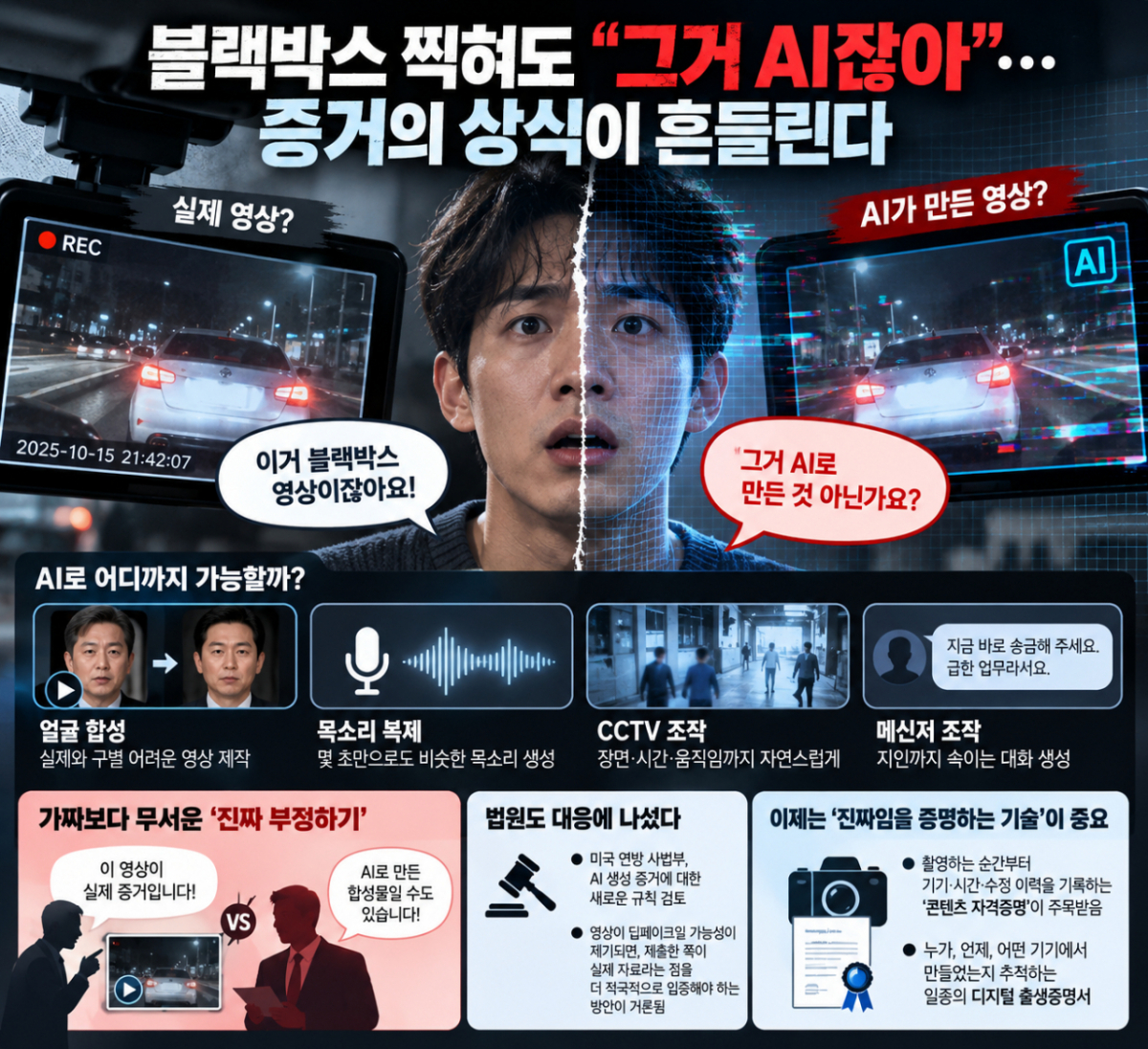
A traffic accident was captured on a black box camera. The license plate number of the other vehicle and the driver's face are clear. In the past, this would have been decisive evidence. From now on, the other party may say this: "Isn't that video made with AI?"
As generative AI produces videos and voices that are difficult to distinguish from actual footage, the common sense that photos, videos, and recordings represent "facts as they appear" is being shaken. The problem does not end with the increase in fakes. It is also that genuine videos can be suspected of being fake.
OpenAI and Meta recently warned the U.S. federal judiciary that it is difficult to perfectly filter out AI-generated video or audio with current technology, and that creating a 100% accurate detector will not be easy in the future either.
This is also what courts are concerned about. Even if there is CCTV footage of an assault scene or a recording of workplace bullying, if the other party claims it is an "AI composite," the authenticity must be re-verified. The technology to create fakes effectively provides a pretext to deny the real thing.
The U.S. judiciary is considering revising evidence rules in preparation for such situations. It is mentioned that if the possibility of a video being a deepfake is raised, the side submitting it as evidence would be required to more actively prove that it is actual material.
Responses from the IT industry are also changing. Rather than looking at already created videos to find fakes, methods that leave traces indicating "this is the genuine original" from the moment of shooting are gaining attention.
A representative example is 'Content Credentials.' When taking a photo or video, it records which device and when it was created, and also leaves a record of subsequent editing processes. It is a kind of digital birth certificate. In the future, there is a high possibility that verification will extend beyond just looking at the video itself to checking who shot it, what device created it, and whether it was modified in between.
Korea is no exception. While mandatory labeling for AI-generated content has been introduced, verifying the authenticity of materials used in actual disputes, such as black box footage, CCTV, and call recordings, is a separate issue.
What AI changes is not only the quality of fake videos. Until now, it was thought that "if there is video, it is fact." In the future, it is expected to become more important whether one can prove where that video came from and that it has not been tampered with in between. The power of evidence is being shaken.

 in TECH
