

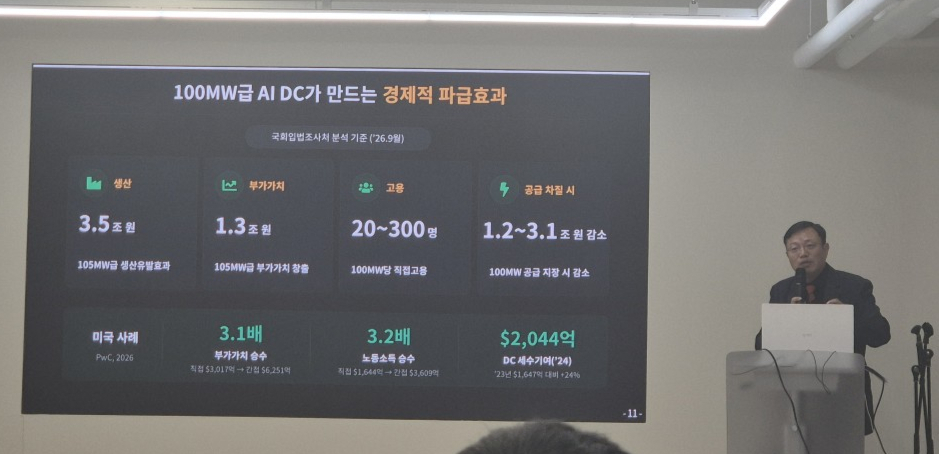
It was pointed out that Korea must not miss the optimal window to leap forward as an AI data center (DC) powerhouse. Additionally, it was requested that the scope of the AIDC Special Act be expanded and regulations on "grid codes" for power grid stability be relaxed, given that attracting a 100-megawatt-class AI DC would generate tax revenue effects of several hundred billion won annually for the region.
Lee Young-tak, Vice President of SK Telecom's AIDC Integrated Promotion Team, delivered a presentation titled "The Role and Future of AIDCs in the Era of AI Factories" at the "12th AI Future Value Forum" held on the 21st at the Korea Telecommunications Business Association (KTOA) building in Samsung-dong, Gangnam-gu, Seoul. As data centers evolve into core infrastructure that produces "tokens," the intelligence of AI, and as Korea aims to leap forward as Asia's largest AI infrastructure hub, it was noted that there are limitations to designating only corporate self-consumption as eligible for tax credits.
Based on analysis materials from the National Assembly Research Service, Vice President Lee stated that the production-inducing effect of a 100-megawatt-class AIDC is 3.5 trillion won, the employment-inducing effect is up to 300 people, and the tax revenue contribution exceeds 1 trillion won. He also noted that amid fierce global competition to attract AIDCs, Korea is drawing attention based on its stable power grid, geographical advantages, spare capacity in submarine cables, and strengths as a semiconductor powerhouse.
However, he pointed out that due to the "self-consumption" provision within the AIDC Special Act, few companies are receiving the 15th% tax credit, which could hinder the activation of AIDC investment. The AIDC Special Act was promulgated on June 9 and will take effect from March 10 of next year, nine months after its promulgation.
Vice President Lee emphasized, "AI DCs are facilities that produce intelligence and provide it externally, rather than for self-consumption," adding, "If tax credits for colocation (leasing) formats that utilize external parties are excluded, the credit for AI DCs as national strategic technology commercialization facilities becomes meaningless."
Furthermore, he stated that while the Ministry of Climate, Energy and Environment is showing moves to introduce a "grid code" exclusively for AI DCs within this year to ensure power grid stability, it is important for the private sector and government to consult so that it does not become an obstacle to the large-scale AI DC industry.
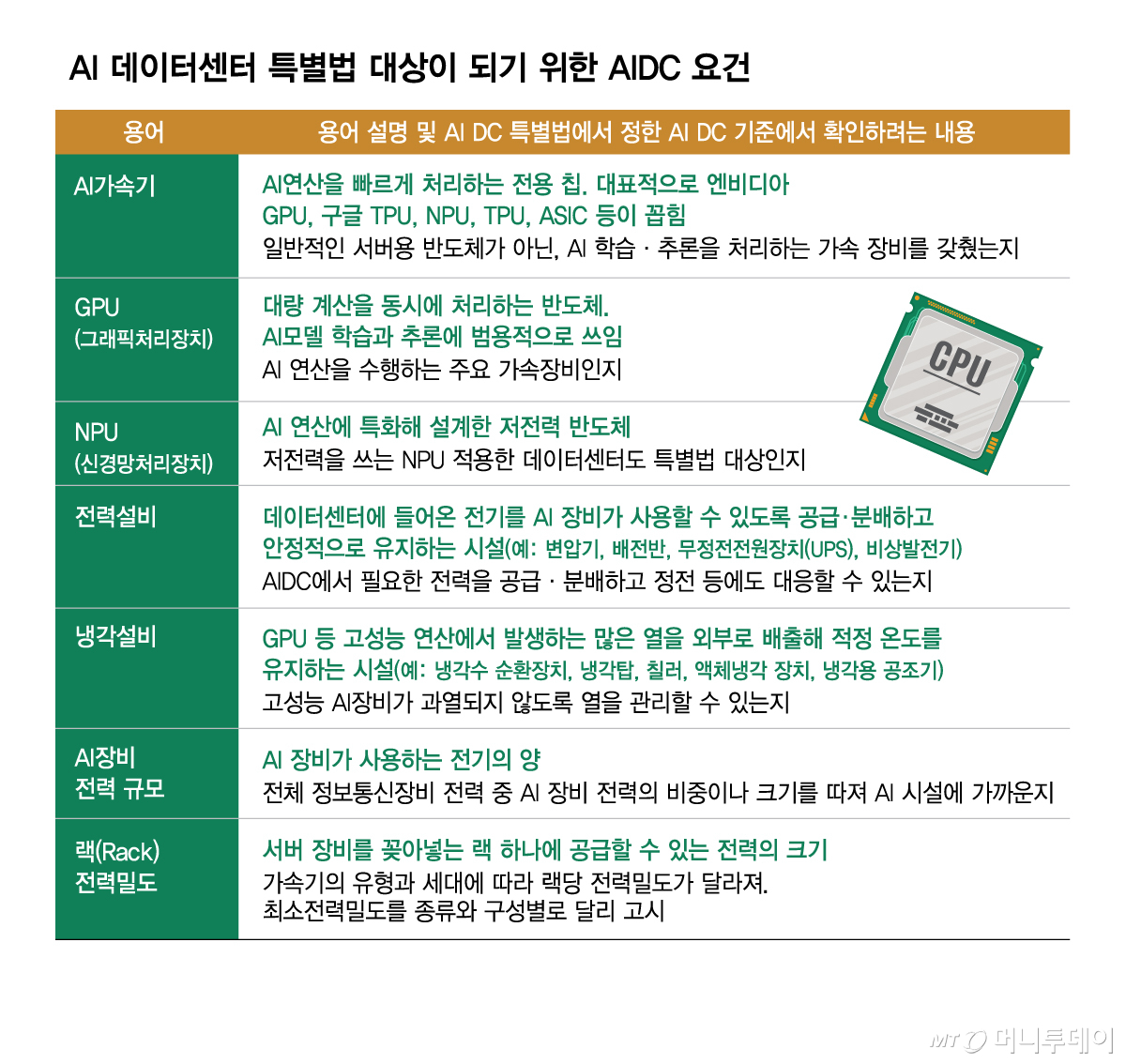
Song Do-young, a lawyer and head of the AI-Infrastructure Center at Law Firm Jipyeong, explained the "Subordinate Regulations of the AIDC Special Act," scheduled for release in November. In particular, he examined legal issues regarding three criteria distinguishing general DCs from AIDCs: △installation of AI accelerators and meeting a certain level of power density per AI rack unit △securing power and cooling equipment necessary for accelerator operation △and the ratio or scale of AI equipment power exceeding a certain standard.
First, regarding why the design power of AI racks is set as an AIDC requirement, Lawyer Song stated, "Power consumption varies by AI accelerator, and even for racks of the same size, power consumption differs depending on how they are integrated." He added that they plan to issue a notice dividing types and configuration methods into CPU (Central Processing Unit) series, NPU (Neural Processing Unit) series, and GPU (Graphics Processing Unit) series. They also plan to consider facility-level power requirements alongside the design power of AI racks.
Assessing the ratio of AI equipment power to total facility power is intended to examine how close a facility is to being AI-exclusive. However, plans are in place to ensure that facilities converting existing DCs to AIDCs, or those operated primarily with relatively low-power-consuming NPUs or AI inference services, do not fall outside the scope of benefits.
The "One-Stop Permit Processing System" within the Special Act is designed as a "time-out" method requiring relevant institutional investors to decide on approval or rejection within statutory deadlines, rather than a system guaranteeing business operators' permit passage. Statutory deadlines set by law include: △power grid impact assessment up to 150 days △consultation on energy usage plans and review of traffic, landscape, and architecture up to 90 days △and building permits and fire safety consent up to 40 days. Extensions are limited to one instance of 30 days.
Subsequently, in the overall discussion session, moderated by Lee Seong-yeop from the Technology Management Department at Korea University, experts from industry, academia, and research institutes participated to discuss AIDC infrastructure expansion and legal and policy support measures. Attendees discussed the need to resolve structural bottlenecks such as power security, site selection, and permit delays, and to strengthen public-private cooperation.

 in TECH

