

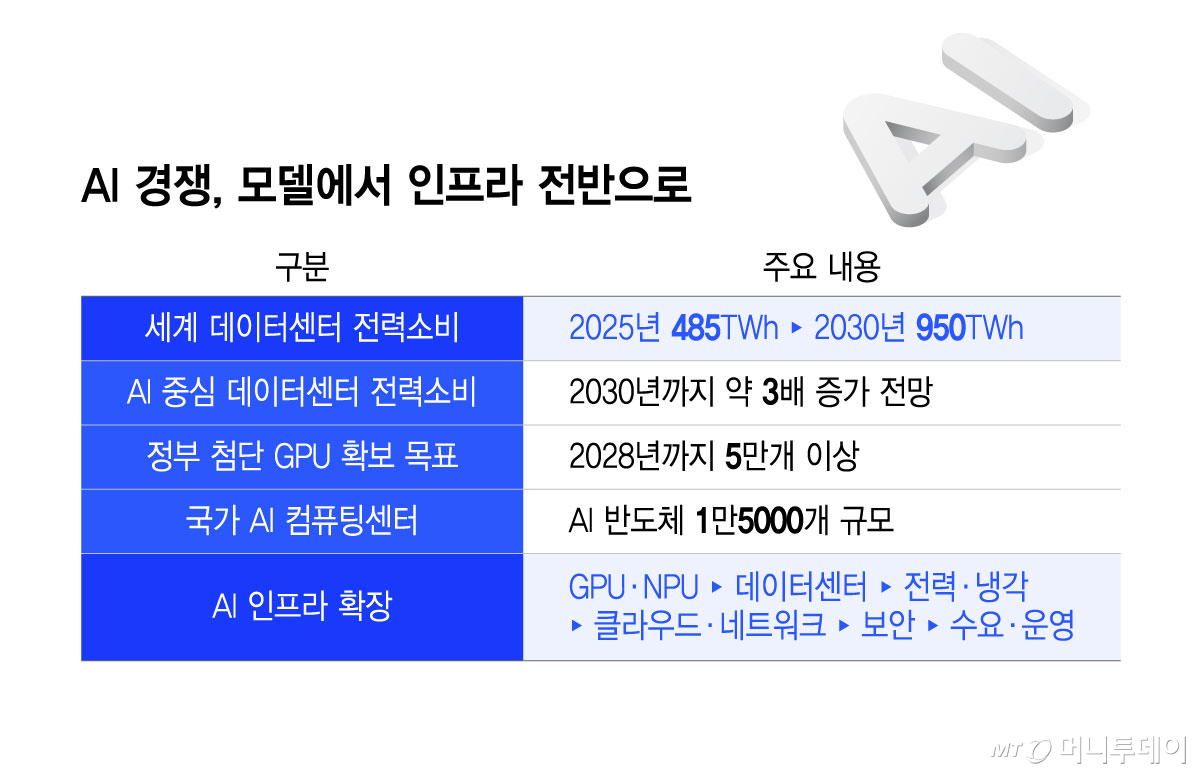
The center of gravity in AI competition is rapidly expanding from models to infrastructure. The importance of data centers, power, cooling, cloud, and networks that house computing resources such as GPUs and NPUs is being highlighted. As AI begins to enter real-world sites such as offices and factories, security has also established itself as a critical piece of infrastructure.
The change first appears in power demand. According to the International Energy Agency (IEA), global data center power consumption is projected to nearly double from 485 TWh (terawatt-hours) in 2025 to 950 TWh by 2030. In particular, power consumption for AI-centric data centers is expected to increase approximately threefold over the same period.
The government aims to secure more than 50,000 advanced GPUs based on B200 performance standards by 2028. The computing resources secured by the government amount to approximately 35,200 units when converted to B200 equivalents. The National AI Computing Center being built in Solar City, Haenam, South Jeolla Province, will be equipped with 15,000 AI semiconductors.
Securing GPUs alone does not complete AI infrastructure. After installing the equipment, power and cooling must be connected, networks linked, and it must be made accessible for actual companies and research institutional investors to use.
Kim Eun-ju, Head of the Intelligent Technology Infrastructure Division at the Korea Institute of Defense Intelligence Command (NIA), described AI data centers (AIDC) not as mere computer facilities, but as "national strategic factories that produce intelligent tokens." She noted that the role of AIDCs is growing as the market expands from generative AI to physical AI that operates in the real world, such as agentic AI, robots, automobiles, and industrial equipment.
Data center technology is also changing. Division Head Kim cited 48V power systems, diversification of energy sources such as Small Modular Reactors (SMRs), and cooling technologies for high-density computing environments, such as water-cooling and immersion cooling, as key changes. This signifies that the scope of AI infrastructure is broadening beyond semiconductors to include power, energy, and cooling.
Security challenges are also growing. In production sites, Operational Technology (OT) connected to actual equipment must be protected. In business environments, how to divide authority between humans and AI has emerged as a new issue, as AI agents directly access corporate systems.
The entities responsible for each area of AI infrastructure have also become diverse. Data center operators need power and cooling companies, while GPU and cloud operators must find companies and research institutional investors who will use the computing resources. Financial, public, and manufacturing companies also need to cooperate with supply companies on how to adopt rapidly changing and evolving infrastructure.
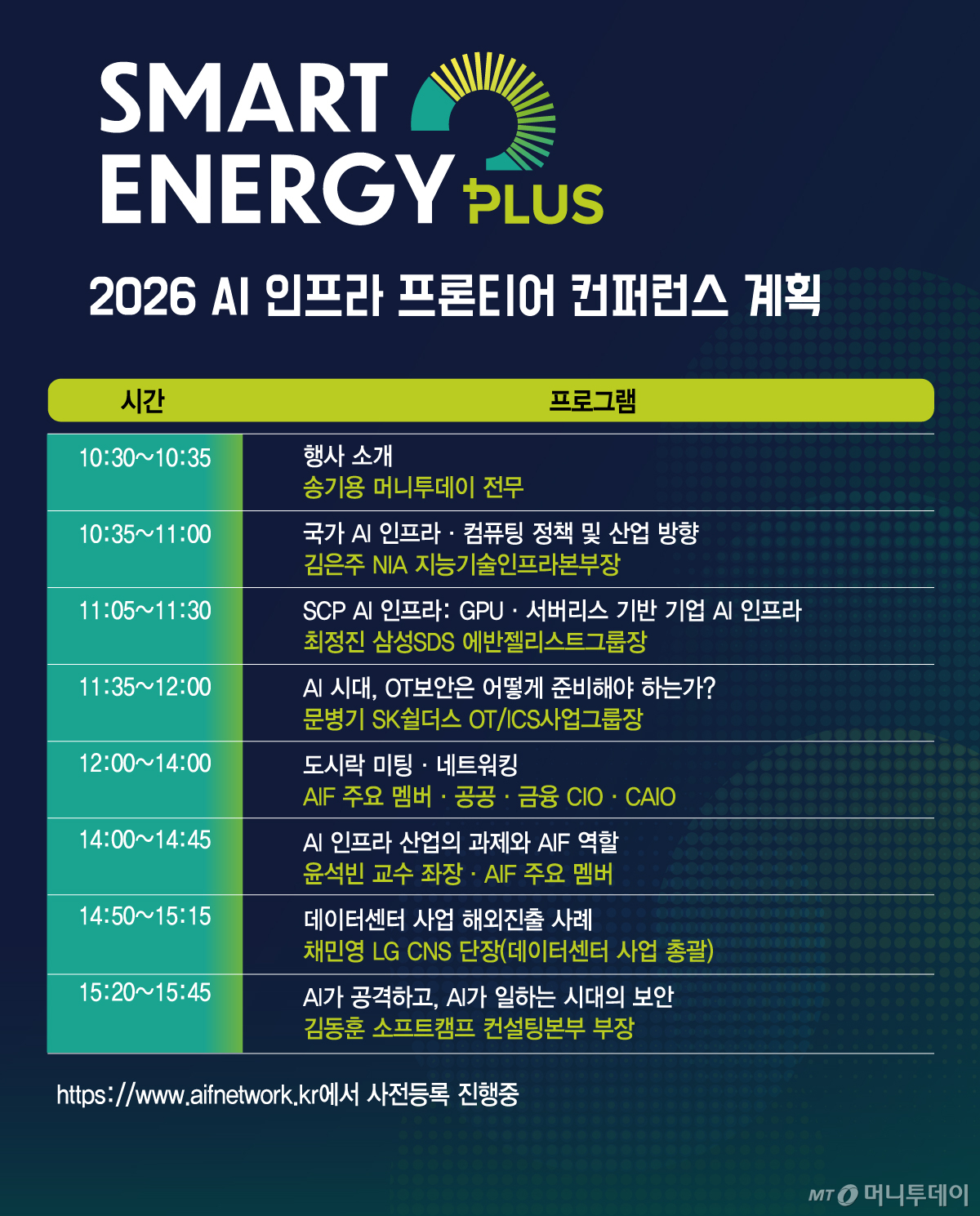
Money Today will hold the "AI Infrastructure Frontier Conference" at Seoul COEX on the 29th to examine these changes. Kim Eun-ju, Head of NIA, will present on national AI infrastructure and computing policies, as well as AIDC strategies. Samsung SDS, SK Shielders, LG CNS, and Softcamp will each introduce field cases regarding computing resources and cloud, industrial security, data centers, and AI agent security.
On the same day, the AI Infrastructure Network AIF (AI Infra Frontier) will also officially launch. It focuses on connecting necessary technologies with demand among supply companies, actual demand-side companies in finance, public sectors, and manufacturing, and investment and policy stakeholders. As AI infrastructure expands, connecting different resources and demands has become as important as securing individual technologies.

 in TECH

