

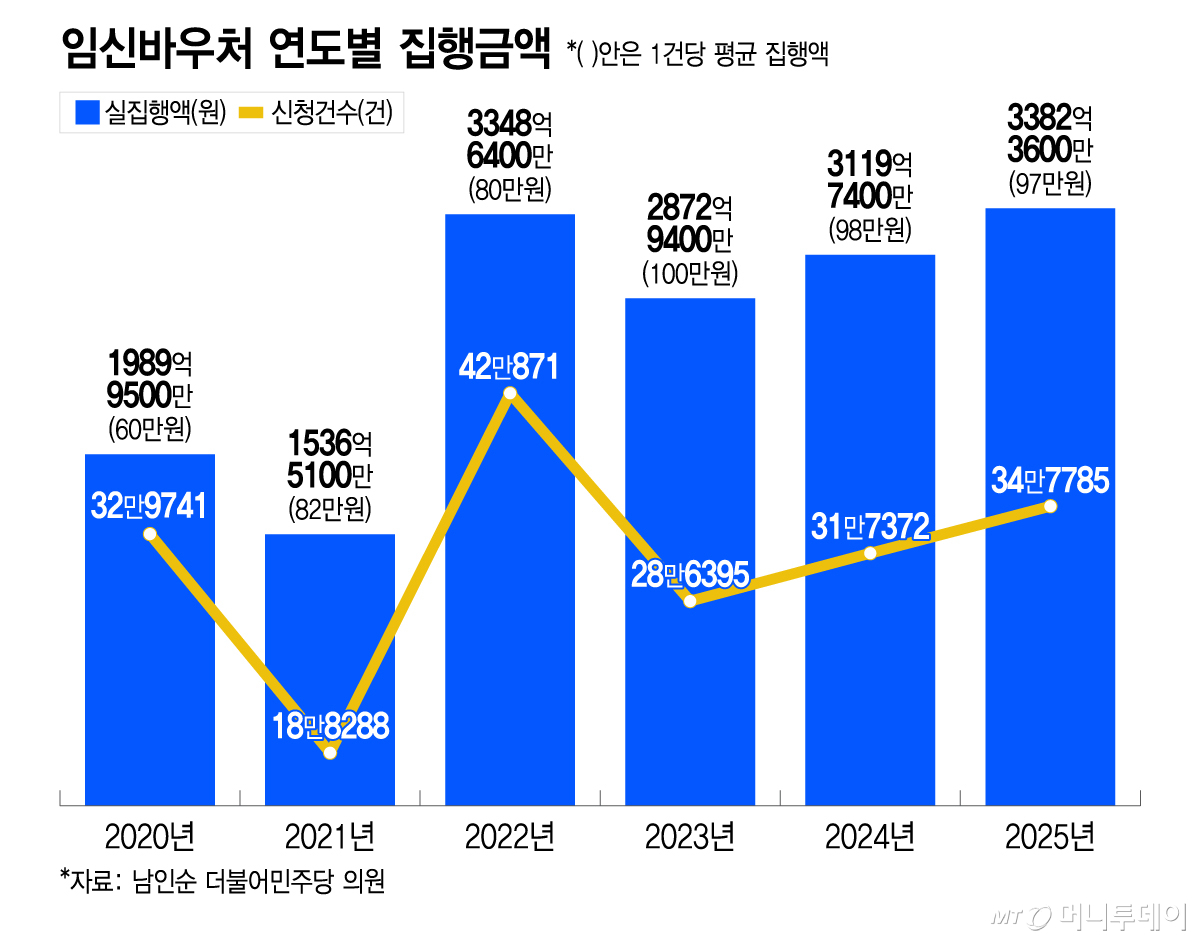
Last year, nearly 340 billion won was spent through the "pregnancy voucher" program, a 70% increase compared to five years ago. As government subsidies have grown, non-covered service prices related to pregnancy and childbirth have continued to rise. Critics argue that a policy introduced with good intentions has been used less to reduce patient burdens and more to "pad the profits of medical institutional investors."
According to data on annual expenditure amounts for pregnancy vouchers obtained by Democratic Party of Korea lawmaker Nam In-soon (Seoul Songpa-byeong), a member of the National Assembly's Health and Welfare Committee, from the Ministry of Health and Welfare, the amount disbursed last year was 338.236 billion won. This represents a 70% increase compared to 198.995 billion won in 2020.
Last year, there were 347,785 applications for pregnancy vouchers, with an average disbursement of 970,000 won per case. This is an increase from the 329,741 applications and an average disbursement of 600,000 won per case in 2020. The rise reflects the government's consistent expansion of pregnancy voucher support amounts to address low birth rates.
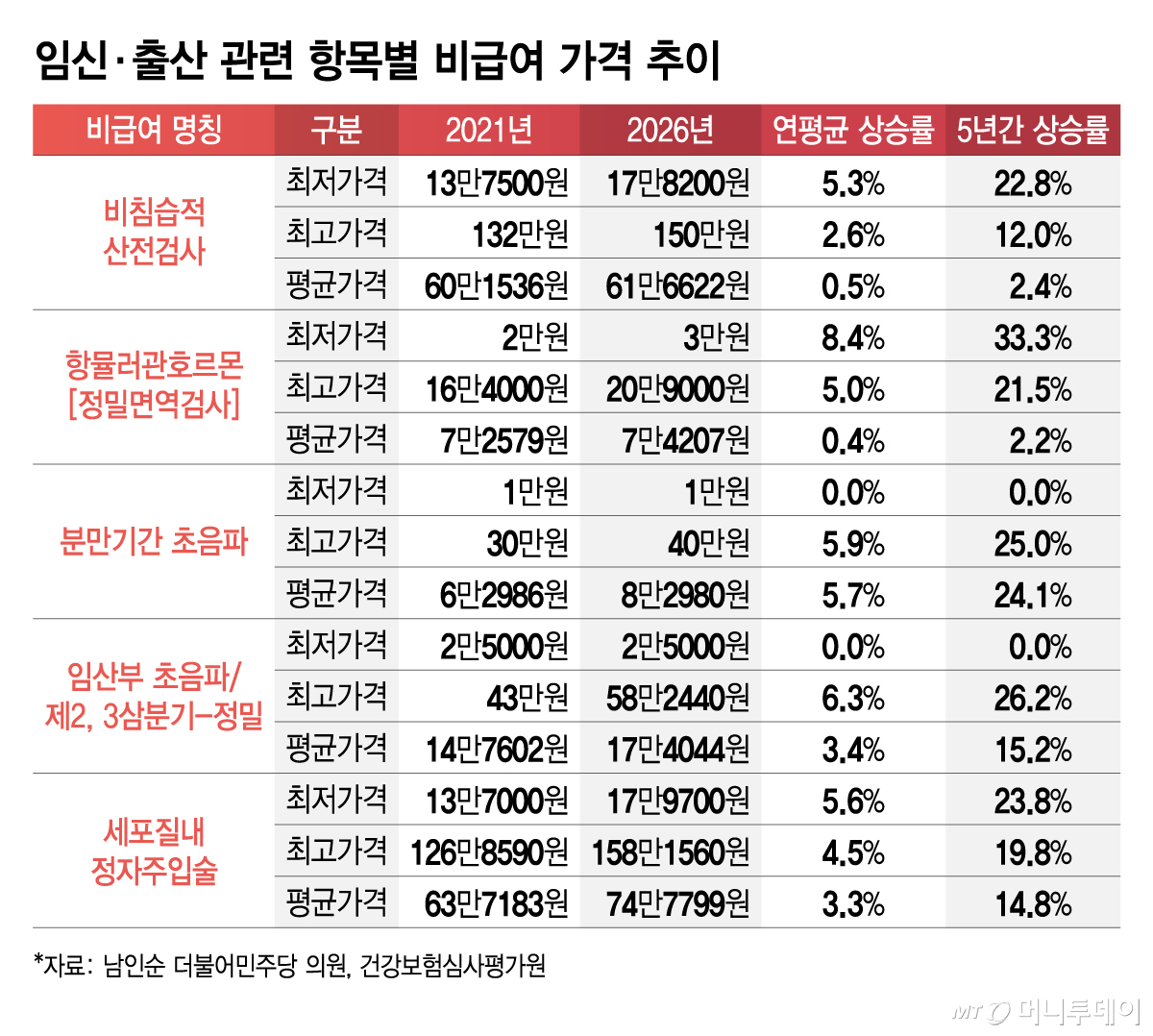
During a similar period, non-covered service prices related to pregnancy and childbirth rose steadily. The item with the largest increase was "ultrasound during delivery period." This year's average price was 82,980 won, up 24.1% compared to 2021, representing an annual average increase of 5.7%. The average price for "pregnant woman ultrasound (second and third trimesters - detailed)" was 174,044 won, rising 15.2% over five years, with an annual average increase of 3.4%. Based on the highest price, it reached 582,440 won, up 26.2% over five years, with an annual average increase of 6.3%.
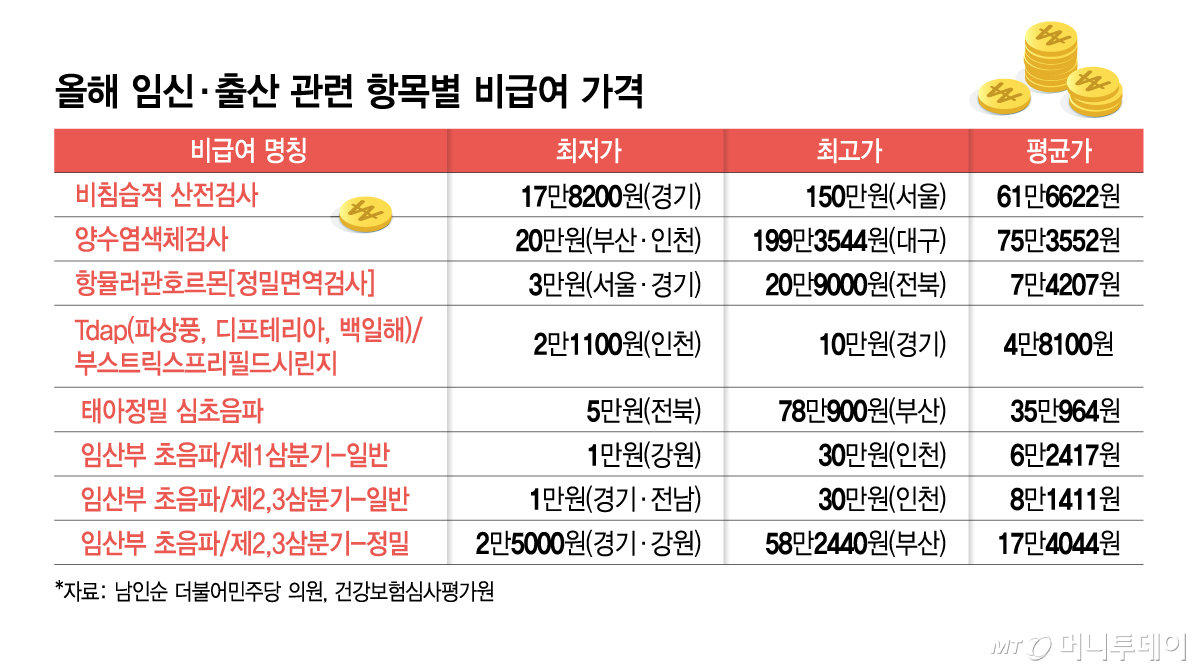
Because these are "rubber-band" prices set arbitrarily by medical institutional investors, price gaps between regions and among medical institutional investors were significant. For the "anti-Mullerian hormone" test, the lowest price in Seoul was 30,000 won, while the highest price in North Jeolla Province reached 209,000 won, approximately seven times higher. For "non-invasive prenatal testing," the lowest price in Gyeonggi Province was 178,200 won, whereas the highest price in Seoul was 1.5 million won, more than eight times higher.
Nam (Rep.) emphasized, "Even if support funds for pregnancy and childbirth are increased, if non-covered service prices rise simultaneously, the perceived benefit for mothers may decrease." She added, "Given that non-covered service prices vary significantly depending on the medical institutional investor, the government should not stop at expanding vouchers but must also establish price monitoring and management mechanisms for major non-covered services related to pregnancy and childbirth."

 in THEBIO


