


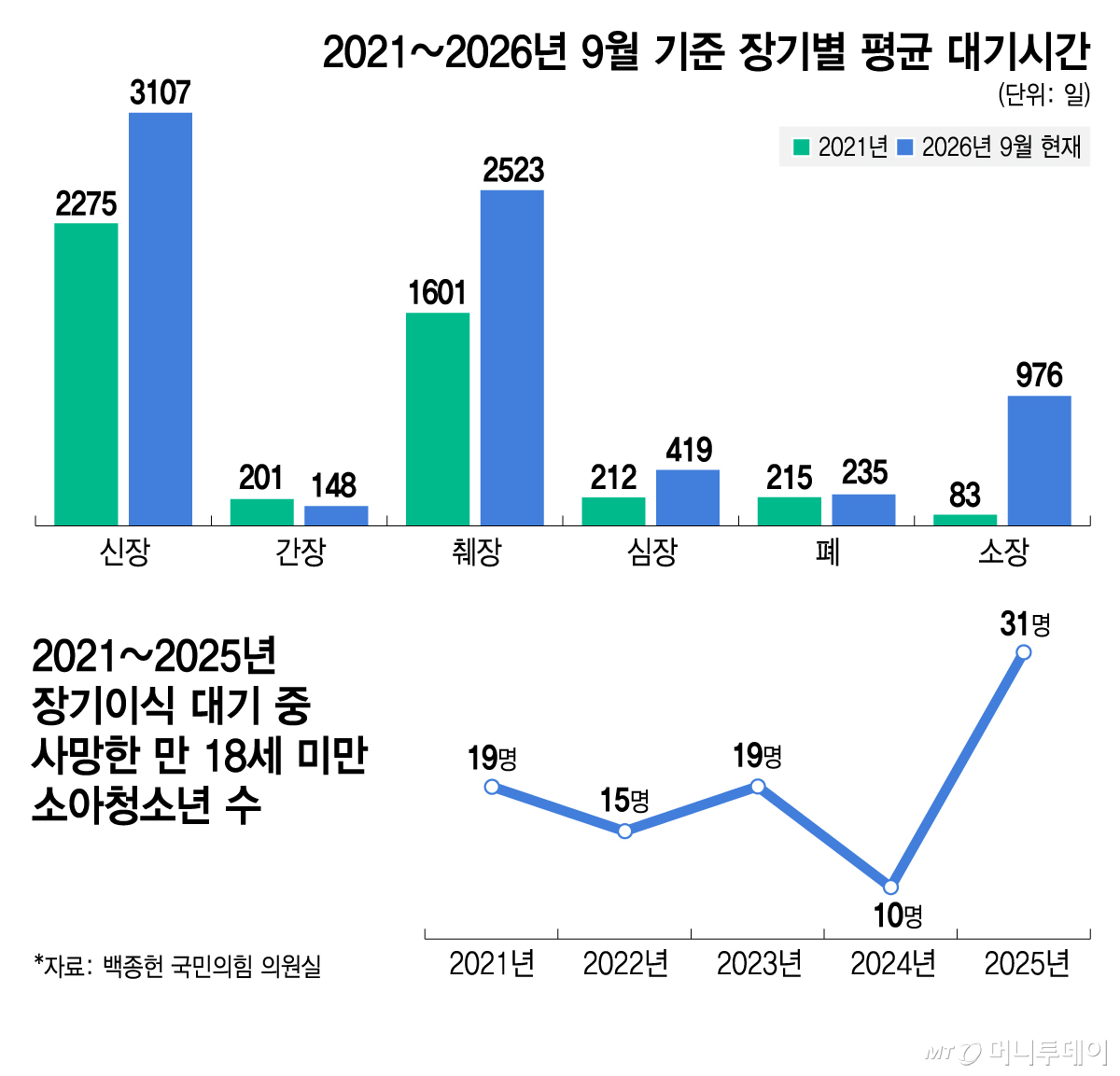
The average waiting time for a kidney transplant has lengthened by more than two years, meaning recipients must now wait an average of approximately eight years and six months before receiving a transplant. The number of children and adolescents who died while awaiting organ transplants tripled in one year.
According to data submitted by the Korea National Tissue and Blood Management Institute and other agencies to the office of Rep. Baek Jong-heon, a member of the People Power Party on the National Assembly’s Health and Welfare Committee, the average waiting time for kidney transplants increased from 2,275 days (six years and three months) in 2021 to 3,107 days (approximately eight years and six months) as of September this year, an increase of about two years and three months. During the same period, the waiting time for pancreas transplants lengthened from 1,601 days (approximately four years and five months) to 2,523 days (six years and eleven months), an increase of about two years and six months.
The number of children and adolescents who died while waiting for a transplant also rose. Among those who died while on the organ transplant waiting list by year, the number of minors under the age of 18 increased from 10 in 2024 to 31 last year, a threefold increase.
While the number of people on organ transplant waiting lists continues to rise due to factors such as an aging population and an increase in chronic diseases, the number of donors providing organs has declined. In fact, the number of people on transplant waiting lists increased from 39,261 in 2021 to 46,550 last year, while the number of brain-dead organ donors decreased from 442 to 370 during the same period. As of August this year, the number of people on organ transplant waiting lists has reached 48,456.
The consent rate for organ donation is also declining each year. According to data from the Korea Organ and Tissue Donation Foundation on the annual consent rate for organ donation among estimated brain-dead individuals, the annual consent rate fell from 36.7% in 2021 to 28.2% last year, breaking below the 30th% mark. The organ donation consent rate refers to the proportion of guardians of estimated brain-dead individuals who are eligible for organ donation and consent to the donation.
Amid deepening imbalances between demand and supply in organ transplants, the government stated it is exploring relevant countermeasures. The Ministry of Health and Welfare formulated the "Comprehensive Plan for Organ and Tissue Donation and Transplantation (2025–2030)" last October. The plan’s key points include significantly expanding donation intent registration institutional investors over the next five years and legislating the "Donation after Circulatory Death (DCD)" system, which has become widespread in advanced countries such as the United States and the United Kingdom.
A Ministry of Health and Welfare official said, "To improve public accessibility to donation intent registration, we are continuously expanding related registration institutional investors." The official added, "The number of new institutional investors increased by 15, from 462 at the time the comprehensive plan was formulated to 477 as of this month. We plan to actively promote and guide medical institutions, non-profit corporations, and public institutions so that they can be designated as donation intent registration institutional investors, going beyond merely providing information on donation."
Regarding the introduction of the DCD system, Reps. Seo Mi-hwa and Seo Yeong-seok of the Democratic Party of Korea previously filed a bill to amend related laws as representative sponsors. A Ministry of Health and Welfare official said, "In April last year, we held an initial expert roundtable to gauge the acceptance of the DCD system in medical settings and gather opinions from relevant academic societies." The official added, "If the amendment is passed, we are currently advancing a research project titled 'Study on Establishing Detailed Guidelines for DCD' to develop standard protocols that can be immediately applied in medical settings."
Baek Jong-heon (Rep.) said, "As waiting times for transplants by organ continue to lengthen, more pediatric and adolescent patients are dying while waiting indefinitely for a transplant." The official added, "We must swiftly formulate substantive countermeasures to improve the prolonged structural imbalance between demand and supply in organ transplantation."

 in THEBIO

