

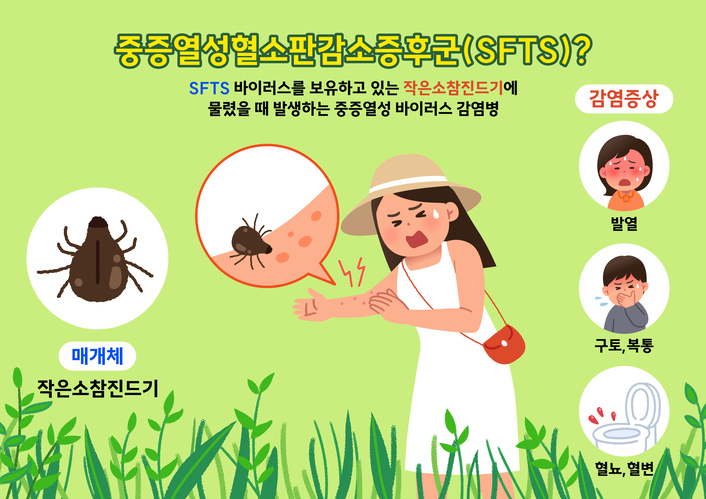
Among zoonotic infectious diseases that can infect both humans and animals, infections such as Salmonella and Enterohemorrhagic E. coli have shown a steady increase for the past decade. Notably, Severe Fever with Thrombocytopenia Syndrome (SFTS), known as the “lethal tick” disease, was confirmed to surge domestically last year.
On the 30th, the KDCA published the “2026 One Health Annual Report,” which comprehensively analyzes the occurrence status and response systems for domestic zoonotic infectious diseases. One Health is a cross-ministerial, multi-sectoral, and multidisciplinary cooperation strategy that recognizes the interconnectedness of human health with animal and environmental health, aiming to provide optimal health for all.
Zoonotic infectious diseases are infections that can be transmitted between humans and animals, and their risk of occurrence may increase due to climate change, increased contact with pets and wild animals, and expanded international exchanges. Accordingly, the KDCA has published an annual One Health report every year since 2023 to establish a cross-ministerial, multi-sectoral integrated surveillance foundation for zoonotic infectious diseases. In particular, it has compiled domestic occurrence status and analyzed major changes regarding 14 “priority zoonotic infectious diseases.”
The 14 priority zoonotic infectious diseases include △Salmonella infection △Campylobacter infection △Enterohemorrhagic E. coli infection △Toxoplasmosis △Tuberculosis △Brucellosis △Q fever △Multidrug-resistant bacterial infection △Severe Fever with Thrombocytopenia Syndrome (SFTS) △Japanese encephalitis △Human infection from animal influenza △Psittacosis △Rabies, and △Anthrax.
In particular, this report strengthened long-term trend analysis by considering changes in surveillance systems and reporting criteria over the past 10 years (2016–2025), while also examining the status of surveillance systems in each sector (human-animal-environment) and the comparability of data.
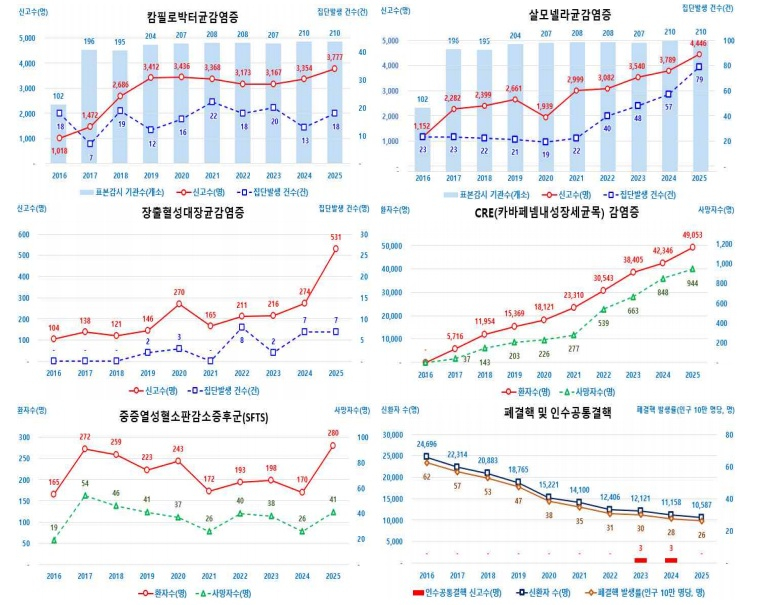
Among them Enterohemorrhagic E. coli infection saw reported cases rise by 257 (93.8%) from 274 in the previous year to 531 last year, but cluster outbreaks remained unchanged at 7 incidents involving 17 people. Salmonella infection had sample surveillance reports increase by 657 (17.3%) from 3,789 in the previous year to 4,446, with cluster outbreaks totaling 79 incidents and 3,915 cases.
Severe Fever with Thrombocytopenia Syndrome (SFTS) saw patient numbers increase by 110 (64.7%) from 170 in the previous year to 280, while deaths rose by 15 (57.7%) from 26 in the previous year to 41. Q fever reports increased by 15 (26.3%) from 57 in the previous year to 72. Among multidrug-resistant bacterial infections, CRE infection patient numbers were found to have increased by 6,707 (15.8%) from 42,346 in the previous year to 49,053.
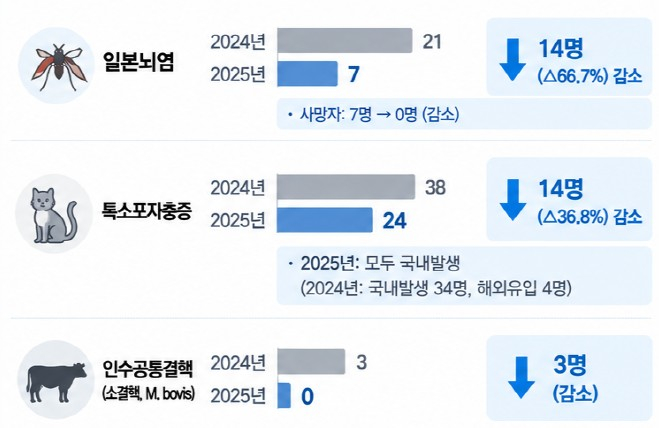
Conversely, Japanese encephalitis patient numbers decreased by 14 (△66.7%) from 21 in the previous year to 7, and while there were 7 deaths in 2024, none occurred in 2025. Toxoplasmosis reports decreased by 14 (△36.8%) from 38 in the previous year (34 domestic cases, 4 imported from overseas) to 24 (all domestic cases). Zoonotic tuberculosis (bovine tuberculosis, M. bovis) had 3 cases in 2024, but no cases occurred in 2025.
This report analyzed long-term occurrence trends of major zoonotic infectious diseases by considering changes in surveillance systems and reporting criteria over the past 10 years (2016–2025).
Infectious diseases showing a clear increasing trend over the past 10 years were Salmonella infection, Campylobacter infection, Enterohemorrhagic E. coli infection, and CRE (Carbapenem-Resistant Enterobacterales) infection, while Severe Fever with Thrombocytopenia Syndrome (SFTS) showed fluctuations during the same period but surged in 2025.
On the other hand, new pulmonary tuberculosis patients continued to decrease during the same period. However, zoonotic tuberculosis infections were additionally confirmed in 3 reported tuberculosis patients each in 2023 and 2024, suggesting the need for continuous management such as ongoing surveillance of related workers in livestock industries.
The KDCA officially launched the cross-ministerial One Health cooperation system “National One Health Integrated Infectious Disease Management Council (One Health Council)” to formulate and implement an integrated infectious disease management plan based on One Health, and held its first meeting on July 30.
KDCA Director Im Seung-gwan stated, “To prevent and manage zoonotic infectious diseases, the need for a One Health approach through joint review of information from human, animal, and environmental sectors and close cooperation among relevant institutional investors is increasing.” He added, “Through the cross-governmental One Health Council launched this year, we will build an integrated surveillance system including sharing and linking of surveillance information and data standardization among relevant institutional investors, and continuously strengthen joint surveillance and response.”
The “2026 One Health Annual Report” can be viewed in the publications corner of the “Notice Materials” section on the KDCA website.

 in THEBIO


