

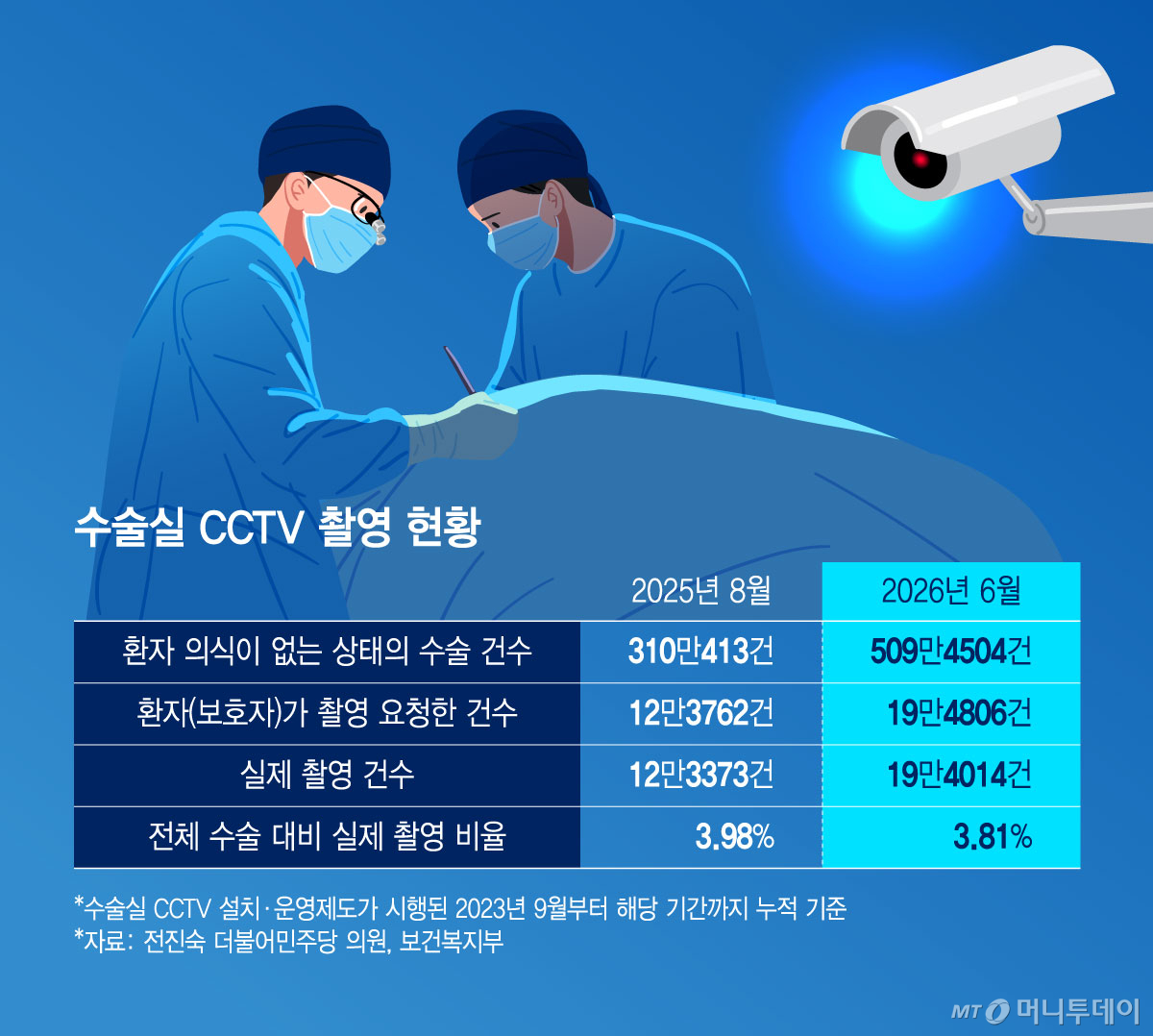
Although it has been approximately three years since closed-circuit television (CCTV) installation became mandatory in operating rooms, the actual filming rate has declined. The proportion of surgeries filmed dropped from 3.98% in August last year (cumulative basis) to 3.81% in June this year. Critics argue that the system's effectiveness must be enhanced by requiring prior notification to patients that CCTV filming is possible in operating rooms.
According to data on "Investigation of CCTV Installation Status in Operating Rooms" obtained from the Ministry of Health and Welfare by Jeon Jin-sook, a member of the Democratic Party of Korea representing Gwangju Buk-gu-eul district and a member of the National Assembly's Health and Welfare Committee, there were 2,529 medical institutions nationwide obligated to install CCTV in operating rooms as of the end of June this year. All 2,528 institutions, excluding one that was suspended from operations, had installed CCTV in their operating rooms.
Since the mandatory installation and operation system for operating room CCTV took effect in September 2023, a total of 194,014 instances of CCTV filming have been conducted at these medical institutions through June this year. This accounts for only 3.81% of the 5,094,504 total surgeries performed on unconscious patients by these institutions. Moreover, out of the 194,806 cases where filming was requested, 792 were not actually filmed due to reasons such as refusal.
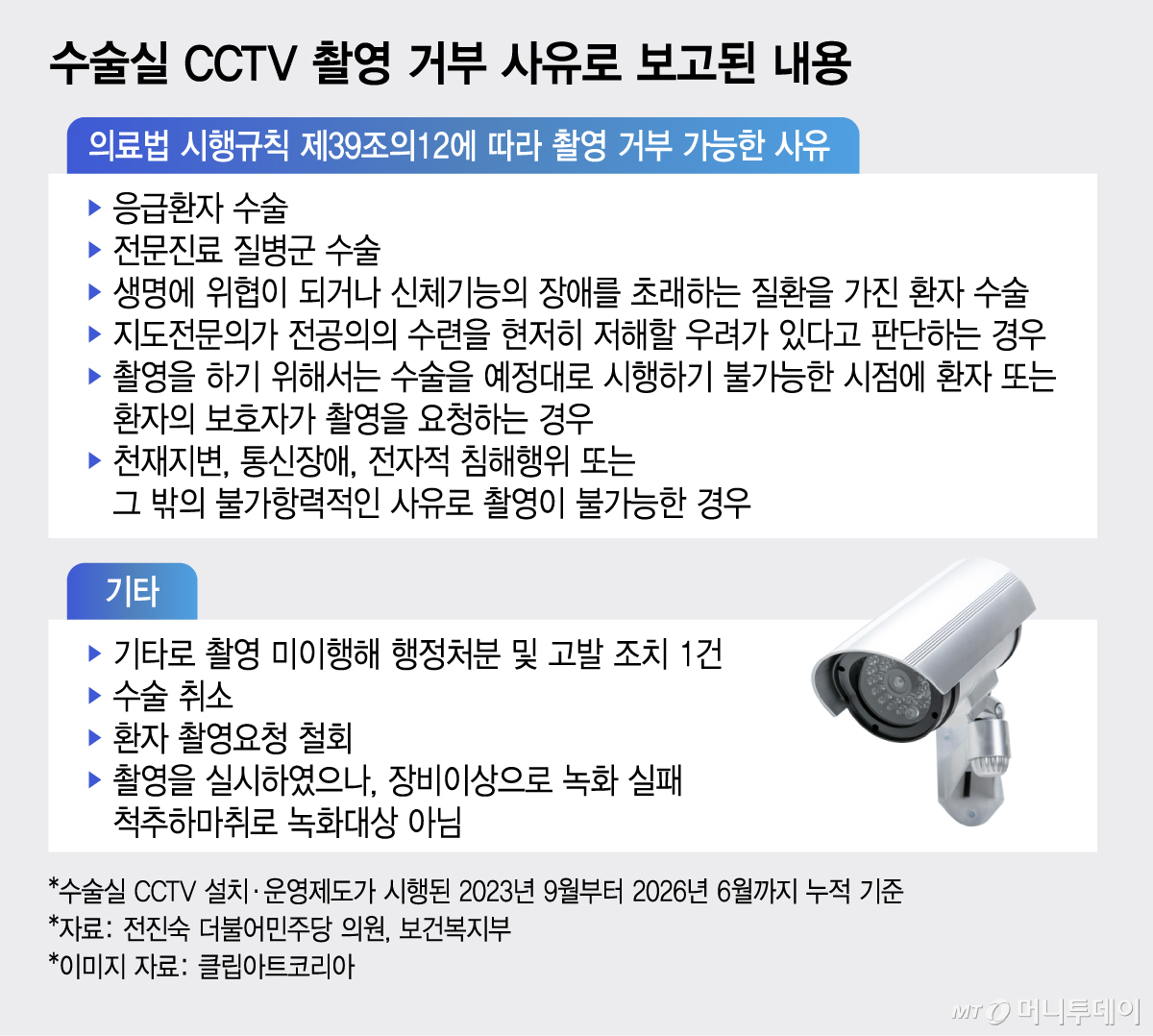
The primary reasons for refusing filming cited were those stipulated under Article 39-12 (Grounds for Refusal of Filming) of the Enforcement Decree of the Medical Service Act. Other reasons included: △surgeries on emergency patients; △cases where a supervising specialist physician determines that filming would significantly hinder the training of residents; △surgeries within specialized disease groups; △cases where patients or guardians requested filming at a point when it was impossible to proceed with the surgery as scheduled; and △force majeure. There were also instances where patients canceled their filming requests, or surgeries were canceled.
In addition, there was one case where administrative sanctions and criminal reporting measures were taken because filming was not conducted for unjustifiable reasons.
The issue is that the low filming rate is continuing to decline. This is analyzed as being due to complex procedures, such as requiring patients to directly apply to medical institutions for filming, and a lack of awareness about the system among many patients. Voices are rising calling for enhanced effectiveness of the system to expand patient protection.
Jeon Jin-suk (Rep.) pointed out, "While operating room CCTV has been installed in virtually all target medical institutions, actual filming accounts for only 3.8% of total surgeries." They added, "In the current structure, where filming occurs only upon patient request but mechanisms to properly inform patients of this right are lacking, it is difficult to fully realize the intent behind introducing the system." Emphasizing further, they stated, "We must clearly guide patients on whether filming is possible before surgery and establish procedures allowing patients to make direct choices, so that no one misses the opportunity for filming due to ignorance of the system."
Ahn Ki-jong, head of the Korea Patient Groups Alliance, said, "Improvements are needed, such as shifting to a 'refusal-based' approach where CCTV filming in operating rooms is conducted by default and only omitted if patients refuse." He added, "The mandatory video retention period of 30 days is too short and should be extended to approximately 100 days."
Lee Jung-min, an attorney at Hippocrates Law Firm, stated at a recent forum, "The current system does not sufficiently guarantee patients' rights to CCTV filming in operating rooms and access to video information." He noted, "System improvements are necessary, such as relaxing related requirements and extending retention periods." Specifically, he suggested, "Grounds for exceptions to filming are broadly defined; the law should be amended by removing both the filming requirements and the grounds for refusal of filming."

 in THEBIO

