

[For more diverse corporate information on the startups featured in this article, please visit the Unicorn Factory big data platform 'Data Lab'.]
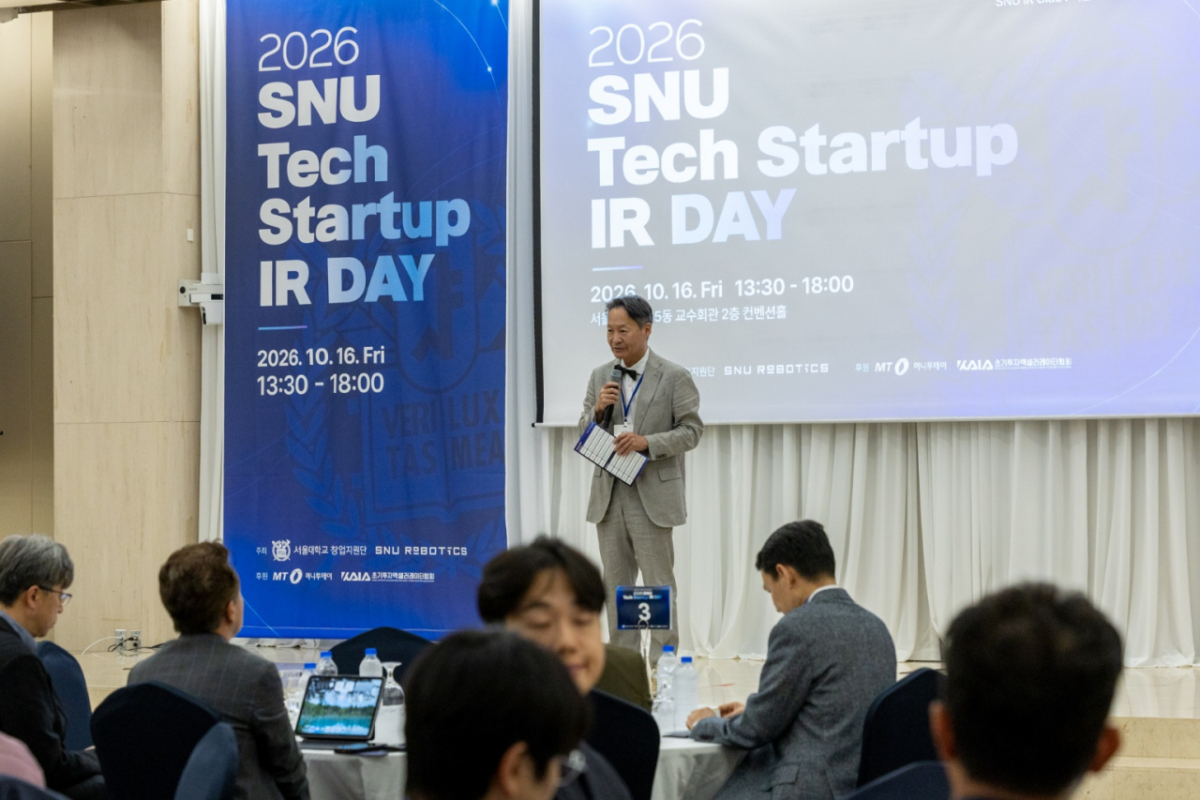
"We hope this event will serve as a venue where technologies whose potential has been confirmed in the laboratory can also demonstrate product-market fit (PMF) in the actual market."
Kang Geon-wook, Head of Seoul National University's Startup Support Division, made these remarks at the '2026 SNU Tech Startup IR Day' held on the 16th in the Convention Hall of the Professors' House at Seoul National University's Gwanak Campus. The event was hosted by Seoul National University's Startup Support Division. MoneyToday and the Early-Stage Investment Accelerator Association provided support.
Ten early-stage startups from various fields, ranging from industrial site automation using robots to core components for semiconductors and displays, as well as next-generation energy technologies, presented their technologies and commercialization strategies in front of representatives from investment firms such as venture capital (VC) companies.
The companies participating in the IR session included 10 firms: △Rosota △Resensing △Euler Robotics △FTDS △Wearable AI △BizCure △Reops △Whistle Lab △MetaFarmers △BioLogen Energy Systems.
In a welcome address preceding the presentations, Cho Gyu-jin, Director of Seoul National University's Robotics Research Institute, stated, "The robotics field is not easy to start a business in because hardware and various technologies must work together." He added, "Only those with globally competitive technological capabilities should start businesses for world-class companies to emerge." He further noted, "We expect that the companies presenting today will grow and help support the startups of their juniors, creating a virtuous cycle."
In the subsequent IR pitches, 'Physical AI' technologies addressing challenges in various industrial sites such as healthcare, logistics, and infrastructure drew attention. Rosota, in the medical field, is a company collecting actual surgical data to develop surgical assistant robots. In a typical laparoscopic surgery, a doctor inserts tools through small incisions; while endoscopic images are recorded, it is difficult to record how much and where the tools moved or how much force was applied to the tissue.
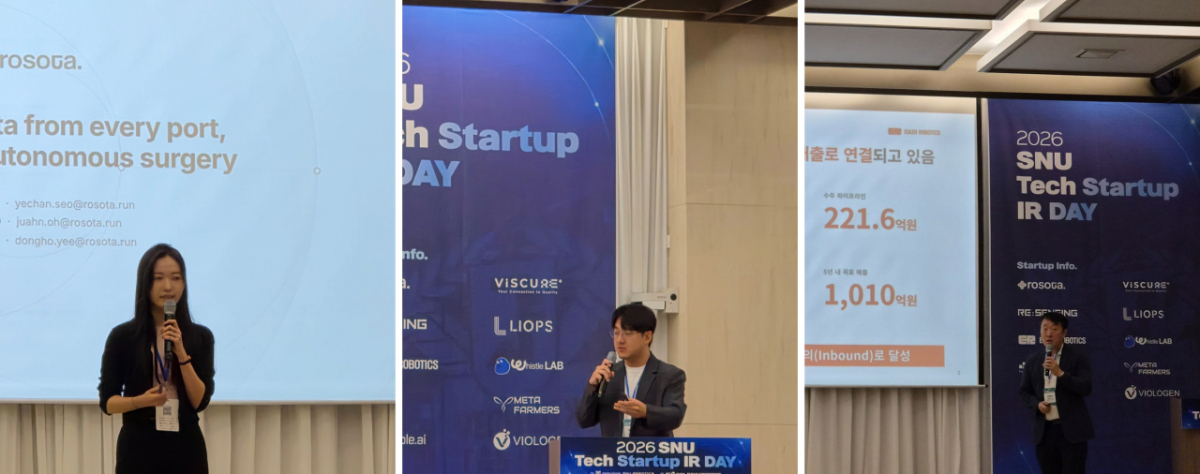
Noting that for a robot to learn the surgical process, it must understand how doctors actually manipulate tools, Rosota developed a sensor called 'SurgeLogger' that measures the position, angle, insertion depth, and force of the tools. A robot trained on 849 actual surgical cases successfully performed appendectomy in three out of four rabbits in an experiment.
Rosota plans to continuously collect real operating room data and expand it into a general-purpose foundation model. Oh Ju-an, Chief Financial Officer (CFO) of Rosota, said, "Our ultimate goal is to accumulate as much surgical data as possible to create a robot-based model capable of handling various surgeries."
Automation solutions aimed at reducing inefficiencies in logistics sites were also introduced. Euler Robotics is a company that holds 'RBS (Random Box Stack)' technology, which allows robots to autonomously recognize and stack boxes of varying sizes and shapes. Previously, workers had to manually input the size, location, and stacking method for each box, but this process has been automated.
Its strength lies in handling everything from standardized boxes to a mix of various types with a single solution. It can be applied regardless of the robot manufacturer, and the company has developed its own cameras, loading software, and grippers (which act as robot hands) to ensure price competitiveness.
Wearable AI develops autonomous driving solutions that move in place of people at industrial sites such as airports, ports, and shipyards. A key feature is that it can be implemented immediately without high-precision maps or separate infrastructure. Based on this, the company secured a contract to supply 11 autonomous driving carts for Incheon Airport within four months of its establishment.
Baekdu Mountain, CEO of Wearable AI, said, "After airports, we aim to prove our technological capabilities at ports." He added, "We will build a pipeline by first entering the field with driver assistance and safety solutions to accumulate meaningful data." The company plans to apply autonomous driving technology to yard tractors that transport containers at ports. The concept is to convert tractors, which incur annual labor costs exceeding 300 million won per unit, into autonomous vehicles to achieve cost savings.
Additionally, the company is developing a robot that follows large block transporters at shipyards and sends signals, serving the role of a signalman. In July this year, it was selected for a national project worth 16 billion won involving major domestic shipbuilders, securing development funds. The company plans to expand its revenue by focusing on vertical B2B markets in each industrial site.
Investment firm representatives who attended the event highly evaluated the robust technological capabilities of the participating companies and expressed expectations for future market expansion. Ahn Sun-jong, CEO of Hanil VC, said, "Since there are many teams with excellent technology, they have sufficient potential to leap into larger companies if they delve deeper into their target markets."
Meanwhile, Seoul National University's Startup Support Division plans to broaden investment opportunities for on-campus startups by consecutively holding the Climate Tech Startup Competition finals on November 11, SNU Big Scale-up Networking on December 3, and the Bio/Healthcare IR Day on December 11.
[MoneyToday Startup Media Platform Unicorn Factory]

 in FUTURE

