

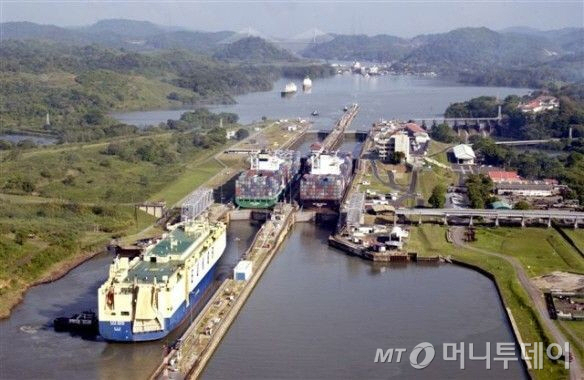
Transit demand at the Panama Canal has reached the limit the canal can handle. Demand is surging as the Panama Canal Authority announced it will reduce the number of daily transits starting next month, compounded by supply cuts due to drought. Pressure on freight rates is expected to rise, particularly for very large gas carriers (VLGCs) and petroleum product tankers.
According to the shipping industry on the 28th, the average daily transit volume at the Panama Canal was around 35 ships in the six months prior to the Middle East conflict, rising to 39–41 ships in March–April this year, approaching its maximum processing capacity. The number of waiting vessels increased from about 40 last year to around 60 this year, and the average waiting time for deep-sea cargo ships lengthened from approximately 30 hours to about 50 hours.
Congestion immediately translated into higher costs. The Panama Canal Authority (ACP) announced on the 25th (local time) that some transit slot auction prices exceeded $1 million. Between October last year and February this year, prior to the Middle East conflict, the average intermediate auction price was around $55,000. The canal authority explained that this reflects temporary supply-demand volatility rather than a toll increase.
This year’s congestion stems from different causes than in 2023–2024. Back then, the core issue was reduced transit capacity due to El Niño-induced droughts. This year, however, demand surged first due to energy trade restructuring triggered by the Middle East conflict and increased U.S. energy exports. As demand for U.S.-origin petroleum products bound for Asia grew, monthly average product tanker transits in April–May reached about 300 ships, a roughly 50% increase compared to last year’s average. According to industry sources, the Panama Canal handles approximately 3% of global maritime cargo volume and over 20% of liquefied petroleum gas (LPG) trade.
Supply constraints have further exacerbated the situation. Rainfall in the canal region this year was 34% below the annual average. In response to falling water levels, the canal authority decided to reduce daily transit capacity to 34 ships starting next month on the 4th and to 32 ships from the 15th onward.
The impact is concentrated on ship types that rely heavily on the Panama Canal. The Korea Maritime & Ocean Development Institute (KODI) recently classified the impact on VLGCs as “very high” in a published report. In fact, with average waiting times exceeding 80 hours last May, the proportion of VLGCs using the Panama Canal dropped from 80–90% to around 55%, while the use of the Cape Route increased from about 10% to 45%.
Cape routing inevitably leads to freight rate increases. Using the Cape Route on the U.S.–Asia trade lane can extend voyage distances by up to 70% compared to transiting via the Panama Canal. Carrying the same cargo over longer distances reduces vessel turnover rates and shrinks available shipping capacity that can be deployed immediately. If transit restrictions tighten for product tankers, effective capacity for medium-range (MR) and long-range (LR) tankers could also decline. In contrast, liquefied natural gas (LNG) carriers are less affected since a significant portion of U.S.–Asia cargo already uses the Cape Route. Container ship traffic remains stable, but if canal water levels drop further and transit limits on vessel numbers and cargo capacity are strengthened, it could lead to rising freight rates and logistics costs for U.S. East Coast-bound shipments.
The outlook is not bright. Industry sources suggest that El Niño conditions in the fourth quarter of this year may intensify significantly beyond baseline levels. If worsening El Niño further lowers water levels and expands cargo capacity restrictions, the situation could shift into a complex risk combining demand-driven congestion with reduced supply-side transit capacity. Related impacts are likely to be more pronounced in early next year than in the second half of this year.
In its report, KODI recommended that the shipping industry proactively secure transit slots, optimize routes and vessel fleets, and reflect additional costs in freight rates and contracts as countermeasures. For importers and exporters, the institute advised preparing for cost and delivery volatility by utilizing alternative routes, alternative ports, maintaining safety stock, and securing available shipping capacity.

 in INDUSTRY
