

With electric vehicle sales surging in major European auto markets, competition among global automakers is intensifying. Hyundai Motor and Kia are also strengthening their market offensive by expanding their EV lineups and boosting local production.
According to a Reuters tally on the 20th, new registrations of battery electric vehicles (BEVs) across 17 major European markets last month totaled 300,202, a sharp 70.3% increase from the same month last year. This pushed their share of total new car registrations to 32.6%. In other words, one in every three new cars was a BEV.
Cumulative BEV registrations for January through September this year also reached approximately 1.98 million, up 38.1% from the same period last year. As EV demand in the United States slows, Europe is emerging as a key EV market.
By country, growth was particularly pronounced in France and Germany. France's new BEV registrations last month stood at 65,243, accounting for 41.7% of its total new car market. Germany also recorded 88,724 registrations, with a share reaching 34.6%.
Factors behind the growth include high fuel prices, government purchase subsidies in various countries, and an expanded supply of affordable EVs. However, disparities between countries were also evident, with BEV market shares in Italy and Poland remaining at just 7.6% and 6.2%, respectively. Italy and Poland have long been assessed as lacking sufficient EV charging infrastructure.
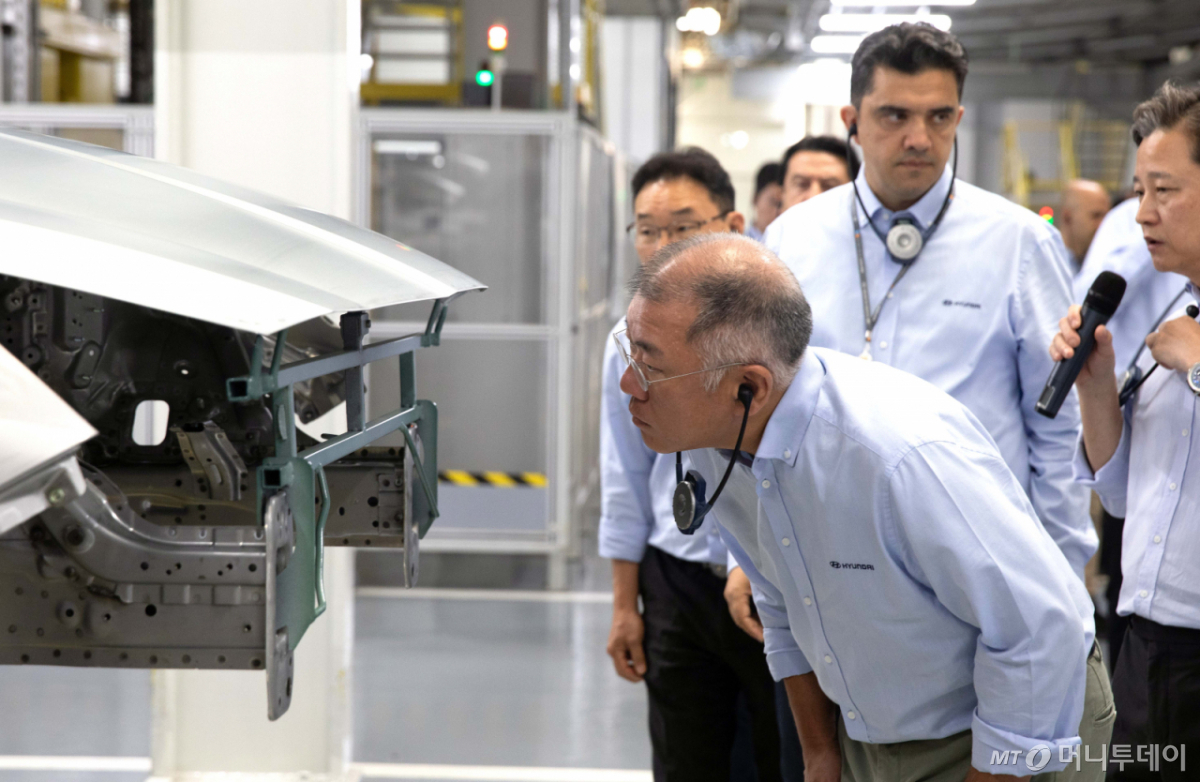
Hyundai Motor and Kia are also accelerating their push into the European EV market. Following its small EV Inster and the Ioniq 5, 6, and 9, Hyundai has introduced the Ioniq 3, targeted at the European market. Starting in August, it began producing the Ioniq 3 at its Izmit plant in Turkey, strengthening its local supply base.
Hyundai Motor aims to increase its European EV sales volume to over 420,000 units by 2030. This is more than triple the 116,000 units sold last year. To achieve this, it plans to build an electrified product lineup covering 85% of the European market and diversify its lineup with SUVs (sport utility vehicles) and light commercial vehicles.
Kia is targeting the European market centered on a full EV lineup and its purpose-built vehicle (PBV) business. While leading with affordable EVs such as the EV2, 3, 4, and 5, it is also expanding local supply capacity by producing the EV2 and EV4 at its Slovakia plant.
It has also fully entered the commercial vehicle market. Kia is targeting the European electric light commercial vehicle market with its first PBV, the PV5. It plans to sequentially unveil the PV7 in 2027 and the PV9 in 2029. It has also set targets of 746,000 units in European sales by 2030 and an EV sales share of 66%.
European automakers are also responding. Volkswagen and Renault, among others, are expanding their small EV lineups. Chinese manufacturers are likewise expanding market entry by leveraging low prices and pushing to build local production facilities.
An industry official said, "Although the European Union (EU) is imposing additional tariffs on Chinese-made EVs, market entry by Chinese companies will continue." The official added, "As price competition intensifies, Hyundai Motor and Kia are also broadening their stride in the European market based on new models and local production."

 in INDUSTRY
