

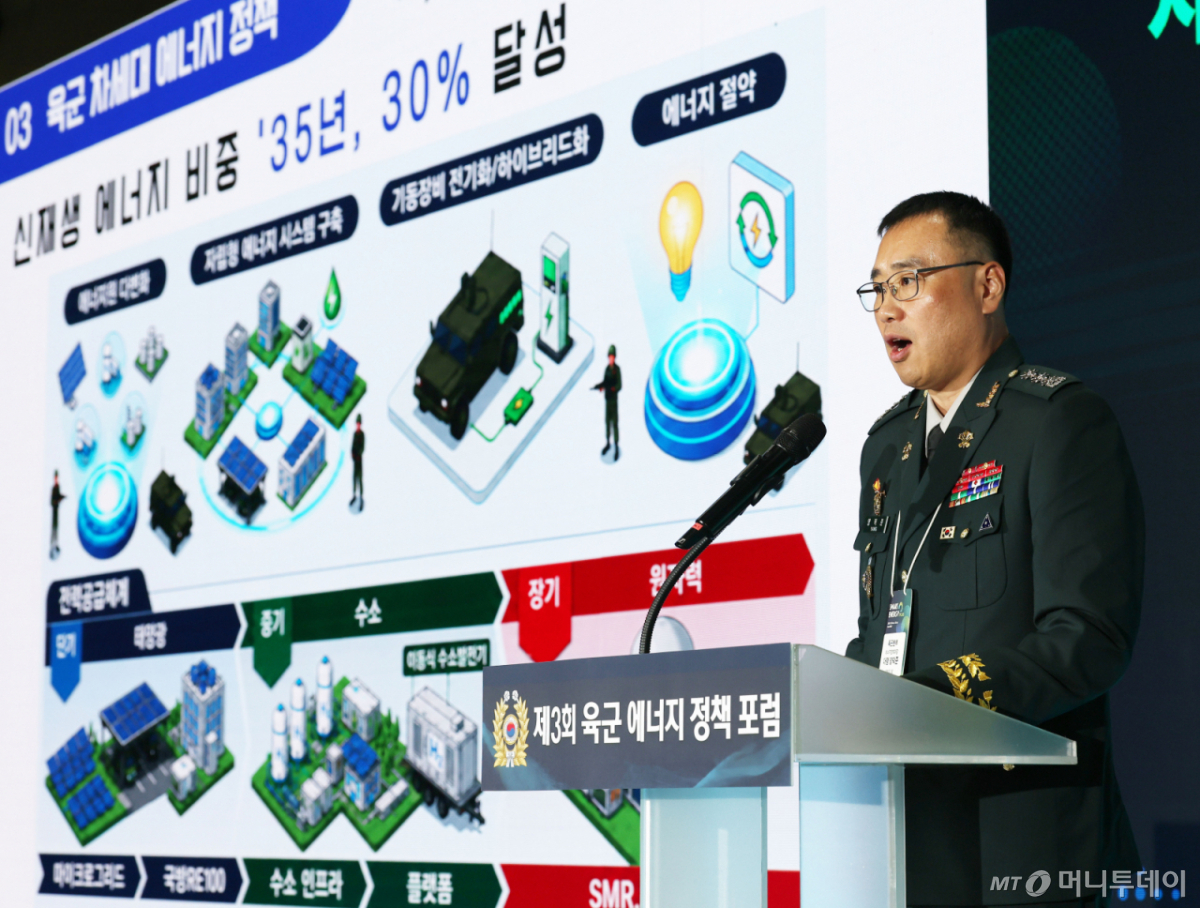
The Army will push for legislative amendments to improve conditions for utilizing hydrogen energy, marking a milestone with "Smart Energy Plus (SMART ENERGY PLUS·SEP) 2026."
Yang Deok-jun, Section Chief of the Energy Policy Division under the Army Logistics Staff Department, stated at the "3rd Army Energy Policy Forum," held alongside SEP 2026 on the 28th in Hall B of COEX in Seoul, that "methods for charging hydrogen while on the move are restricted under current laws." He added, "Accordingly, we are pushing for legislative amendments." He further explained, "Institutional preparations must come first so that the Army can install hydrogen charging stations and conduct training with mobile hydrogen charging stations. This could also expand to the introduction of various equipment utilizing hydrogen."
Previously, Rep. Heo Seong-mu of the Democratic Party of Korea, a member of the National Assembly Hydrogen Economy Forum, introduced the "Partial Amendment Act on the High-Pressure Gas Safety Management Act" as the lead sponsor on the 12th. The current law defines hydrogen charging as the manufacture of high-pressure gas, requiring each charging facility to obtain permission from the mayor, county head, or district head and undergo periodic inspections.
This applies to hydrogen facilities within military bases as well. It has been pointed out that repeated entry of inspection personnel into bases is difficult for security reasons, and that the duty of permanently appointing a safety manager does not align with the Army's personnel management system, which centers on rotational assignments.
There is also no legal basis to regulate the Army's operational method of repeatedly deploying to training grounds and test sites for charging. Therefore, the core of the amendment bill is to allow the installation or modification of military hydrogen facilities to be substituted with permission through consultation with the competent authority. While maintaining technical review by the Korea Gas Safety Corporation, inspections would be conducted jointly by the Korea Gas Safety Corporation and institutional investors designated by the Minister of National Defense.
The bill also establishes grounds for the integrated appointment of safety managers and the designation of proxies, as well as special provisions for consultation and submission of inspection materials when necessary for national security. It also creates a new legal basis for operating military mobile hydrogen charging facilities in pre-designated operational zones.
On the same day, the Army also signed an industry-academia-research memorandum of understanding (MOU) to jointly develop eco-friendly and next-generation energy technologies and apply them militarily. This agreement aims to strengthen the application of next-generation energy technologies to the military and enhance the cooperation system by linking the government's policy capabilities, research institutions' technological expertise, and universities' specialization with the Army. Attendees at the signing ceremony included Ha Heon-cheol, Head of the Logistics Staff Department at Army Headquarters; Oh Il-yeong, Director of the Climate Energy Policy Office at the Ministry of Climate, Energy and Environment; Choi Gi-yong, Vice President of the Korea Atomic Energy Research Institute; Jin Jong-wook, President of the Korea Automotive Technology Institute; and Park Jin-ho, Acting President of the University of Science and Technology.

 in INDUSTRY
