

SK hynix is accelerating its development of next-generation memory semiconductor (hereinafter referred to as "memory") technologies and improving the power efficiency of high-bandwidth memory (HBM) to overcome the power issue that has emerged as a new growth constraint in the artificial intelligence (AI) industry.
The company's strategy is to enhance both performance and power efficiency in AI data centers by reducing the energy required for data movement, going beyond simply expanding memory capacity and bandwidth.
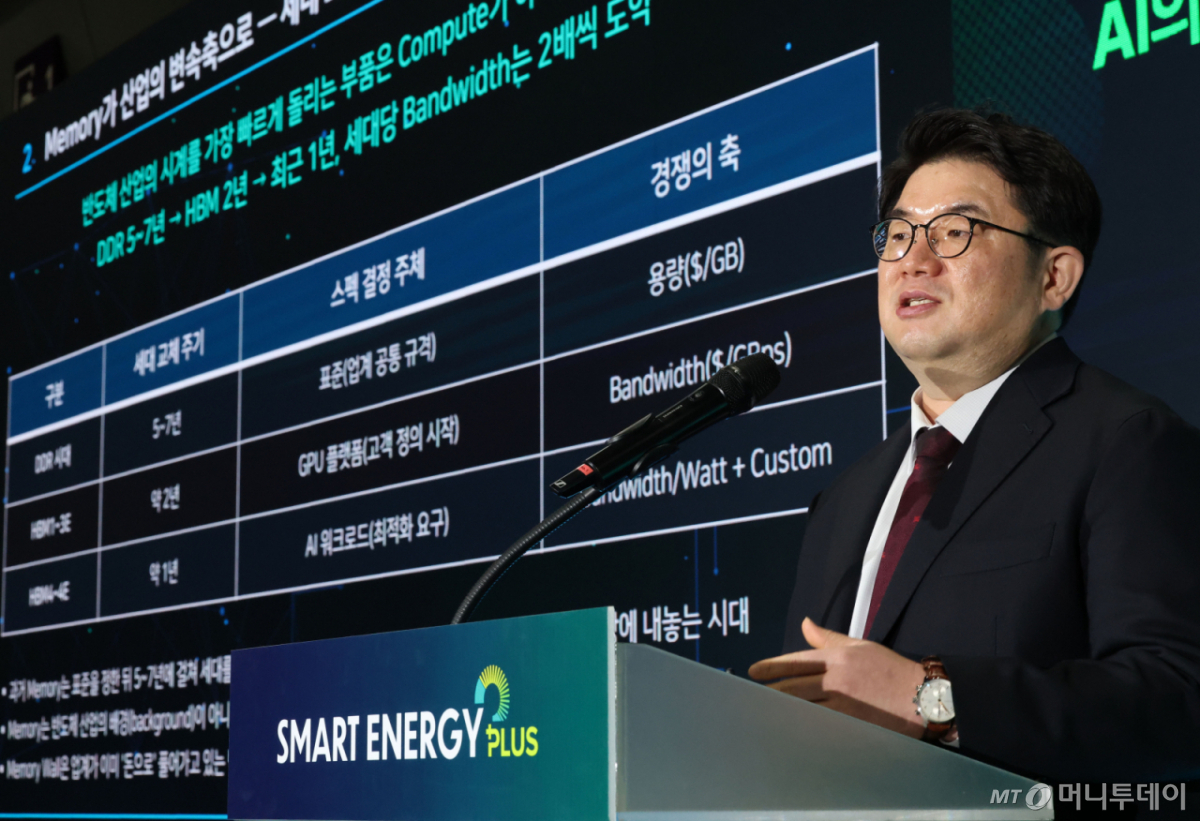
"We must always remember that power is the new axis and the new core. We are preparing future products centered on how much intelligence we can efficiently provide with limited power," said Choi Jun-yong, director of HBM Business Planning at SK hynix.
He made the remarks at a conference at COEX in Samsung-dong, Seoul, Wednesday, as part of 'Smart Energy Plus 2026.'
On this day, Choi delivered a presentation titled "Memory Defining the Future of AI: From the Memory Wall to the Energy Wall," diagnosing that the bottleneck in the AI industry is shifting from computational performance to memory, and then to power. He explained that while the number of devices determined demand in past PC and mobile markets, in the AI era, increasing service usage and data throughput are rapidly driving up demand for both memory and power.
Choi emphasized, "How quickly and how much data is sent from memory is the most important factor defining overall performance. Rather than computation, reducing reading and movement is the way to cut energy and the direction memory must take."
This means that shortening data transfer distances and processing more data with the same amount of power are key to AI competitiveness.
Accordingly, SK hynix plans to gradually unveil a next-generation memory lineup with significantly improved power efficiency.
First, the HBM4E (7th generation) currently under development aims to achieve a maximum capacity of 48 gigabytes (GB) and a bandwidth of over 4 terabytes (TB) per second, while reducing power consumption by approximately 20% compared to HBM4 (6th generation). Furthermore, the company is concurrently developing "3D stacked DRAM" technology, which vertically stacks GPUs and memory to minimize data transfer distances.
In addition, SK hynix is pursuing intelligent memory (PIM) technology that performs computation directly within the memory to reduce data movement, as well as customer-tailored HBM development.
Choi explained, "It is a concept where computing units move inside the memory." He added, "By sending only processed data to processing units, we can significantly reduce data transfer and computational load."
SK hynix is also advancing the development of high-bandwidth flash (HBF), which is cited as a next-generation high-capacity memory. Regarding HBF commercialization plans, Choi emphasized, "The leadership and technological competitiveness secured in HBM will extend to HBF," adding, "We are actively preparing in the direction of providing larger capacities."
Finally, Choi said, "The breakthrough for AI does not come only from computing; structurally, it must also come from memory." He concluded, "We are preparing a virtuous cycle where we provide more AI services with less power, which in turn drives further increases in memory demand."

 in INDUSTRY
