

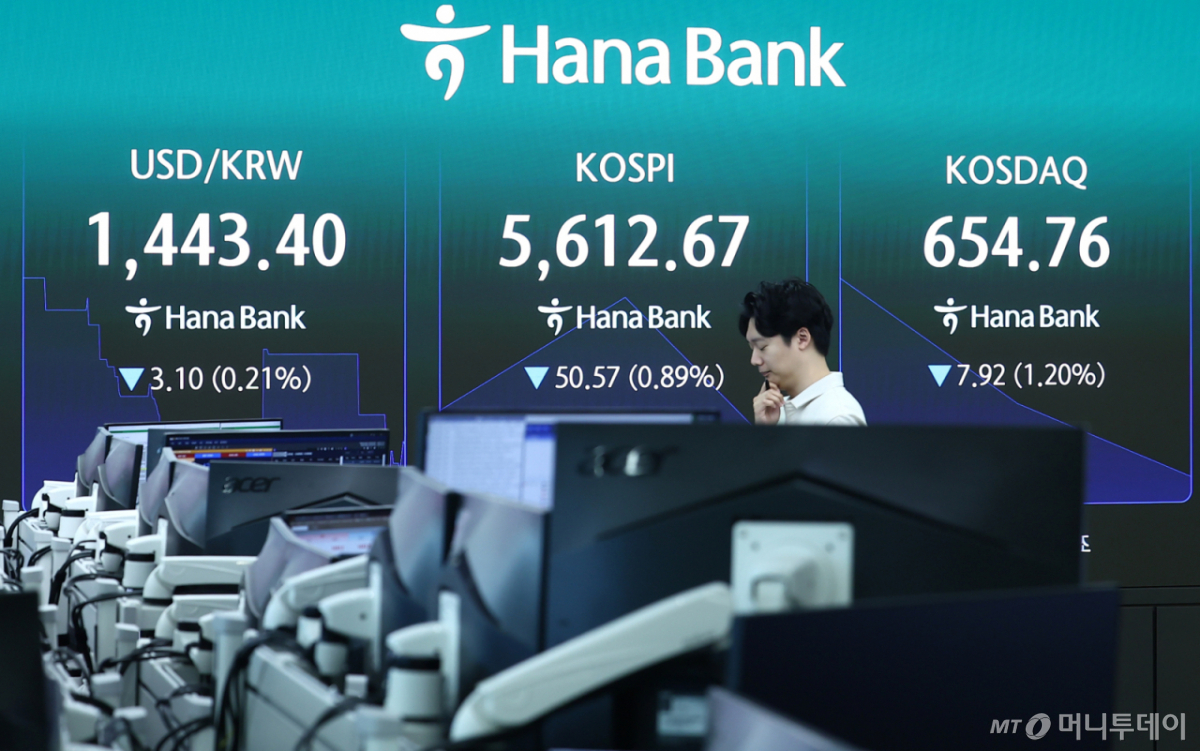
Over the course of July, the KOSPI plummeted by 33%. This was due to concerns over AI (artificial intelligence) profitability, compounded by a concentration in single-stock leverage ETFs (exchange-traded funds). With measures against leverage ETFs being introduced and the KOSPI index reaching an undervalued phase, expectations are rising that the KOSPI will change starting from August.
As of 11:06 a.m. on the 30th, the KOSPI was up 271.38 points (4.79%) from the previous trading day at 5,934.62. The KOSPI, which opened higher today, fluctuated around the 5,600 level before widening its gains and reaching as high as 5,976.82.
Han Ji-young, a researcher at Kiwoom Securities, stated, "Having entered an oversold phase, we expect the KOSPI to attempt a rebound after experiencing expanded volatility in the early trading session."
From the beginning of this month until yesterday, the KOSPI had plummeted by 33.19%, with the index falling from 8,476.48 to the 5,600 range. Within this month alone, sidecar (futures market circuit breaker) mechanisms triggered 12 times, and circuit breakers activated twice. Notably, on the 28th and 29th, two consecutive days saw circuit breakers activate, resulting in a sharp 16.17% drop. This marks the first time in KOSPI history that circuit breakers have been triggered on consecutive days.
Experts in the financial investment industry attribute the sharp decline in the KOSPI this month to the concentration in semiconductor stocks and single-stock leverage ETFs. Amid this situation, big tech companies such as Alphabet (Google) and Meta recorded cash flows and EPS (earnings per share) that fell short of market expectations due to AI CAPEX (capital expenditure). The growth of Chinese semiconductor companies also negatively impacted investor sentiment.
Lee Kyung-min, head of FICC Research at Daishin Securities, analyzed, "The sharp decline in the KOSPI this month was influenced by extreme concentration in semiconductors during the formation of last June's peak and the backlash from the strengthened influence of leverage ETFs that caused it." He added, "Negative news originating from semiconductors, which had shown absolute impact, led not only to a sharp drop in semiconductor stocks but also to a contraction in overall KOSPI market sentiment and an expansion of selling pressure."
Macroeconomic conditions were also negative for the stock market. As tensions between the United States and Iran reignited, uncertainty surrounding a potential Middle East war increased. International oil prices rose again into the $90 range, and concerns over a U.S. base rate hike expanded. On the 29th (local time), the Federal Reserve System (Federal Reserve·Fed) decided to keep the base rate unchanged at its July FOMC meeting, but the market interpreted the Fed's meeting content as hawkish.
Experts believe that despite these circumstances, the recent decline in the KOSPI has been excessive. The growth trends of Samsung Electronics and SK Hynix continue, and the current PER (price-to-earnings ratio) for these companies relative to their earnings is at historically low levels of 4–5 times. Although Chinese semiconductor companies are growing, Samsung Electronics and SK Hynix still hold a significant technological lead. Despite concerns over AI profitability, big tech companies continue to invest steadily in CAPEX.
One researcher noted, "Currently, we are in a period where negative narratives surrounding leading stocks like semiconductors are forming. It is also important to note that fundamentals have not yet been materially damaged, as earnings estimates have not begun to decline significantly." The researcher further predicted, "While the 2026 KOSPI operating profit consensus estimate has decreased by about 3 trillion won from its peak of approximately 970 trillion won to around 967 trillion won, it is expected to be revised upward again during the process of major stock earnings events scheduled for early next month."
Regarding the issue of single-stock leverage ETFs, which is cited as a major cause of the KOSPI plunge, there are expectations that the problem will be somewhat resolved starting next month. Jo Jae-woon, a researcher at Daishin Securities, stated, "The period when liquidation pressure from leverage ETFs meaningfully eases is expected to occur in about 3–4 weeks at the current pace." He added, "Measures by financial authorities are accelerating this timeline."
Experts advise investors not to sell out of panic immediately but rather to observe the situation.
Lee Jae-won, a researcher at Yuanta Securities, remarked, "If July was the 'month of fear,' next month is likely to be a period where excessive fear normalizes." He continued, "It is difficult to recommend joining the sell-off by looking at technical and fundamental indicators in the oversold zone. Moving forward, the strategy should not involve discarding leading stocks out of panic but rather taking a calm, phased approach toward semiconductors with confirmed earnings and growth stocks that have declined excessively."

 in STOCK
