

Behind SK hynix’s announcement of an annual 100 trillion won shareholder return policy lies a significant increase in cash generation capability, driven by expanding AI (artificial intelligence) demand. The strategy aims to share management performance with shareholders while creating an opportunity for the stock price to rebound amid the current weakness in semiconductor stocks.
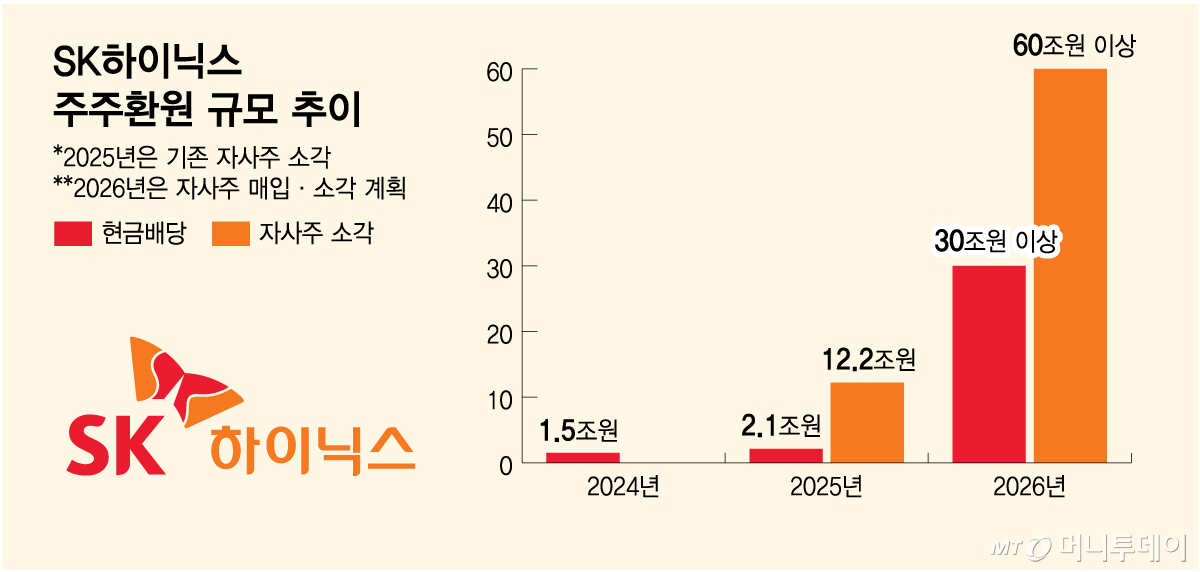
CFO Kim Woo-hyun stated during the Q3 earnings announcement conference call on the 28th, “We will continuously conduct share buybacks and cancellations to directly share performance with you, our shareholders, through dividends, ensuring that the value per share appropriately reflects intrinsic value.” SK hynix plans to pursue approximately 100 trillion won in annual shareholder returns this year through cash dividends of over 30 trillion won and share buybacks and cancellations of over 60 trillion won.
This shareholder return plan was announced amid ongoing weakness across semiconductor stocks generally. Slowing revenue growth among AI companies and China’s CXMT (ChangXin Memory Technologies) plans to develop next-generation DRAM new technologies have dampened investor sentiment, exerting downward pressure on semiconductor stocks. Consequently, demands have intensified in the market for semiconductor companies to actively return increased profits to shareholders.
SK hynix has initially moved to appease shareholders with total dividends reaching 14 trillion won. This amount is equivalent to about 20,000 won per share, comprising 10,000 won reflecting improved performance and an additional 10,000 won as a special dividend reflecting the investment results in Japan’s Kioxia. A particular point of note is the “Kioxia special dividend.” SK hynix invested approximately 3.9 trillion won in Kioxia through a U.S.-Japan-Korea consortium led by Bain Capital in 2018. Recently, as Kioxia has pushed for a listing on the Japanese stock market, the capital gains from share sales during the equity disposal process are estimated to exceed 20 trillion won.
SK hynix decided to return most of the Kioxia investment results to shareholders in the form of special dividends. A portion will be included in this quarter’s dividend, while the remainder is scheduled to be paid as part of the final dividend after the settlement of the fiscal year 2026 accounts is finalized.
Some observers also speculate that Solidigm’s U.S. stock market listing could have been an opportunity to return investment results to shareholders, similar to Kioxia. SK hynix had pushed for an IPO (initial public offering) on the U.S. NASDAQ exchange for its grand-subsidiary Solidigm, but halted the listing process after concerns arose over damage to shareholder value due to duplicate listings. At the time, Bloomberg News projected that Solidigm could raise approximately $10 billion (about 13.4 trillion won) through the IPO.
CEO and President Kwak No-jeong also emphasized during the Q3 earnings announcement conference, “We have always taken as a principle to share most of the fruits when strategic investments bear fruit,” adding, “We will uphold this principle without change so that shareholders can directly feel the results of our strategic investments.”
The company is also committed to continuing share buybacks every quarter. CFO Kim stated, “I believe the company’s stock price is undervalued and does not sufficiently reflect the profits and cash flows it generates,” emphasizing, “In this situation, I judged that buying back and canceling treasury shares is an effective method to increase value per share.” The 40 trillion won worth of treasury shares recently purchased will also be canceled soon.
This year’s shareholder return scale is approximately seven times that of last year (14.3 trillion won). Last year, 2.1 trillion won and 12.2 trillion won were allocated to dividends and share buybacks, respectively. SK hynix had previously signaled an expansion of its shareholder return policy by raising its existing guideline of returning 50% of FCF (free cash flow) to shareholders to “over 50%.” President Kwak also promised, “Going forward, we will build trust in future growth through continuous performance creation and share those fruits with you, our shareholders.”

 in INDUSTRY
