

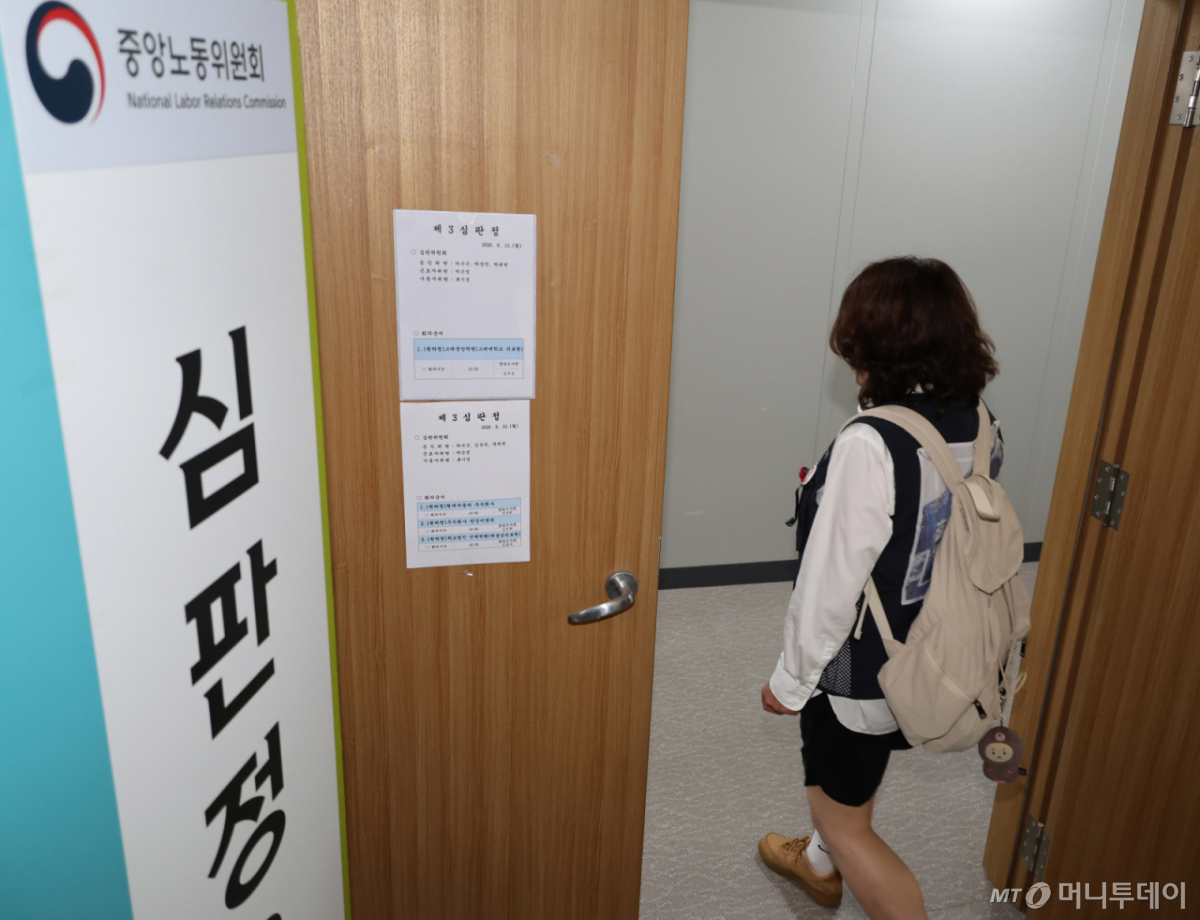
While the Central Labor Relations Commission is reviewing expedited measures such as 'summary judgment' to resolve case backlogs, critics argue that ruling credibility must be enhanced before speed. In a situation where fairness controversies persist due to rulings being concentrated on specific public members, simply simplifying procedures will not suffice to end disputes.
According to the labor and legal sectors on the 17th, Labor Commission rulings address disputes directly affecting workers' livelihoods and corporate personnel and labor management practices, such as dismissals, disciplinary actions, and unfair labor practices. While swift rights protection is important, there are concerns that simplifying hearing procedures before facts and legal interpretations are fully established could undermine the credibility of rulings.
In particular, it has been consistently pointed out that Labor Commission hearings often proceed with brief questioning and a focus on written documents depending on the case, making it difficult for parties to fully explain their claims. The more complex the labor dispute, the more carefully both sides' claims and evidence must be examined; focusing solely on processing speed could compromise the thoroughness of rulings.
Fairness in the composition of public members and the assignment of ruling committee members is also a challenge. Recent controversies over fairness arose when it was pointed out at the National Assembly that rulings in retrial cases related to the amended Labor Union Act were concentrated on specific public members.
According to the office of People Power Party lawmaker Na Kyung-won, among 39 retrial cases related to the amended Labor Union Act, only seven of the total 31 public members participated. Central Labor Relations Commission Chairman Park Soo-geun participated in 36 cases, Standing Commissioner Kim Yu-jin in 35 cases, and Standing Commissioner Kim Eun-cheol in 28 cases.
Na (Rep.) pointed out concerns over fairness due to the concentration of rulings on specific members and demanded adherence to the principle of random assignment. In response, Park (Chairman) stated, "I share some concerns regarding doubts about fairness," and pledged to strive for random assignment.
The Central Labor Relations Commission explained that it initially conducted hearings primarily with full-time public members to ensure expertise and consistency in judgment for subcontracting negotiation cases at the early stage of the amended Labor Union Act's implementation. It later announced a change in its operational method to allow external public members to serve as presiding judges of the ruling committees.
If processing speed is increased without sufficient trust in rulings, there is a possibility that disputes will not be resolved at the Labor Commission but will instead shift to the courts—a balloon effect. This is because dissatisfied parties with Labor Commission rulings can appeal for retrial at the Central Labor Relations Commission and subsequently file administrative lawsuits.
The labor and legal sectors emphasize that before accelerating case processing, priority must be given to enhancing the existing credibility of rulings through fair composition and assignment of ruling committee members, thorough verification of facts, and comprehensive review of legal interpretations. They argue that simplifying procedures while controversies over the quality of rulings remain unresolved makes it difficult to rule out the possibility of appeals against rulings.

 in ECONOMY
