

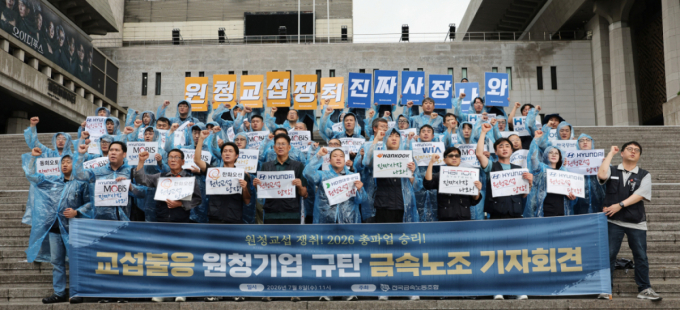
Since the enforcement of the amended Labor Union Act (Yellow Ribbon Act), there has been a sharp rise in requests from both labor and management sides asking the relevant authorities to determine whether prime contractors should be treated as employers separate from their bargaining units. This has led to growing concerns about the excessive workload faced by the Central Labor Relations Commission (CLRC) responsible for handling these cases. Despite limited staffing, case volumes continue to climb, resulting in frequent overtime exceeding 52 hours per week even within the Ministry of Employment and Labor itself, which is mandated to comply with the 52nd-hour weekly work limit.
According to data released by the Ministry of Employment and Labor on the 17th, as of the 7th, there are currently 82 retrial cases related to the amended Labor Union Act filed with the CLRC. In May, there were about 19 such cases; in June, around 14; but in July, the number surged to 40. In the first week of August alone, 9 new cases were filed, surpassing the total for the same period last month.
The Labor Commission determines whether prime contractors qualify as employers under the amended Labor Union Act and decides on the separation of bargaining units in multi-union scenarios. If either labor or management sides appeal a first-instance ruling by a local labor commission, the CLRC conducts a retrial.
Since the amended Labor Union Act came into effect in March this year, subcontract unions have increasingly demanded negotiations with prime contractors, prompting a corresponding rise in requests for rulings from the Labor Commission. During the first month of enforcement (March 10 to April 9), 1,011 subcontract unions requested negotiations targeting 372 prime contractor sites, and over 50 correction applications were filed with local labor commissions.
Starting in April, local labor commissions began issuing formal decisions on requests for bargaining unit separation. Most of these decisions have been appealed, leading to a surge in CLRC retrials beginning in May.
The core issue is that the CLRC lacks sufficient personnel and time to handle all retrial cases submitted from across the country. These amended Labor Union Act cases are managed by the CLRC's Bargaining Representative Decision Division, which currently has only nine staff members. Even this number was increased from five earlier this year in anticipation of the surge in retrials triggered by the new law.
The statutory processing period for amended Labor Union Act cases is up to 20 days for cases involving failure to notify a negotiation request and 30 days for decisions on bargaining unit separation. Given the current rate of increasing retrials and limited staffing, it is practically impossible to resolve all cases within the legally mandated timeframe.
As a result, all CLRC staff are currently enduring monthly overtime ranging from 100 to 120 hours. In response, the Ministry of Employment and Labor plans to raise the cap on overtime pay for these employees from the current limit of 4 hours per day and 57 hours per month to 8 hours per day and 100 hours per month, thereby increasing additional compensation.
However, critics argue this is merely a temporary fix. With structural increases in amended Labor Union Act cases, offering additional pay incentives cannot serve as a fundamental solution.
Moreover, there are growing concerns that once unfair labor practice cases related to the amended law begin to be filed in earnest, the workload will more than double beyond current levels. Even if the CLRC rules in favor of separating bargaining units, if prime contractors refuse to negotiate, unions may again demand rulings on whether such refusal constitutes an unfair labor practice.
It is also difficult to avoid criticism that the Ministry of Employment and Labor, tasked with protecting workers' health rights, is itself encouraging excessive working hours among its own institutional investor staff. While civil servants are not subject to the Working Conditions Act's 52-hour weekly limit, it remains ironic that employees within the very ministry responsible for enforcing labor laws and promoting reduced working hours are exposed to prolonged overtime.
A Ministry of Employment and Labor official stated, "We plan to manage excessive long working hours by providing substitute rest days when daily overtime exceeds eight hours," adding, "Recruitment efforts to address staffing shortages are also underway."

The business community stated that the surge in legal disputes surrounding the Yellow Ribbon Act (amended Labor Union Act) was predictable, with the root cause lying in "vague provisions." They warned that unless this issue is resolved, both prime contractors and subcontract workers will continue to raise objections to rulings by local and central labor commissions, leading to expanded costs and operational burdens.
Business representatives noted that increases in retrials at the CLRC following appeals against first-instance decisions by local labor commissions, as well as administrative lawsuits challenging CLRC rulings, were already anticipated. The analysis suggests this is because the labor movement, having suppressed demands for years, suddenly flooded the system with requests upon the law's enforcement, many of which included unreasonable claims, thereby creating numerous potential sources of conflict. TaPyongyang Law Firm reported that between March and July 3 following the Yellow Ribbon Act's enforcement, a total of 1,168 subcontract unions requested collective bargaining from 441 prime contractor companies.
A business community official remarked, "Since the implementation of the Yellow Ribbon Act, many subcontract unions have indiscriminately demanded collective bargaining," adding, "There are also numerous cases where issues that should be resolved through contract relationships between prime contractors and subcontractors are being escalated into disputes over whether prime contractors qualify as employers."
Critics point out that the core problem lies in the ambiguity of key provisions in the Yellow Ribbon Act, which inevitably leads to conflicts between prime contractors and subcontract unions. The law includes individuals who "are in a position to substantially and concretely exercise control or make decisions" within the scope of employers, but lacks clear criteria for determining what constitutes "substantial and concrete." Additionally, defining labor disputes (strikes) as matters involving "decisions on working conditions and business decisions that affect working conditions" is considered too abstract. Although the government has prepared an "interpretation guideline" in response to these concerns, it is widely regarded as insufficient to resolve confusion due to remaining ambiguities and lack of legal binding force.
Given such regulatory ambiguity, even the Labor Commission — which should serve as a stabilizing authority — faces credibility challenges. In fact, there are cases where CLRC rulings overturn decisions made by local labor commissions. Consequently, acceptance of CLRC rulings is declining, leading to expectations that administrative lawsuits challenging these rulings will continue to increase.
Companies report significant management burdens arising from legal disputes related to the Yellow Ribbon Act. Another business community official stated, "Once cases reach the administrative lawsuit stage, litigation typically spans several years, generating substantial costs and operational burdens during this process," adding, "Unless vague provisions on employer status are improved, legal disputes will inevitably continue to rise."

 in ECONOMY

